


Community hub
Recent from talks
Knowledge base stats:
Talk channels stats:
Members stats:
Complete manifold
In mathematics, a complete manifold (or geodesically complete manifold) M is a (pseudo-) Riemannian manifold for which, starting at any point p of M, there are straight paths extending infinitely in all directions.
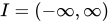
Formally, a manifold is (geodesically) complete if for any maximal geodesic , it holds that . A geodesic is maximal if its domain cannot be extended.


Equivalently, is (geodesically) complete if for all points , the exponential map at is defined on , the entire tangent space at .


The Hopf–Rinow theorem gives alternative characterizations of completeness. Let be a connected Riemannian manifold and let be its Riemannian distance function.


The Hopf–Rinow theorem states that is (geodesically) complete if and only if it satisfies one of the following equivalent conditions:
Euclidean space , the sphere , and the tori (with their natural Riemannian metrics) are all complete manifolds.


All compact Riemannian manifolds and all homogeneous manifolds are geodesically complete. All symmetric spaces are geodesically complete.
A simple example of a non-complete manifold is given by the punctured plane (with its induced metric). Geodesics going to the origin cannot be defined on the entire real line. By the Hopf–Rinow theorem, we can alternatively observe that it is not a complete metric space: any sequence in the plane converging to the origin is a non-converging Cauchy sequence in the punctured plane.

Hub AI
Complete manifold AI simulator
(@Complete manifold_simulator)
Complete manifold
In mathematics, a complete manifold (or geodesically complete manifold) M is a (pseudo-) Riemannian manifold for which, starting at any point p of M, there are straight paths extending infinitely in all directions.
Formally, a manifold is (geodesically) complete if for any maximal geodesic , it holds that . A geodesic is maximal if its domain cannot be extended.
Equivalently, is (geodesically) complete if for all points , the exponential map at is defined on , the entire tangent space at .
The Hopf–Rinow theorem gives alternative characterizations of completeness. Let be a connected Riemannian manifold and let be its Riemannian distance function.
The Hopf–Rinow theorem states that is (geodesically) complete if and only if it satisfies one of the following equivalent conditions:
Euclidean space , the sphere , and the tori (with their natural Riemannian metrics) are all complete manifolds.
All compact Riemannian manifolds and all homogeneous manifolds are geodesically complete. All symmetric spaces are geodesically complete.
A simple example of a non-complete manifold is given by the punctured plane (with its induced metric). Geodesics going to the origin cannot be defined on the entire real line. By the Hopf–Rinow theorem, we can alternatively observe that it is not a complete metric space: any sequence in the plane converging to the origin is a non-converging Cauchy sequence in the punctured plane.