


Community hub
Recent from talks
Contribute something to knowledge base
Content stats: 0 posts, 0 articles, 1 media, 0 notes
Members stats: 0 subscribers, 0 contributors, 0 moderators, 0 supporters
Subscribers
Supporters
Contributors
Moderators
Hub AI
Euclidean space AI simulator
(@Euclidean space_simulator)
Hub AI
Euclidean space AI simulator
(@Euclidean space_simulator)
Euclidean space
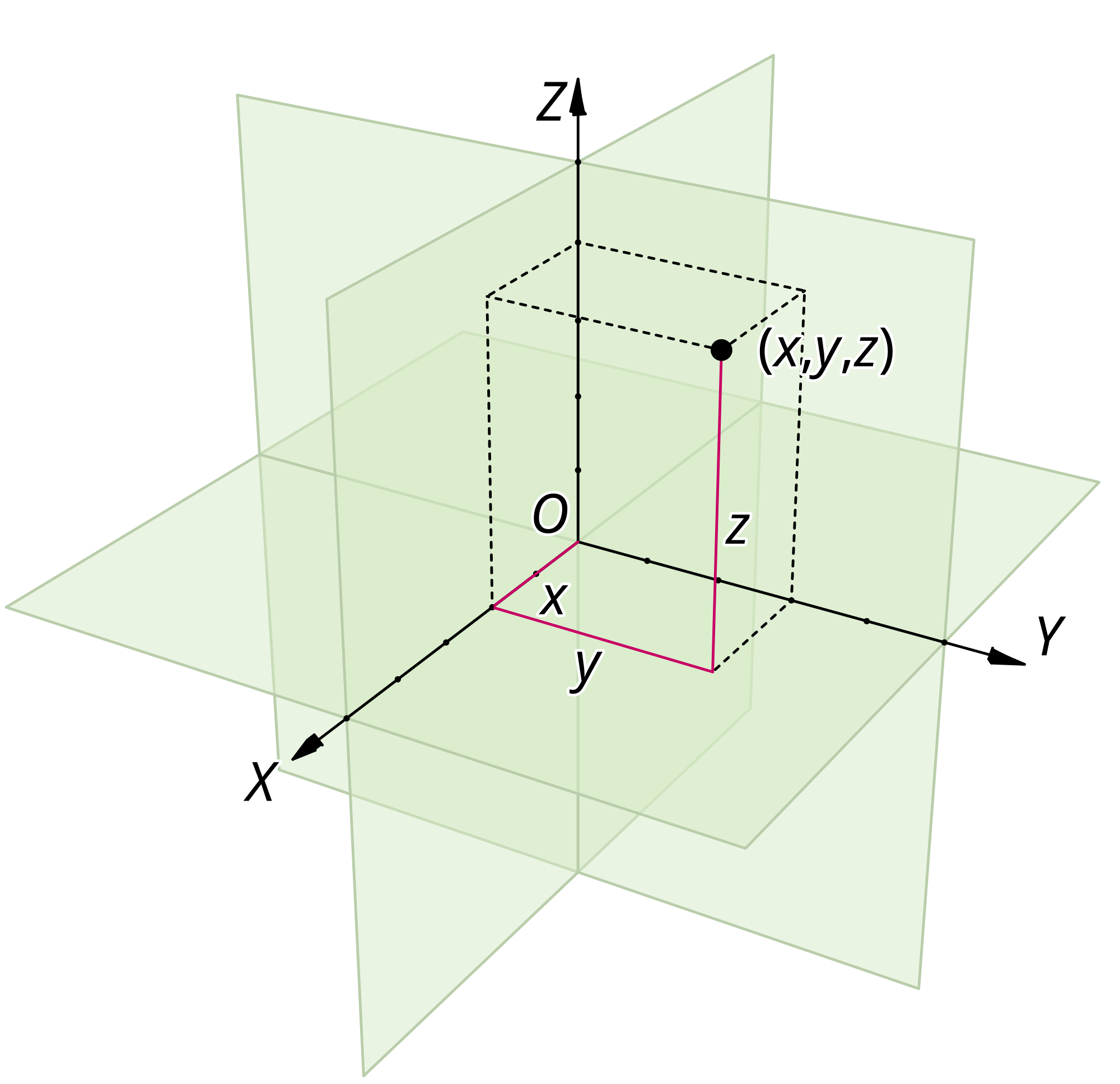
Euclidean space is the fundamental space of geometry, intended to represent physical space. Originally, in Euclid's Elements, it was the three-dimensional space of Euclidean geometry, but in modern mathematics there are Euclidean spaces of any positive integer dimension n, which are called Euclidean n-spaces when one wants to specify their dimension. For n equal to one or two, they are commonly called respectively Euclidean lines and Euclidean planes. The qualifier "Euclidean" is used to distinguish Euclidean spaces from other spaces that were later considered in physics and modern mathematics.
Ancient Greek geometers introduced Euclidean space for modeling the physical space. Their work was collected by the ancient Greek mathematician Euclid in his Elements, with the great innovation of proving all properties of the space as theorems, by starting from a few fundamental properties, called postulates, which either were considered as evident (for example, there is exactly one straight line passing through two points), or seemed impossible to prove (parallel postulate).
After the introduction at the end of the 19th century of non-Euclidean geometries, the old postulates were re-formalized to define Euclidean spaces through axiomatic theory. Another definition of Euclidean spaces by means of vector spaces and linear algebra has been shown to be equivalent to the axiomatic definition. It is this definition that is more commonly used in modern mathematics, and detailed in this article. In all definitions, Euclidean spaces consist of points, which are defined only by the properties that they must have for forming a Euclidean space.
There is essentially only one Euclidean space of each dimension; that is, all Euclidean spaces of a given dimension are isomorphic. Therefore, it is usually possible to work with a specific Euclidean space, denoted or , which can be represented using Cartesian coordinates as the real n-space equipped with the standard dot product.


Euclidean space was introduced by ancient Greeks as an abstraction of our physical space. Their great innovation, appearing in Euclid's Elements was to build and prove all geometry by starting from a few very basic properties, which are abstracted from the physical world, and cannot be mathematically proved because of the lack of more basic tools. These properties are called postulates, or axioms in modern language. This way of defining Euclidean space is still in use under the name of synthetic geometry.
In 1637, René Descartes introduced Cartesian coordinates, and showed that these allow reducing geometric problems to algebraic computations with numbers. This reduction of geometry to algebra was a major change in point of view, as, until then, the real numbers were defined in terms of lengths and distances.
Euclidean geometry was not applied in spaces of dimension more than three until the 19th century. Ludwig Schläfli generalized Euclidean geometry to spaces of dimension n, using both synthetic and algebraic methods, and discovered all of the regular polytopes (higher-dimensional analogues of the Platonic solids) that exist in Euclidean spaces of any dimension.
Despite the wide use of Descartes' approach, which was called analytic geometry, the definition of Euclidean space remained unchanged until the end of 19th century. The introduction of abstract vector spaces allowed their use in defining Euclidean spaces with a purely algebraic definition. This new definition has been shown to be equivalent to the classical definition in terms of geometric axioms. It is this algebraic definition that is now most often used for introducing Euclidean spaces.
Euclidean space
Euclidean space is the fundamental space of geometry, intended to represent physical space. Originally, in Euclid's Elements, it was the three-dimensional space of Euclidean geometry, but in modern mathematics there are Euclidean spaces of any positive integer dimension n, which are called Euclidean n-spaces when one wants to specify their dimension. For n equal to one or two, they are commonly called respectively Euclidean lines and Euclidean planes. The qualifier "Euclidean" is used to distinguish Euclidean spaces from other spaces that were later considered in physics and modern mathematics.
Ancient Greek geometers introduced Euclidean space for modeling the physical space. Their work was collected by the ancient Greek mathematician Euclid in his Elements, with the great innovation of proving all properties of the space as theorems, by starting from a few fundamental properties, called postulates, which either were considered as evident (for example, there is exactly one straight line passing through two points), or seemed impossible to prove (parallel postulate).
After the introduction at the end of the 19th century of non-Euclidean geometries, the old postulates were re-formalized to define Euclidean spaces through axiomatic theory. Another definition of Euclidean spaces by means of vector spaces and linear algebra has been shown to be equivalent to the axiomatic definition. It is this definition that is more commonly used in modern mathematics, and detailed in this article. In all definitions, Euclidean spaces consist of points, which are defined only by the properties that they must have for forming a Euclidean space.
There is essentially only one Euclidean space of each dimension; that is, all Euclidean spaces of a given dimension are isomorphic. Therefore, it is usually possible to work with a specific Euclidean space, denoted or , which can be represented using Cartesian coordinates as the real n-space equipped with the standard dot product.
Euclidean space was introduced by ancient Greeks as an abstraction of our physical space. Their great innovation, appearing in Euclid's Elements was to build and prove all geometry by starting from a few very basic properties, which are abstracted from the physical world, and cannot be mathematically proved because of the lack of more basic tools. These properties are called postulates, or axioms in modern language. This way of defining Euclidean space is still in use under the name of synthetic geometry.
In 1637, René Descartes introduced Cartesian coordinates, and showed that these allow reducing geometric problems to algebraic computations with numbers. This reduction of geometry to algebra was a major change in point of view, as, until then, the real numbers were defined in terms of lengths and distances.
Euclidean geometry was not applied in spaces of dimension more than three until the 19th century. Ludwig Schläfli generalized Euclidean geometry to spaces of dimension n, using both synthetic and algebraic methods, and discovered all of the regular polytopes (higher-dimensional analogues of the Platonic solids) that exist in Euclidean spaces of any dimension.
Despite the wide use of Descartes' approach, which was called analytic geometry, the definition of Euclidean space remained unchanged until the end of 19th century. The introduction of abstract vector spaces allowed their use in defining Euclidean spaces with a purely algebraic definition. This new definition has been shown to be equivalent to the classical definition in terms of geometric axioms. It is this algebraic definition that is now most often used for introducing Euclidean spaces.
Recent media
Recent media