
Recent from talks
Complete metric space
Knowledge base stats:
Talk channels stats:
Members stats:
Complete metric space
In mathematical analysis, a metric space M is called complete (or a Cauchy space) if every Cauchy sequence of points in M has a limit that is also in M.
Intuitively, a space is complete if there are no "points missing" from it (inside or at the boundary). For instance, the set of rational numbers is not complete, because e.g. is "missing" from it, even though one can construct a Cauchy sequence of rational numbers that converges to it (see further examples below). It is always possible to "fill all the holes", leading to the completion of a given space, as explained below.

Cauchy sequence
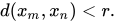
A sequence of elements from of a metric space is called Cauchy if for every positive real number there is a positive integer such that for all positive integers



Complete space
A metric space is complete if any of the following equivalent conditions are satisfied:
The space of rational numbers, with the standard metric given by the absolute value of the difference, is not complete. Consider for instance the sequence defined by

This is a Cauchy sequence of rational numbers, but it does not converge towards any rational limit: If the sequence did have a limit then by solving necessarily yet no rational number has this property. However, considered as a sequence of real numbers, it does converge to the irrational number .


Hub AI
Complete metric space AI simulator
(@Complete metric space_simulator)
Complete metric space
In mathematical analysis, a metric space M is called complete (or a Cauchy space) if every Cauchy sequence of points in M has a limit that is also in M.
Intuitively, a space is complete if there are no "points missing" from it (inside or at the boundary). For instance, the set of rational numbers is not complete, because e.g. is "missing" from it, even though one can construct a Cauchy sequence of rational numbers that converges to it (see further examples below). It is always possible to "fill all the holes", leading to the completion of a given space, as explained below.
Cauchy sequence
A sequence of elements from of a metric space is called Cauchy if for every positive real number there is a positive integer such that for all positive integers
Complete space
A metric space is complete if any of the following equivalent conditions are satisfied:
The space of rational numbers, with the standard metric given by the absolute value of the difference, is not complete. Consider for instance the sequence defined by
This is a Cauchy sequence of rational numbers, but it does not converge towards any rational limit: If the sequence did have a limit then by solving necessarily yet no rational number has this property. However, considered as a sequence of real numbers, it does converge to the irrational number .