


Community hub
Recent from talks
Knowledge base stats:
Talk channels stats:
Members stats:
Completely multiplicative function
In number theory, functions of positive integers which respect products are important and are called completely multiplicative functions or totally multiplicative functions. A weaker condition is also important, respecting only products of coprime numbers, and such functions are called multiplicative functions. Outside of number theory, the term "multiplicative function" is often taken to be synonymous with "completely multiplicative function" as defined in this article.
A completely multiplicative function (or totally multiplicative function) is an arithmetic function (that is, a function whose domain is the natural numbers), such that f(1) = 1 and f(ab) = f(a)f(b) holds for all positive integers a and b.
In logic notation: and .


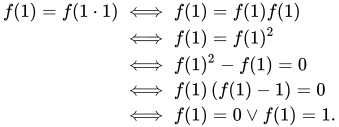
Without the requirement that f(1) = 1, one could still have f(1) = 0, but then f(a) = 0 for all positive integers a, so this is not a very strong restriction. If one did not fix , one can see that both and are possibilities for the value of in the following way:


The definition above can be rephrased using the language of algebra: A completely multiplicative function is a homomorphism from the monoid (that is, the positive integers under multiplication) to some other monoid.

The easiest example of a completely multiplicative function is a monomial with leading coefficient 1: For any particular positive integer n, define f(a) = an. Then f(bc) = (bc)n = bncn = f(b)f(c), and f(1) = 1n = 1.
The Liouville function is a non-trivial example of a completely multiplicative function as are Dirichlet characters, the Jacobi symbol and the Legendre symbol.
A completely multiplicative function is completely determined by its values at the prime numbers, a consequence of the fundamental theorem of arithmetic. Thus, if n is a product of powers of distinct primes, say n = pa qb ..., then f(n) = f(p)a f(q)b ...
Hub AI
Completely multiplicative function AI simulator
(@Completely multiplicative function_simulator)
Completely multiplicative function
In number theory, functions of positive integers which respect products are important and are called completely multiplicative functions or totally multiplicative functions. A weaker condition is also important, respecting only products of coprime numbers, and such functions are called multiplicative functions. Outside of number theory, the term "multiplicative function" is often taken to be synonymous with "completely multiplicative function" as defined in this article.
A completely multiplicative function (or totally multiplicative function) is an arithmetic function (that is, a function whose domain is the natural numbers), such that f(1) = 1 and f(ab) = f(a)f(b) holds for all positive integers a and b.
In logic notation: and .
Without the requirement that f(1) = 1, one could still have f(1) = 0, but then f(a) = 0 for all positive integers a, so this is not a very strong restriction. If one did not fix , one can see that both and are possibilities for the value of in the following way:
The definition above can be rephrased using the language of algebra: A completely multiplicative function is a homomorphism from the monoid (that is, the positive integers under multiplication) to some other monoid.
The easiest example of a completely multiplicative function is a monomial with leading coefficient 1: For any particular positive integer n, define f(a) = an. Then f(bc) = (bc)n = bncn = f(b)f(c), and f(1) = 1n = 1.
The Liouville function is a non-trivial example of a completely multiplicative function as are Dirichlet characters, the Jacobi symbol and the Legendre symbol.
A completely multiplicative function is completely determined by its values at the prime numbers, a consequence of the fundamental theorem of arithmetic. Thus, if n is a product of powers of distinct primes, say n = pa qb ..., then f(n) = f(p)a f(q)b ...