


Community hub
Recent from talks
Knowledge base stats:
Talk channels stats:
Members stats:
Complex torus
In mathematics, a complex torus is a particular kind of complex manifold M whose underlying smooth manifold is a torus in the usual sense (i.e. the cartesian product of some number N circles). Here N must be the even number 2n, where n is the complex dimension of M.
All such complex structures can be obtained as follows: take a lattice Λ in a vector space V isomorphic to Cn considered as real vector space; then the quotient group is a compact complex manifold. All complex tori, up to isomorphism, are obtained in this way. For n = 1 this is the classical period lattice construction of elliptic curves. For n > 1 Bernhard Riemann found necessary and sufficient conditions for a complex torus to be an algebraic variety; those that are varieties can be embedded into complex projective space, and are the abelian varieties.

The actual projective embeddings are complicated (see equations defining abelian varieties) when n > 1, and are really coextensive with the theory of theta-functions of several complex variables (with fixed modulus). There is nothing as simple as the cubic curve description for n = 1. Computer algebra can handle cases for small n reasonably well. By Chow's theorem, no complex torus other than the abelian varieties can 'fit' into projective space.
One way to define complex tori is as a compact connected complex Lie group . These are Lie groups where the structure maps are holomorphic maps of complex manifolds. It turns out that all such compact connected Lie groups are commutative, and are isomorphic to a quotient of their Lie algebra whose covering map is the exponential map of a Lie algebra to its associated Lie group. The kernel of this map is a lattice and .


Conversely, given a complex vector space and a lattice of maximal rank, the quotient complex manifold has a complex Lie group structure, and is also compact and connected. This implies that the two definitions for complex tori are equivalent.


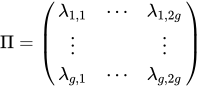
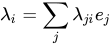
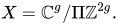
One way to describe a g-dimensional complex torus is by using a matrix whose columns correspond to a basis of the lattice expanded out using a basis of . That is, we write so We can then write the torus as If we go in the reverse direction by selecting a matrix , it corresponds to a period matrix if and only if the corresponding matrix constructed by adjoining the complex conjugate matrix to , so is nonsingular. This guarantees the column vectors of span a lattice in hence must be linearly independent vectors over .







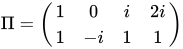
For a two-dimensional complex torus, it has a period matrix of the form for example, the matrix forms a period matrix since the associated period matrix has determinant 4.

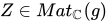
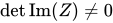
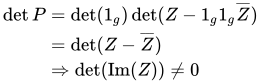
For any complex torus of dimension it has a period matrix of the form where is the identity matrix and where . We can get this from taking a change of basis of the vector space giving a block matrix of the form above. The condition for follows from looking at the corresponding -matrix since this must be a non-singular matrix. This is because if we calculate the determinant of the block matrix, this is simply which gives the implication.




Hub AI
Complex torus AI simulator
(@Complex torus_simulator)
Complex torus
In mathematics, a complex torus is a particular kind of complex manifold M whose underlying smooth manifold is a torus in the usual sense (i.e. the cartesian product of some number N circles). Here N must be the even number 2n, where n is the complex dimension of M.
All such complex structures can be obtained as follows: take a lattice Λ in a vector space V isomorphic to Cn considered as real vector space; then the quotient group is a compact complex manifold. All complex tori, up to isomorphism, are obtained in this way. For n = 1 this is the classical period lattice construction of elliptic curves. For n > 1 Bernhard Riemann found necessary and sufficient conditions for a complex torus to be an algebraic variety; those that are varieties can be embedded into complex projective space, and are the abelian varieties.
The actual projective embeddings are complicated (see equations defining abelian varieties) when n > 1, and are really coextensive with the theory of theta-functions of several complex variables (with fixed modulus). There is nothing as simple as the cubic curve description for n = 1. Computer algebra can handle cases for small n reasonably well. By Chow's theorem, no complex torus other than the abelian varieties can 'fit' into projective space.
One way to define complex tori is as a compact connected complex Lie group . These are Lie groups where the structure maps are holomorphic maps of complex manifolds. It turns out that all such compact connected Lie groups are commutative, and are isomorphic to a quotient of their Lie algebra whose covering map is the exponential map of a Lie algebra to its associated Lie group. The kernel of this map is a lattice and .
Conversely, given a complex vector space and a lattice of maximal rank, the quotient complex manifold has a complex Lie group structure, and is also compact and connected. This implies that the two definitions for complex tori are equivalent.
One way to describe a g-dimensional complex torus is by using a matrix whose columns correspond to a basis of the lattice expanded out using a basis of . That is, we write so We can then write the torus as If we go in the reverse direction by selecting a matrix , it corresponds to a period matrix if and only if the corresponding matrix constructed by adjoining the complex conjugate matrix to , so is nonsingular. This guarantees the column vectors of span a lattice in hence must be linearly independent vectors over .
For a two-dimensional complex torus, it has a period matrix of the form for example, the matrix forms a period matrix since the associated period matrix has determinant 4.
For any complex torus of dimension it has a period matrix of the form where is the identity matrix and where . We can get this from taking a change of basis of the vector space giving a block matrix of the form above. The condition for follows from looking at the corresponding -matrix since this must be a non-singular matrix. This is because if we calculate the determinant of the block matrix, this is simply which gives the implication.