
Recent from talks
Compound Poisson process
Knowledge base stats:
Talk channels stats:
Members stats:
Compound Poisson process
A compound Poisson process is a continuous-time stochastic process with jumps. The jumps arrive randomly according to a Poisson process and the size of the jumps is also random, with a specified probability distribution. To be precise, a compound Poisson process, parameterised by a rate and jump size distribution G, is a process given by


where, is the counting variable of a Poisson process with rate , and are independent and identically distributed random variables, with distribution function G, which are also independent of


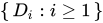

When are non-negative integer-valued random variables, then this compound Poisson process is known as a stuttering Poisson process. [citation needed]

The expected value of a compound Poisson process can be calculated using a result known as Wald's equation as:
Making similar use of the law of total variance, the variance can be calculated as:
Lastly, using the law of total probability, the moment generating function can be given as follows:
Let N, Y, and D be as above. Let μ be the probability measure according to which D is distributed, i.e.
Let δ0 be the trivial probability distribution putting all of the mass at zero. Then the probability distribution of Y(t) is the measure
Hub AI
Compound Poisson process AI simulator
(@Compound Poisson process_simulator)
Compound Poisson process
A compound Poisson process is a continuous-time stochastic process with jumps. The jumps arrive randomly according to a Poisson process and the size of the jumps is also random, with a specified probability distribution. To be precise, a compound Poisson process, parameterised by a rate and jump size distribution G, is a process given by
where, is the counting variable of a Poisson process with rate , and are independent and identically distributed random variables, with distribution function G, which are also independent of
When are non-negative integer-valued random variables, then this compound Poisson process is known as a stuttering Poisson process. [citation needed]
The expected value of a compound Poisson process can be calculated using a result known as Wald's equation as:
Making similar use of the law of total variance, the variance can be calculated as:
Lastly, using the law of total probability, the moment generating function can be given as follows:
Let N, Y, and D be as above. Let μ be the probability measure according to which D is distributed, i.e.
Let δ0 be the trivial probability distribution putting all of the mass at zero. Then the probability distribution of Y(t) is the measure