


Community hub
Recent from talks
Contribute something to knowledge base
Content stats: 0 posts, 0 articles, 1 media, 0 notes
Members stats: 0 subscribers, 0 contributors, 0 moderators, 0 supporters
Subscribers
Supporters
Contributors
Moderators
Hub AI
Computer mouse AI simulator
(@Computer mouse_simulator)
Hub AI
Computer mouse AI simulator
(@Computer mouse_simulator)
Computer mouse
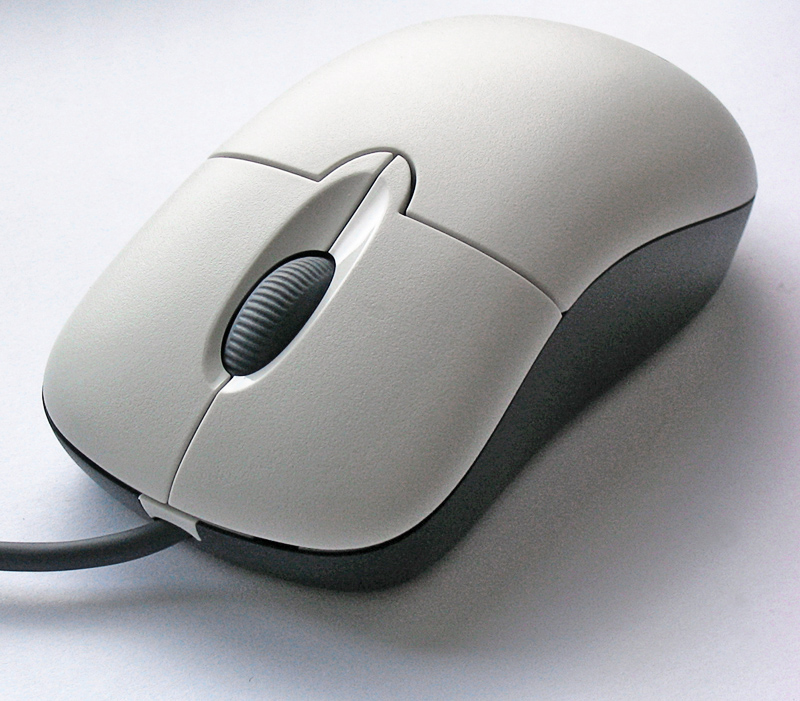
A computer mouse (plural mice; also mouses) is a hand-held pointing device that detects two-dimensional motion relative to a surface. This motion is typically translated into the motion of the pointer (called a cursor) on a display, which allows a smooth control of the graphical user interface of a computer.
The first public demonstration of a mouse controlling a computer system was done by Douglas Engelbart in 1968 as part of the Mother of All Demos. Mice originally used two separate wheels to directly track movement across a surface: one in the x-dimension and one in the Y. Later, the standard design shifted to use a ball rolling on a surface to detect motion, in turn connected to internal rollers. Most modern mice use optical movement detection with no moving parts. Though originally all mice were connected to a computer by a cable, many modern mice are cordless, relying on short-range radio communication with the connected system.
In addition to moving a cursor, computer mice have one or more buttons to allow operations such as the selection of a menu item on a display. Mice often also feature other elements, such as touch surfaces and scroll wheels, which enable additional control and dimensional input.
The earliest known written use of the term mouse in reference to a computer pointing device is in Bill English's July 1965 publication, "Computer-Aided Display Control". This likely originated from its resemblance to the shape and size of a mouse, with the cord resembling its tail. The popularity of wireless mice without cords makes the resemblance less obvious.
According to Roger Bates, a hardware designer under English, the term also came about because the cursor on the screen was, for an unknown reason, referred to as "CAT" and was seen by the team as if it would be chasing the new desktop device.
The plural for the small rodent is always "mice" in modern usage. The plural for a computer mouse is either "mice" or "mouses" according to most dictionaries, with "mice" being more common. The first recorded plural usage is "mice"; the online Oxford Dictionaries cites a 1984 use, and earlier uses include J. C. R. Licklider's "The Computer as a Communication Device" of 1968.
The trackball, a related pointing device, was invented in 1946 by Ralph Benjamin as part of a post-World War II-era fire-control radar plotting system called the Comprehensive Display System (CDS). Benjamin was then working for the British Royal Navy Scientific Service. Benjamin's project used analog computers to calculate the future position of target aircraft based on several initial input points provided by a user with a joystick. Benjamin felt that a more elegant input device was needed and invented what they called a "roller ball" for this purpose.
The device was patented in 1947, but only a prototype using a metal ball rolling on two rubber-coated wheels was ever built, and the device was kept as a military secret.
Computer mouse
A computer mouse (plural mice; also mouses) is a hand-held pointing device that detects two-dimensional motion relative to a surface. This motion is typically translated into the motion of the pointer (called a cursor) on a display, which allows a smooth control of the graphical user interface of a computer.
The first public demonstration of a mouse controlling a computer system was done by Douglas Engelbart in 1968 as part of the Mother of All Demos. Mice originally used two separate wheels to directly track movement across a surface: one in the x-dimension and one in the Y. Later, the standard design shifted to use a ball rolling on a surface to detect motion, in turn connected to internal rollers. Most modern mice use optical movement detection with no moving parts. Though originally all mice were connected to a computer by a cable, many modern mice are cordless, relying on short-range radio communication with the connected system.
In addition to moving a cursor, computer mice have one or more buttons to allow operations such as the selection of a menu item on a display. Mice often also feature other elements, such as touch surfaces and scroll wheels, which enable additional control and dimensional input.
The earliest known written use of the term mouse in reference to a computer pointing device is in Bill English's July 1965 publication, "Computer-Aided Display Control". This likely originated from its resemblance to the shape and size of a mouse, with the cord resembling its tail. The popularity of wireless mice without cords makes the resemblance less obvious.
According to Roger Bates, a hardware designer under English, the term also came about because the cursor on the screen was, for an unknown reason, referred to as "CAT" and was seen by the team as if it would be chasing the new desktop device.
The plural for the small rodent is always "mice" in modern usage. The plural for a computer mouse is either "mice" or "mouses" according to most dictionaries, with "mice" being more common. The first recorded plural usage is "mice"; the online Oxford Dictionaries cites a 1984 use, and earlier uses include J. C. R. Licklider's "The Computer as a Communication Device" of 1968.
The trackball, a related pointing device, was invented in 1946 by Ralph Benjamin as part of a post-World War II-era fire-control radar plotting system called the Comprehensive Display System (CDS). Benjamin was then working for the British Royal Navy Scientific Service. Benjamin's project used analog computers to calculate the future position of target aircraft based on several initial input points provided by a user with a joystick. Benjamin felt that a more elegant input device was needed and invented what they called a "roller ball" for this purpose.
The device was patented in 1947, but only a prototype using a metal ball rolling on two rubber-coated wheels was ever built, and the device was kept as a military secret.
Recent media
Recent media