Hubbry Logo
logo
Concealed carry
Community hub

Concealed carry

logo
0 subscribers
Be the first to start a discussion here.
Contribute something to knowledge base
Hub AI

Concealed carry AI simulator

(@Concealed carry_simulator)

Concealed carry

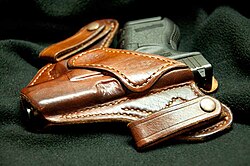
Concealed carry, or carrying a concealed weapon (CCW), is the practice of carrying a weapon (usually a sidearm such as a handgun), either in proximity to or on one's person in public places in a manner that hides or conceals the weapon's presence from surrounding observers. In the United States, the opposite of concealed carry is called open carry.

While most law enforcement officers carry their handguns in a visible holster, some officers such as plainclothes detectives or undercover agents carry weapons in concealed holsters. In some countries and jurisdictions, civilians are legally required to obtain a concealed carry permit in order to possess and carry a firearm. In others, a CCW permit is only required if the firearm is not visible to the eye, such as carrying the weapon in one's purse, bag, trunk, etc.

Concealed carry is legal in most jurisdictions of the United States. A handful of states and jurisdictions severely restrict or ban it, but all jurisdictions make provision for legal concealed carry via a permit or license, or via constitutional carry. Illinois was the last state to pass a law allowing for concealed carry, with license applications available on January 5, 2014. Most states that require a permit have "shall-issue" statutes, and if a person meets the requirements to obtain a permit, the issuing authority (typically, a state law enforcement office such as the state police) must issue one, with no discretionary power given. Prior to June 2022, a few states enforced "may-issue" statutes, which gave authorities discretionary power in issuing permits to otherwise qualified applicants. However, these laws were found to be unconstitutional by the U.S. Supreme Court in New York State Rifle & Pistol Association, Inc. v. Bruen. Furthermore, in most states obtaining the permit is required to bring a weapon into public, (e.g. shopping center). If the gun remains in one's vehicle but is not on said person's property, a permit is required in places like New Jersey.

Further complicating the status of concealed carry is recognition of state permits under the laws of other states. The Full Faith and Credit Clause of the US Constitution pertains to judgments and other legal pronouncements such as marriage and divorce rather than licenses and permits that authorize individuals to prospectively engage in activities. There are several popular combinations of resident and nonresident permits that allow carry in more states than the original issuing state; for example, a Utah nonresident permit is recognized for carry in 30 states. Some states, however, do not recognize permits issued by other states to nonresidents of the issuing state: Colorado, Florida, Maine, Michigan, New Hampshire, North Dakota and South Carolina. Some other states do not recognize any permit from another state: California, Connecticut, Hawaii, Illinois (recognizes permits while in vehicle), Maryland, Massachusetts, New Jersey, New York, Oregon, Rhode Island (recognizes permits while in vehicle) and the District of Columbia.

Concealed or open carry of any weapon is generally prohibited in Great Britain (i.e. England, Wales, and Scotland), the Prevention of Crime Act 1953 prohibiting this in a public place. Permission exists only with lawful authority or reasonable excuse. As per Section 1(4) Prevention of Crime Act 1953, the definition of an offensive weapon is: "offensive weapon" means any article made or adapted for use for causing injury to the person, or intended by the person having it with him for such use by him or by some other person. Self defence is no longer considered a legitimate reason for the granting of a Firearms Certificate (FAC) in Great Britain.

Unlike Great Britain, Northern Ireland still allows the carry of concealed handguns for the purpose of self defence. An FAC for a personal protection weapon will only be authorised where the Police Service of Northern Ireland deems there is a "verifiable specific risk" to the life of an individual, and that the possession of a firearm is a reasonable, proportionate and necessary measure to protect their life. Permits for personal protection also allow the holder to carry their firearms concealed. In reality – aside from off-duty constables – the only individuals who will be granted a permit to carry will be those who are government officials or retirees, such as prison officers, military personnel, or politicians still considered to be at risk from paramilitary attack.

The practice of CCW is generally prohibited in Canada. Section 90 of the Criminal Code prohibits carrying a concealed weapon unless authorized for a lawful occupational purpose under the Firearms Act. Section 20 of the Firearms Act allows issuance of an Authorization to Carry (ATC) in limited circumstances. Concealment of the firearm is permitted only if it is specifically stipulated in the conditions of the ATC, as section 58(1) of the Firearms Act allows a CFO to attach conditions to an ATC.

Provincial chief firearm officers (CFOs) may only issue an authorization in accordance with the regulations. Specifically, SOR 98-207 section 2 requires, for an ATC for protection of life, for an individual to be in imminent danger and for police protection to be insufficient. As such, if the relevant police agency determines its protection is sufficient, the CFO would have difficulty in issuing the ATC over police objections.

See all
the practice of carrying a handgun or other weapon concealed on one's person or in close proximity
User Avatar
No comments yet.