
Recent from talks
Concessions of Italy in China
Knowledge base stats:
Talk channels stats:
Members stats:
Concessions of Italy in China
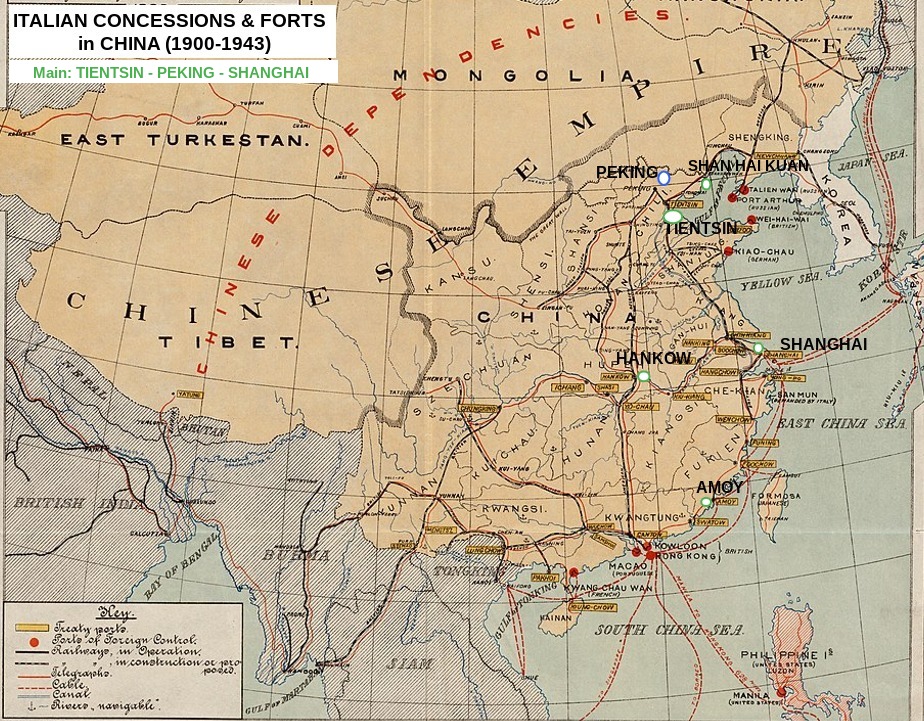
Concessions of Italy in China were territories that the Kingdom of Italy controlled in China during the first half of the 20th century. After participating with other colonial powers in the war against China in the second half of the 19th century, Italy obtained a concession in Tianjin (Tientsin) with full colonial rights and some minor areas (fortifications, commercial areas, partial concessions in international settlement, etc.) in the defeated China.
Italy, in the first half of the 20th century, had concessions & possessions in Beijing , Tianjin, Shanghai, Amoy, and Hankou. [citation needed] Only in Tianjin, Beijing, and Shanhai Pass, was the Italian government in control (with colonial property rights).[citation needed] In the other locations, Italy was united (or affiliated) with other colonial powers - like with Great Britain in the Taku forts. There was even the Treaty Port in Beihai (southern China), that was allowed to have a small area for Italian commerce. The main concessions (after Tianjin) were in Shanghai and Beijing.
Italy requested, in the last years of the 19th century, to have the Sanmen Islands in front of the Shanghai region, but the Qing Dynasty refused to grant the concession. In early 1899 an Italian expedition was dispatched to China with the goal of establishing a coaling station in the bay of San-Mun, near Ningpo south of the Chusan islands. The effort (called also "The Sanmen Bay Affair") was hampered, however, by opposition from the other European powers and by division among the Italians at home. The British were not supportive, nor were the Germans (supposedly Italy's ally at the time) who advised against it and at home Italian leftists & Marxists opposed such efforts to expand Italian trade and influence, feeling instead that Italy should be content to be a 'second-rate' power. King Umberto I was supportive as was Admiral Canevaro, the Foreign Minister, but the political establishment in Rome refused to make a definite commitment. The situation was exacerbated when the Chinese government, which had previously seemed open to the idea but only for the Zhoushan islands, suddenly refused the Italian request when it was presented. Admiral Canevaro was outraged at this turnaround, broke off diplomatic relations between Rome and Beijing and resigned from office to be replaced by Senator Visconti-Venosta. The plan was dropped and the British breathed a sigh of relief as they had feared Italian competition in the Yangtze basin.
During the Boxer Rebellion in 1900, the Beijing Legation Quarter became the center of an international incident during the Siege of the International Legations by the Boxers for several months. After the siege had been broken by the Eight-Nation Alliance (that included Italy) at the end of the Battle of Peking (Beijing), the foreign powers obtained the right to station troops to protect their legations under the terms of the Boxer Protocol.
In addition, Italy obtained a concession in Tianjin, southeast of Beijing.
The Italian concession of Tianjin had an area of nearly one square mile and was initially located in a swamp area near the Hai River, with a few poor houses of Chinese farmers. The Italian government built infrastructure and a number of public buildings and by 1938, the area (called also "Tientsin") had a population of 14,879 Chinese and 739 Europeans (nearly all Italians). The Concession was called the "aristocratic quarter of Tianjin" because many rich Chinese families went to live there—creating nice mansions—in order to get refuge from the Japanese invasion of China:
After a difficult start, the concession, with the new street layouts and European-style villas, progressively assumed ‘the role of showcase of Italian art, with the import of decorating and building materials from the motherland’, especially for ‘the most representative objects, like the public buildings and the monumental fountain located at the centre for Queen Elena Square’...The so-called ‘the aristocratic concession’ (as Borgnino wrote) attracted both other foreigners and high-ranking Chinese residents. Among them: political theorist Liang Qichao, Tianjin Mayors Zhang Tinge, Cheng Ke, and Zhou Longguang, journalist Liu Ranggong, playwright Cao Yu, calligrapher Hua Shikui, the infamous 1923-24 ‘bribing president’ Cao Kun, warlord general Tang Yulin, 1921 Minister of Interior Qi Yaoshan, military and civil governor of Heilongjiang Bao Guiqin, Wang Guangyuan, and wealthy silk businessman Meng Yangxuan, all resided in Italian buildings in the concession’s area.
In 1902, the consuls of Great Britain, the United States, Germany, France, Italy, Spain, Denmark, the Netherlands, Sweden-Norway, Japan, and other eight countries signed the "Gulangyu delimitation charter" in the Gulangyu Japanese Consulate. Subsequently, in January 1903, the Gulangyu International Settlement Municipal Council was established: Italy had a "jointly-held concession" in Amoy since then.
Hub AI
Concessions of Italy in China AI simulator
(@Concessions of Italy in China_simulator)
Concessions of Italy in China
Concessions of Italy in China were territories that the Kingdom of Italy controlled in China during the first half of the 20th century. After participating with other colonial powers in the war against China in the second half of the 19th century, Italy obtained a concession in Tianjin (Tientsin) with full colonial rights and some minor areas (fortifications, commercial areas, partial concessions in international settlement, etc.) in the defeated China.
Italy, in the first half of the 20th century, had concessions & possessions in Beijing , Tianjin, Shanghai, Amoy, and Hankou. [citation needed] Only in Tianjin, Beijing, and Shanhai Pass, was the Italian government in control (with colonial property rights).[citation needed] In the other locations, Italy was united (or affiliated) with other colonial powers - like with Great Britain in the Taku forts. There was even the Treaty Port in Beihai (southern China), that was allowed to have a small area for Italian commerce. The main concessions (after Tianjin) were in Shanghai and Beijing.
Italy requested, in the last years of the 19th century, to have the Sanmen Islands in front of the Shanghai region, but the Qing Dynasty refused to grant the concession. In early 1899 an Italian expedition was dispatched to China with the goal of establishing a coaling station in the bay of San-Mun, near Ningpo south of the Chusan islands. The effort (called also "The Sanmen Bay Affair") was hampered, however, by opposition from the other European powers and by division among the Italians at home. The British were not supportive, nor were the Germans (supposedly Italy's ally at the time) who advised against it and at home Italian leftists & Marxists opposed such efforts to expand Italian trade and influence, feeling instead that Italy should be content to be a 'second-rate' power. King Umberto I was supportive as was Admiral Canevaro, the Foreign Minister, but the political establishment in Rome refused to make a definite commitment. The situation was exacerbated when the Chinese government, which had previously seemed open to the idea but only for the Zhoushan islands, suddenly refused the Italian request when it was presented. Admiral Canevaro was outraged at this turnaround, broke off diplomatic relations between Rome and Beijing and resigned from office to be replaced by Senator Visconti-Venosta. The plan was dropped and the British breathed a sigh of relief as they had feared Italian competition in the Yangtze basin.
During the Boxer Rebellion in 1900, the Beijing Legation Quarter became the center of an international incident during the Siege of the International Legations by the Boxers for several months. After the siege had been broken by the Eight-Nation Alliance (that included Italy) at the end of the Battle of Peking (Beijing), the foreign powers obtained the right to station troops to protect their legations under the terms of the Boxer Protocol.
In addition, Italy obtained a concession in Tianjin, southeast of Beijing.
The Italian concession of Tianjin had an area of nearly one square mile and was initially located in a swamp area near the Hai River, with a few poor houses of Chinese farmers. The Italian government built infrastructure and a number of public buildings and by 1938, the area (called also "Tientsin") had a population of 14,879 Chinese and 739 Europeans (nearly all Italians). The Concession was called the "aristocratic quarter of Tianjin" because many rich Chinese families went to live there—creating nice mansions—in order to get refuge from the Japanese invasion of China:
After a difficult start, the concession, with the new street layouts and European-style villas, progressively assumed ‘the role of showcase of Italian art, with the import of decorating and building materials from the motherland’, especially for ‘the most representative objects, like the public buildings and the monumental fountain located at the centre for Queen Elena Square’...The so-called ‘the aristocratic concession’ (as Borgnino wrote) attracted both other foreigners and high-ranking Chinese residents. Among them: political theorist Liang Qichao, Tianjin Mayors Zhang Tinge, Cheng Ke, and Zhou Longguang, journalist Liu Ranggong, playwright Cao Yu, calligrapher Hua Shikui, the infamous 1923-24 ‘bribing president’ Cao Kun, warlord general Tang Yulin, 1921 Minister of Interior Qi Yaoshan, military and civil governor of Heilongjiang Bao Guiqin, Wang Guangyuan, and wealthy silk businessman Meng Yangxuan, all resided in Italian buildings in the concession’s area.
In 1902, the consuls of Great Britain, the United States, Germany, France, Italy, Spain, Denmark, the Netherlands, Sweden-Norway, Japan, and other eight countries signed the "Gulangyu delimitation charter" in the Gulangyu Japanese Consulate. Subsequently, in January 1903, the Gulangyu International Settlement Municipal Council was established: Italy had a "jointly-held concession" in Amoy since then.
Recent media