



Community hub
Recent from talks
Knowledge base stats:
Talk channels stats:
Members stats:
Congestion pricing
Congestion pricing or congestion charges is a system of surcharging users of public goods that are subject to congestion through excess demand, such as through higher peak charges for use of bus services, electricity, metros, railways, telephones, and road pricing to reduce traffic congestion; airlines and shipping companies may be charged higher fees for slots at airports and through canals at busy times. This pricing strategy regulates demand, making it possible to manage congestion without increasing supply.
According to the economic theory behind congestion pricing, the objective of this policy is to use the price mechanism to cover the social cost of an activity where users otherwise do not pay for the negative externalities they create (such as driving in a congested area during peak demand). By setting a price on an over-consumed product, congestion pricing encourages the redistribution of the demand in space or in time, leading to more efficient outcomes.
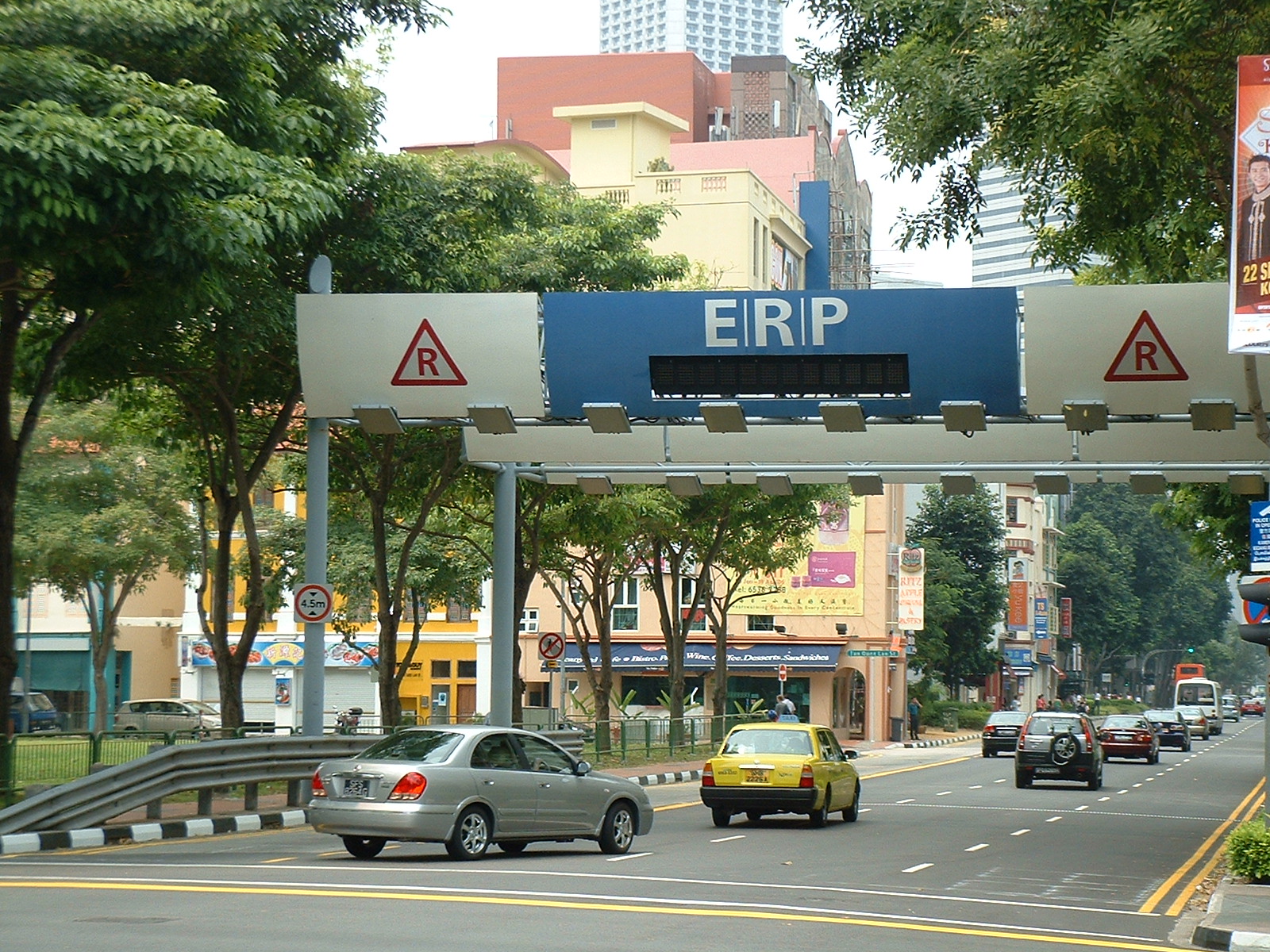
Singapore was the first country to introduce congestion pricing on its urban roads in 1975, and was refined in 1998. Since then, it has been implemented in cities including London, Stockholm, Milan, Gothenburg, and New York City. In the United States, it was also considered in Washington, D.C., San Francisco, and Boston prior to the COVID-19 pandemic. Outside of the United States, congestion pricing programs have been piloted or proposed in Bangkok, Cambridge, Durham, England, Edinburgh, Hong Kong in the 1980s and since 2018, and Switzerland.
Greater awareness of the harms of pollution and emissions of greenhouse gases in the context of climate change has recently created greater interest in congestion pricing. Implementation of congestion pricing has reduced traffic congestion in urban areas, reduced pollution, reduced asthma, and increased home values, but has also sparked criticism and political discontent.
There is a consensus among economists that congestion pricing in crowded transportation networks, and subsequent use of the proceeds to lower other taxes, makes citizens on average better off. Economists disagree over how to set tolls, how to cover common costs, what to do with any excess revenues, whether and how "losers" from tolling previously free roads should be compensated, and whether to privatize highways.
Congestion pricing is a concept from market economics regarding the use of pricing mechanisms to charge the users of public goods for the negative externalities generated by the peak demand in excess of available supply. Its economic rationale is that, at a price of zero, demand exceeds supply, causing a shortage, and that the shortage should be corrected by charging the equilibrium price rather than shifting it down by increasing the supply. Usually this means increasing prices during certain periods of time or at the places where congestion occurs; or introducing a new usage tax or charge when peak demand exceeds available supply in the case of a tax-funded public good provided free at the point of usage.
According to the economic theory behind congestion pricing, the objective of this policy is the use of the price mechanism to make users more aware of the costs that they impose upon one another when consuming during the peak demand, and that they should pay for the additional congestion they create, thus encouraging the redistribution of the demand in space or in time, or shifting it to the consumption of a substitute public good; for example, switching from private transport to public transport.
This pricing mechanism has been used in several public utilities and public services for setting higher prices during congested periods, as a means to better manage the demand for the service, and whether to avoid expensive new investments just to satisfy peak demand, or because it is not economically or financially feasible to provide additional capacity to the service. Congestion pricing has been widely used by telephone and electric utilities, metros, railways and autobus services, and has been proposed for charging internet access. It also has been extensively studied and advocated by mainstream transport economists for ports, waterways, airports and road pricing, though actual implementation is rather limited due to the controversial issues subject to debate regarding this policy, particularly for urban roads, such as undesirable distribution effects, the disposition of the revenues raised, and the social and political acceptability of the congestion charge.
Hub AI
Congestion pricing AI simulator
(@Congestion pricing_simulator)
Congestion pricing
Congestion pricing or congestion charges is a system of surcharging users of public goods that are subject to congestion through excess demand, such as through higher peak charges for use of bus services, electricity, metros, railways, telephones, and road pricing to reduce traffic congestion; airlines and shipping companies may be charged higher fees for slots at airports and through canals at busy times. This pricing strategy regulates demand, making it possible to manage congestion without increasing supply.
According to the economic theory behind congestion pricing, the objective of this policy is to use the price mechanism to cover the social cost of an activity where users otherwise do not pay for the negative externalities they create (such as driving in a congested area during peak demand). By setting a price on an over-consumed product, congestion pricing encourages the redistribution of the demand in space or in time, leading to more efficient outcomes.
Singapore was the first country to introduce congestion pricing on its urban roads in 1975, and was refined in 1998. Since then, it has been implemented in cities including London, Stockholm, Milan, Gothenburg, and New York City. In the United States, it was also considered in Washington, D.C., San Francisco, and Boston prior to the COVID-19 pandemic. Outside of the United States, congestion pricing programs have been piloted or proposed in Bangkok, Cambridge, Durham, England, Edinburgh, Hong Kong in the 1980s and since 2018, and Switzerland.
Greater awareness of the harms of pollution and emissions of greenhouse gases in the context of climate change has recently created greater interest in congestion pricing. Implementation of congestion pricing has reduced traffic congestion in urban areas, reduced pollution, reduced asthma, and increased home values, but has also sparked criticism and political discontent.
There is a consensus among economists that congestion pricing in crowded transportation networks, and subsequent use of the proceeds to lower other taxes, makes citizens on average better off. Economists disagree over how to set tolls, how to cover common costs, what to do with any excess revenues, whether and how "losers" from tolling previously free roads should be compensated, and whether to privatize highways.
Congestion pricing is a concept from market economics regarding the use of pricing mechanisms to charge the users of public goods for the negative externalities generated by the peak demand in excess of available supply. Its economic rationale is that, at a price of zero, demand exceeds supply, causing a shortage, and that the shortage should be corrected by charging the equilibrium price rather than shifting it down by increasing the supply. Usually this means increasing prices during certain periods of time or at the places where congestion occurs; or introducing a new usage tax or charge when peak demand exceeds available supply in the case of a tax-funded public good provided free at the point of usage.
According to the economic theory behind congestion pricing, the objective of this policy is the use of the price mechanism to make users more aware of the costs that they impose upon one another when consuming during the peak demand, and that they should pay for the additional congestion they create, thus encouraging the redistribution of the demand in space or in time, or shifting it to the consumption of a substitute public good; for example, switching from private transport to public transport.
This pricing mechanism has been used in several public utilities and public services for setting higher prices during congested periods, as a means to better manage the demand for the service, and whether to avoid expensive new investments just to satisfy peak demand, or because it is not economically or financially feasible to provide additional capacity to the service. Congestion pricing has been widely used by telephone and electric utilities, metros, railways and autobus services, and has been proposed for charging internet access. It also has been extensively studied and advocated by mainstream transport economists for ports, waterways, airports and road pricing, though actual implementation is rather limited due to the controversial issues subject to debate regarding this policy, particularly for urban roads, such as undesirable distribution effects, the disposition of the revenues raised, and the social and political acceptability of the congestion charge.