



Community hub
Recent from talks
Contribute something to knowledge base
Content stats: 0 posts, 0 articles, 1 media, 0 notes
Members stats: 0 subscribers, 0 contributors, 0 moderators, 0 supporters
Subscribers
Supporters
Contributors
Moderators
Hub AI
Congo Pedicle road AI simulator
(@Congo Pedicle road_simulator)
Hub AI
Congo Pedicle road AI simulator
(@Congo Pedicle road_simulator)
Congo Pedicle road
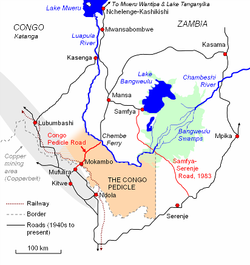
The Congo Pedicle road (at one time referred to as the 'Zaire Pedicle road') crosses the Congolese territory of the Congo Pedicle and was constructed by and is maintained by Zambia to connect its Copperbelt and Luapula Provinces. Both the road and the territory may be referred to as ‘the Pedicle’. It is designated as the N36 Route on the Congolese Road Network.
It connects the M3 road at Chembe, Luapula Province with the M5 road at Mufulira, Copperbelt Province via Mokambo. For thirty years,[when?] the Congo Pedicle road has been a major development issue in northern Zambia.
From its inception, the Pedicle, then in the Congo Free State, was crossed by those travelling between the Luapula, Mweru and Bangweulu areas and the south, especially after Rhodesia Railways constructed the railway to Ndola in 1906. But there were other routes. In the 19th century the more travelled trade route from those areas had been to the south end of Lake Tanganyika, by boat up the lake to Ujiji, overland to Dar es Salaam, and by boat to Zanzibar. Completion of the Dar es Salaam railway to Kigoma, near Ujiji, in German East Africa in 1914, coupled with a lake steamer service to Mpulungu near Abercorn, made it even more viable.
Development of the Copperbelt from the late 1920s had a big impact on overland routes. Copperbelt towns including Élisabethville (now 'Lubumbashi') in the province of Katanga in the Belgian Congo became the markets and chief source of supplies and employment for the Luapula-Mweru-Bangweulu region, and in turn their large fisheries (the largest in Northern Rhodesia) supplied the growing Copperbelt labour force.
However, it was Élisabethville and Katanga which benefited initially, via a road to the Congolese port of Kasenga on the Luapula, and another to a ferry at Shiniama across the Luapula near Matanda and on to Fort Rosebery (now known as Mansa). There was migration from Luapula Province to Katanga, and some of Mwata Kazembe's people looked to Élisabethville for employment and advancement rather than Mufulira, Kitwe and Ndola. The Northern Rhodesian authorities and mines were slower to catch on, and when dried fish was bought for their workforce from Katanga, it may well have been caught in the Northern Rhodesian waters of Lake Mweru, Lake Mweru Wantipa, south-west Lake Tanganyika or even Lake Bangweulu. There was a road from Ndola across the border to Sakania in the Belgian Congo, and a dirt road to a small ferry over the Luapula at Kapalala, but it was not a direct route, took at least a day to travel, and was not suitable for the heavier vehicles. Eventually, in the late 1940s, the Government of Northern Rhodesia realised the need for a larger, direct road from the Copperbelt to Fort Rosebery with a higher-capacity ferry over the Luapula.
Negotiations with the Belgian colonial authorities in the Belgian Congo produced an agreement for Northern Rhodesia to build and maintain a 70 km (43 mi) graded laterite road from Mokambo, which is 16 km (10 mi) from the Copperbelt town of Mufulira, to Chembe. Although only used by Northern Rhodesia and with no Congolese settlements except Mokambo on its route, it had border control posts at both ends and traffic drove on the right. By the 1950s the Chembe Ferry had two motorised pontoons able to take the largest trucks, the border posts worked smoothly and the 174 km (108 mi) drive from Mufulira to Mansa could be completed in four or five hours. By comparison the same journey keeping to roads within the country was 1,166 km (725 mi) and took at least two days, going via Kapiri Mposhi, Mpika, Kasama and Luwingu.
In the past four decades the superiority of the Katangan roads has reversed, with the Lubumbashi-Kasenga road deteriorating to the extent that it may take several days to reach Kasenga. Congolese travellers and goods frequently cross into the Zambian Copperbelt from Lubumbashi and take the Pedicle or the Samfya-Serenje road to Kasenga.
Apart from the Luapula occasionally bursting its banks at Chembe in the rainy season and halting the Chembe Ferry for a few days, this happy state of affairs continued until the Congo Crisis of 1961 when travel on the pedicle stopped for security reasons and had to be routed by air or via Kasama. Although the interruption did not last long, it highlighted the vulnerability of the route.
Congo Pedicle road
The Congo Pedicle road (at one time referred to as the 'Zaire Pedicle road') crosses the Congolese territory of the Congo Pedicle and was constructed by and is maintained by Zambia to connect its Copperbelt and Luapula Provinces. Both the road and the territory may be referred to as ‘the Pedicle’. It is designated as the N36 Route on the Congolese Road Network.
It connects the M3 road at Chembe, Luapula Province with the M5 road at Mufulira, Copperbelt Province via Mokambo. For thirty years,[when?] the Congo Pedicle road has been a major development issue in northern Zambia.
From its inception, the Pedicle, then in the Congo Free State, was crossed by those travelling between the Luapula, Mweru and Bangweulu areas and the south, especially after Rhodesia Railways constructed the railway to Ndola in 1906. But there were other routes. In the 19th century the more travelled trade route from those areas had been to the south end of Lake Tanganyika, by boat up the lake to Ujiji, overland to Dar es Salaam, and by boat to Zanzibar. Completion of the Dar es Salaam railway to Kigoma, near Ujiji, in German East Africa in 1914, coupled with a lake steamer service to Mpulungu near Abercorn, made it even more viable.
Development of the Copperbelt from the late 1920s had a big impact on overland routes. Copperbelt towns including Élisabethville (now 'Lubumbashi') in the province of Katanga in the Belgian Congo became the markets and chief source of supplies and employment for the Luapula-Mweru-Bangweulu region, and in turn their large fisheries (the largest in Northern Rhodesia) supplied the growing Copperbelt labour force.
However, it was Élisabethville and Katanga which benefited initially, via a road to the Congolese port of Kasenga on the Luapula, and another to a ferry at Shiniama across the Luapula near Matanda and on to Fort Rosebery (now known as Mansa). There was migration from Luapula Province to Katanga, and some of Mwata Kazembe's people looked to Élisabethville for employment and advancement rather than Mufulira, Kitwe and Ndola. The Northern Rhodesian authorities and mines were slower to catch on, and when dried fish was bought for their workforce from Katanga, it may well have been caught in the Northern Rhodesian waters of Lake Mweru, Lake Mweru Wantipa, south-west Lake Tanganyika or even Lake Bangweulu. There was a road from Ndola across the border to Sakania in the Belgian Congo, and a dirt road to a small ferry over the Luapula at Kapalala, but it was not a direct route, took at least a day to travel, and was not suitable for the heavier vehicles. Eventually, in the late 1940s, the Government of Northern Rhodesia realised the need for a larger, direct road from the Copperbelt to Fort Rosebery with a higher-capacity ferry over the Luapula.
Negotiations with the Belgian colonial authorities in the Belgian Congo produced an agreement for Northern Rhodesia to build and maintain a 70 km (43 mi) graded laterite road from Mokambo, which is 16 km (10 mi) from the Copperbelt town of Mufulira, to Chembe. Although only used by Northern Rhodesia and with no Congolese settlements except Mokambo on its route, it had border control posts at both ends and traffic drove on the right. By the 1950s the Chembe Ferry had two motorised pontoons able to take the largest trucks, the border posts worked smoothly and the 174 km (108 mi) drive from Mufulira to Mansa could be completed in four or five hours. By comparison the same journey keeping to roads within the country was 1,166 km (725 mi) and took at least two days, going via Kapiri Mposhi, Mpika, Kasama and Luwingu.
In the past four decades the superiority of the Katangan roads has reversed, with the Lubumbashi-Kasenga road deteriorating to the extent that it may take several days to reach Kasenga. Congolese travellers and goods frequently cross into the Zambian Copperbelt from Lubumbashi and take the Pedicle or the Samfya-Serenje road to Kasenga.
Apart from the Luapula occasionally bursting its banks at Chembe in the rainy season and halting the Chembe Ferry for a few days, this happy state of affairs continued until the Congo Crisis of 1961 when travel on the pedicle stopped for security reasons and had to be routed by air or via Kasama. Although the interruption did not last long, it highlighted the vulnerability of the route.
Recent media
Recent media