


Community hub
Recent from talks
Contribute something
Nothing was collected or created yet.
Conical surface
View on Wikipedia
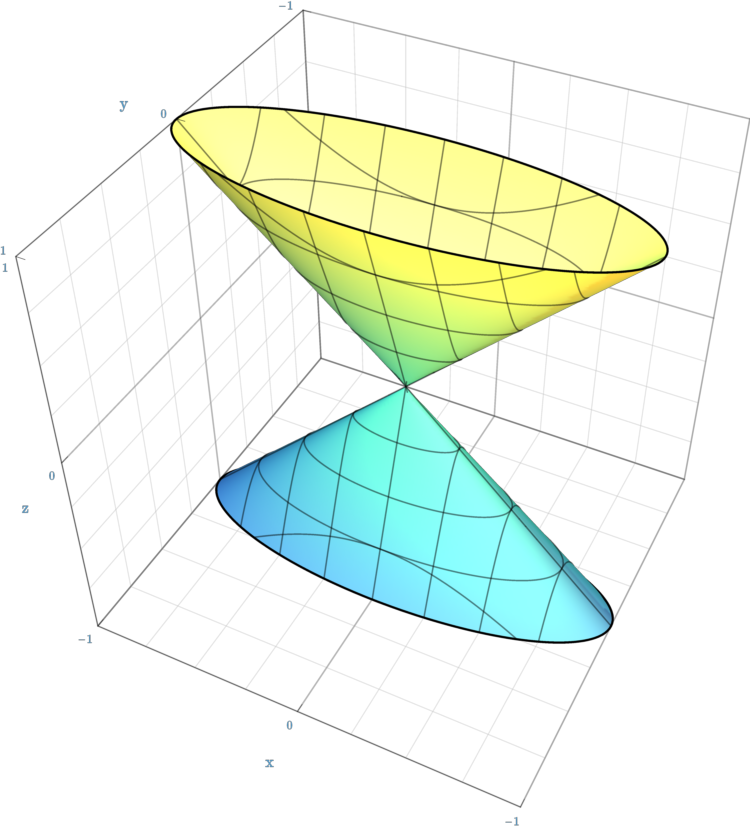
In geometry, a conical surface is an unbounded surface in three-dimensional space formed from the union of infinite lines that pass through a fixed point and a space curve.
Definitions
[edit]A (general) conical surface is the unbounded surface formed by the union of all the straight lines that pass through a fixed point — the apex or vertex — and any point of some fixed space curve — the directrix — that does not contain the apex. Each of those lines is called a generatrix of the surface. The directrix is often taken as a plane curve, in a plane not containing the apex, but this is not a requirement.[1]
In general, a conical surface consists of two congruent unbounded halves joined by the apex. Each half is called a nappe, and is the union of all the rays that start at the apex and pass through a point of some fixed space curve.[2] Sometimes the term "conical surface" is used to mean just one nappe.[3]
Special cases
[edit]If the directrix is a circle , and the apex is located on the circle's axis (the line that contains the center of and is perpendicular to its plane), one obtains the right circular conical surface or double cone.[2] More generally, when the directrix is an ellipse, or any conic section, and the apex is an arbitrary point not on the plane of , one obtains an elliptic cone.[4]

Equations
[edit]


Related surface
[edit]Conical surfaces are ruled surfaces, surfaces that have a straight line through each of their points.[6] Patches of conical surfaces that avoid the apex are special cases of developable surfaces, surfaces that can be unfolded to a flat plane without stretching. When the directrix has the property that the angle it subtends from the apex is exactly , then each nappe of the conical surface, including the apex, is a developable surface.[7]

A cylindrical surface can be viewed as a limiting case of a conical surface whose apex is moved off to infinity in a particular direction. Indeed, in projective geometry a cylindrical surface is just a special case of a conical surface.[8]
See also
[edit]References
[edit]- ^ Adler, Alphonse A. (1912), "1003. Conical surface", The Theory of Engineering Drawing, D. Van Nostrand, p. 166
- ^ a b Wells, Webster; Hart, Walter Wilson (1927), Modern Solid Geometry, Graded Course, Books 6-9, D. C. Heath, pp. 400–401
- ^ Shutts, George C. (1913), "640. Conical surface", Solid Geometry, Atkinson, Mentzer, p. 410
- ^ Young, J. R. (1838), Analytical Geometry, J. Souter, p. 227
- ^ Gray, Alfred (1997), "19.2 Flat ruled surfaces", Modern Differential Geometry of Curves and Surfaces with Mathematica (2nd ed.), CRC Press, pp. 439–441, ISBN 9780849371646
- ^ Mathematical Society of Japan (1993), Ito, Kiyosi (ed.), Encyclopedic Dictionary of Mathematics, Vol. I: A–N (2nd ed.), MIT Press, p. 419
- ^ Audoly, Basile; Pomeau, Yves (2010), Elasticity and Geometry: From Hair Curls to the Non-linear Response of Shells, Oxford University Press, pp. 326–327, ISBN 9780198506256
- ^ Giesecke, F. E.; Mitchell, A. (1916), Descriptive Geometry, Von Boeckmann–Jones Company, p. 66
Conical surface
View on GrokipediaDefinitions and Fundamentals
Formal Definition
A conical surface is a ruled surface in three-dimensional Euclidean space, defined as the locus of all points lying on straight lines—known as rulings—that pass through a fixed point, called the vertex or apex, and intersect a fixed curve, termed the directrix, which does not contain the vertex.[2][3] This construction ensures that every ruling connects the vertex to a point on the directrix, forming an unbounded surface unless intersected by a plane.[1] While the term "cone" is sometimes used interchangeably, it often refers to the solid region bounded by the conical surface and a base plane intersecting the directrix, distinguishing the surface itself as the boundary rather than the volume it encloses.[1][3] As a foundational concept, a ruled surface is any surface that can be parameterized as the union of a family of straight lines, providing the geometric framework for the conical surface's linear generators.[4] The directrix serves as the guiding curve that shapes the surface's profile, without passing through the vertex.[2] For instance, a right circular conical surface arises when the directrix is a circle and the rulings are generated by rotating a straight line around an axis passing through the vertex and the circle's center.[1] Conical surfaces with conic directrices represent special cases of quadric surfaces.[5]Key Components
A conical surface is fundamentally composed of three primary elements: the vertex, the generating lines, and the directrix. The vertex serves as the fixed point in three-dimensional space from which all other components emanate, acting as the apex or singular point of convergence for the surface's structure.[6][7] This point is essential, as it ensures that the surface is ruled, meaning it is formed exclusively by straight lines passing through it. Without the vertex, the defining characteristic of the conical form would be lost, distinguishing it from other ruled surfaces like cylinders.[8] The generating lines, also known as rulings or generatrices, constitute an infinite family of straight lines that all pass through the vertex and sweep out the surface. Each generating line connects the vertex to a point on the directrix, and their collective union forms the unbounded conical surface, which typically extends infinitely in both directions from the vertex, creating two nappes or sheets.[7][8] These lines are the dynamic elements that "generate" the surface as they move while maintaining contact with the fixed directrix, providing the linear texture inherent to cones.[6] The directrix is a fixed curve in space—often, but not necessarily, planar—that is intersected by every generating line at exactly one point, with the critical condition that the curve does not pass through the vertex itself.[7][8] This curve dictates the shape and extent of the surface, serving as the guiding path for the rulings. In contexts where the directrix is closed and lies in a plane, it is sometimes referred to as the base curve, particularly for finite cones like those with circular or elliptical bases; however, for general conical surfaces, the directrix may be a non-planar space curve, broadening the applicability beyond simple right cones.[6] Together, these components uniquely determine the conical surface: for any given vertex and directrix, there exists precisely one such surface formed by the rulings connecting them, ensuring no ambiguity in the geometric construction.[9] This uniqueness underscores the conical surface's role as a fundamental ruled surface in geometry, where the interplay of the fixed point and curve yields a structure invariant under homotheties centered at the vertex.[9]Geometric Properties
Generating Elements
A conical surface is generated by the motion of a straight line, known as the generatrix, that passes through a fixed point called the vertex and intersects a fixed curve termed the directrix.[10] This process traces out the surface as the generatrix sweeps along the directrix, with the vertex remaining stationary. For instance, rotating a line around the vertex while ensuring it touches the directrix at varying points constructs the surface in a rotational manner, or skewing the line can produce more general forms.[10] The generating elements form a one-parameter family of rulings, which are the straight lines comprising the surface.[11] Each ruling in this family passes through the vertex and is parameterized by a single variable corresponding to its position along the directrix. When the directrix is a smooth curve not passing through the vertex, each ruling intersects the directrix at exactly one point, ensuring the surface is fully covered without overlaps or gaps.[10] The vertex serves as the only singular point on the conical surface, where all rulings converge, leading to a breakdown in the usual differentiability properties away from this apex.[12] This convergence creates a ray-like structure emanating from the vertex, visually resembling a bundle of lines radiating outward to meet the directrix, which underscores the surface's ruled nature.[12]Developability and Metrics
A conical surface is a developable surface, meaning it is a ruled surface with zero Gaussian curvature everywhere except possibly at the vertex, allowing it to be isometrically mapped onto a plane without distortion. This property arises because the surface can be generated by straight lines (rulings) passing through a fixed vertex, ensuring that the product of the principal curvatures is zero, as one principal curvature vanishes along the rulings. Such surfaces, including cones, cylinders, and tangent developables, can be constructed from flat sheets like paper or metal, preserving lengths and angles during the mapping.[13] For a general conical surface, the unrolling process maps it to a portion of the plane in which the image of the directrix forms the outer boundary and the generators correspond to straight lines radiating from the image of the vertex. Geodesics on the original surface correspond to straight lines in this planar development. Intrinsic metrics, such as lengths along the generators, are preserved under unrolling, facilitating the computation of distances and areas on the surface.[13]Algebraic Representation
General Equation
A conical surface is represented algebraically as a special case of a quadric surface, given by the general second-degree equation in three variables: where the coefficients are chosen such that the equation describes a conical type, specifically a degenerate quadric with a singular point known as the vertex.[14][15] Conical surfaces are classified among quadric surfaces by the presence of a singular point at the vertex, where the partial derivatives vanish simultaneously, and by discriminant conditions that identify degeneracy. In matrix terms, the quadric is expressed in homogeneous coordinates as , where and is the symmetric 4×4 coefficient matrix; a conical surface corresponds to , distinguishing it from full-rank (rank 4) non-degenerate quadrics like ellipsoids or hyperboloids.[14][15] When the vertex is positioned at the origin, the linear and constant terms vanish (), simplifying the equation to a homogeneous quadratic form. For an elliptic cone aligned with the coordinate axes, this takes the canonical form where determine the semi-axes, with two positive and one negative coefficients (up to overall sign and permutation of variables), corresponding to the signature (2,1) of the quadratic form matrix.[16][15] To obtain this canonical form from the general equation, the coordinate system is transformed via translation to shift the vertex to the origin, followed by rotation to diagonalize the quadratic form matrix through orthogonal transformation, aligning the principal axes with the coordinate axes. This process reduces the equation to its standard type, facilitating analysis in computational geometry contexts where matrix operations enable efficient classification and intersection computations.[14][15]Specific Forms
A conical surface can be represented parametrically as , where is the position vector of the vertex, is a scaling parameter along each generating line (ruling), and is a vector function parameterizing the directions from the vertex to the directrix curve, with varying over the parameter domain of the directrix.[1] This form captures the ruled nature of the surface, with each fixed tracing a straight line from the vertex. For a right circular cone with vertex at the origin and semi-vertical angle , an example uses parameters (replacing ) and , yielding .[1] In cylindrical coordinates , the equation for a right circular cone with vertex at the origin and axis along the positive -direction simplifies to , where is the semi-vertical angle and . This relation holds because the radial distance increases linearly with height along the generators. For oblique cones, where the generators do not form right angles with the base plane, the implicit form incorporates linear terms into the general quadratic equation of a quadric surface, such as , with the surface degenerating into a pair of nappes meeting at the vertex. The parametric form (assuming vertex at origin for simplicity) derives from the definition: select points on the directrix curve , then form rays from the vertex through these points, parameterizing each ray as scalar multiples of the direction vectors .[17] In computer graphics, the vector form position = vertex + \cdot direction_vector is commonly used for ray-cone intersections and rendering, where scales along the generator and the direction_vector varies to trace the surface.[18]Special Cases and Variations
Circular Cones
A circular cone is a conical surface whose directrix is a circle, exhibiting rotational symmetry about its axis. This symmetry distinguishes it from more general elliptic or hyperbolic cones, allowing for uniform generating lines at a constant angle to the axis. In applications ranging from geometry to optics, circular cones serve as foundational models due to their isotropic properties.[1] The right circular cone represents the standard form, where the axis is perpendicular to the plane of the circular base, positioning the apex directly above the base center. The semi-vertical angle α is the fixed angle between the axis and any generating line from the apex to the base circumference. For a right circular cone with apex at the origin and axis along the positive z-direction, the surface equation is given bydescribing the set of points where the radial distance in the xy-plane scales linearly with height z according to the angle α. This equation captures the linear taper from the apex, with the base at z = h forming a circle of radius r = h tan α.[1][19][20] In contrast, an oblique circular cone maintains a circular directrix but tilts the axis away from perpendicularity to the base plane, offsetting the apex from the base center. This obliqueness results in generating lines of varying lengths, while preserving the circular nature of the directrix in its own plane; however, projections of the base onto planes perpendicular to the axis or along the line of sight often appear elliptical due to the angular distortion. The surface remains ruled, with properties like slant height varying azimuthally around the axis.[21][1] Specific to circular cones, the aperture is defined as twice the semi-vertical angle, or 2α, representing the maximum angle subtended between two opposite generating lines at the apex. This measure quantifies the cone's angular width and is invariant under translation along the axis. For eccentricity in circular cases, the base directrix has zero eccentricity, reflecting perfect circularity, while cross-sections parallel to the base remain circles (e = 0); oblique or tilted sections yield ellipses with eccentricity e < 1, determined by the cutting plane's angle relative to α.[22][23] Although the focus here is on the surface, the enclosed solid right circular cone has volume V = (1/3) π r² h, where r is the base radius and h the perpendicular height; for oblique variants, the formula uses the same perpendicular height despite varying slant heights along the surface, which affect lateral area computations. The slant height l = √(r² + h²) = h / cos α emphasizes the surface's generative aspect, influencing metrics like lateral surface area π r l.[1] In ray tracing applications, circular conical surfaces exhibit advantageous optical properties due to their axial symmetry, enabling efficient ray propagation along generators without deviation in azimuthal directions. Cone tracing algorithms extend standard ray tracing by modeling light as conical bundles rather than infinitesimal rays, improving sampling of indirect illumination and shadows in scenes with circular cone primitives; this approach reduces aliasing by accounting for the cone's aperture 2α to approximate penumbra and soft shadows. Such methods are particularly effective for rendering reflections and refractions on conical optics, as rays intersecting the surface follow predictable bilinear paths.[24][25]