
Recent from talks
Surface (mathematics)
Knowledge base stats:
Talk channels stats:
Members stats:
Surface (mathematics)
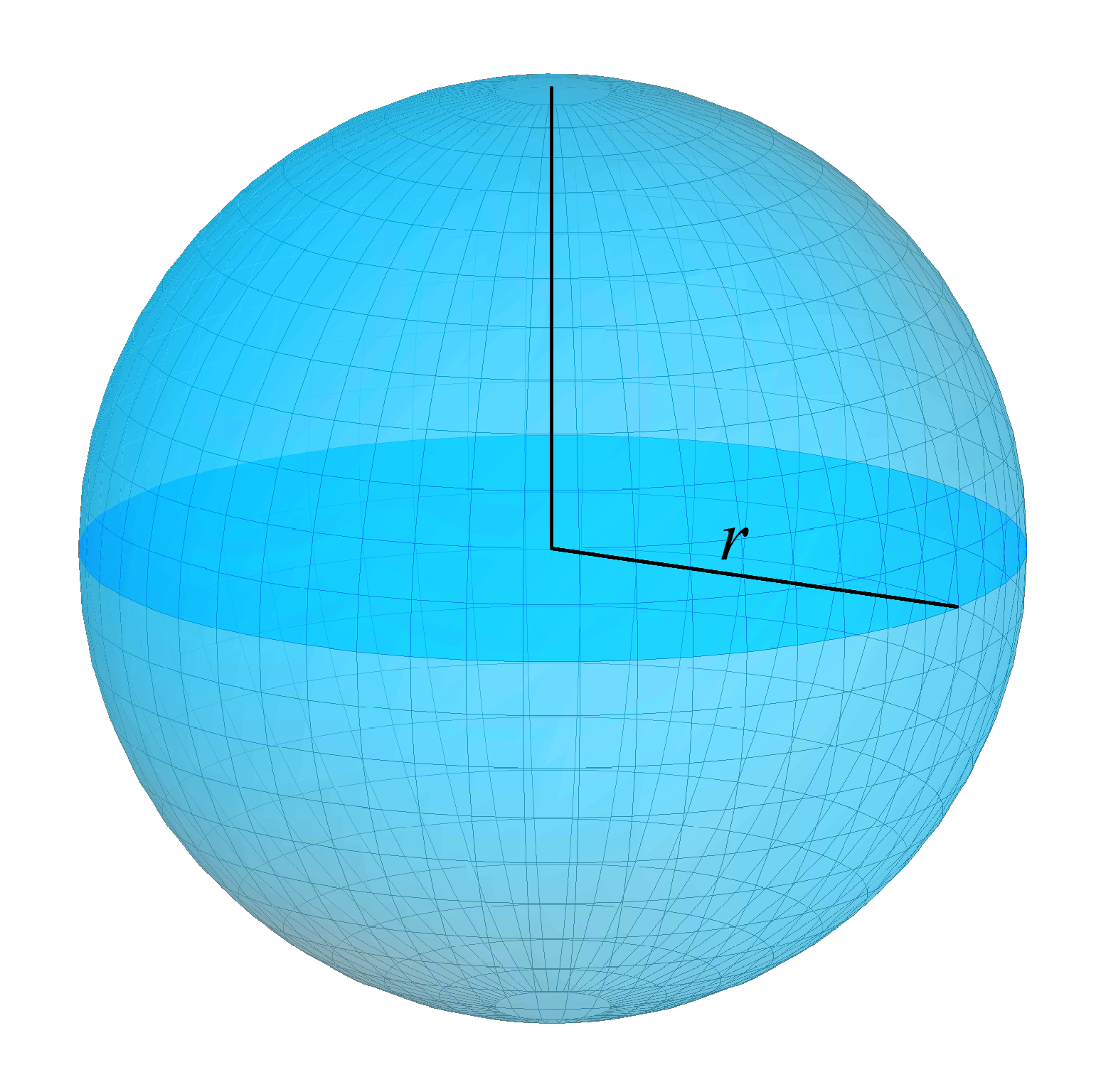
In mathematics, a surface is a mathematical model of the common concept of a surface. It is a generalization of a plane, but, unlike a plane, it may be curved; this is analogous to a curve generalizing a straight line. An example of a non-flat surface is the sphere.
There are several more precise definitions, depending on the context and the mathematical tools that are used for the study. The simplest mathematical surfaces are planes and spheres in the Euclidean 3-space. Typically, in algebraic geometry, a surface may cross itself (and may have other singularities), while, in topology and differential geometry, it may not.
A surface is a topological space of dimension two; this means that a moving point on a surface may move in two directions (it has two degrees of freedom). In other words, around almost every point, there is a coordinate patch on which a two-dimensional coordinate system is defined. For example, the surface of the Earth resembles (ideally) a sphere, and latitude and longitude provide two-dimensional coordinates on it (except at the poles and along the 180th meridian).
Often, a surface is defined by equations that are satisfied by the coordinates of its points. This is the case of the graph of a continuous function of two variables. The set of the zeros of a function of three variables is a surface, which is called an implicit surface. If the defining three-variate function is a polynomial, the surface is an algebraic surface. For example, the unit sphere is an algebraic surface, as it may be defined by the implicit equation
A surface may also be defined as the image, in some space of dimension at least 3, of a continuous function of two variables (some further conditions are required to ensure that the image is not a curve). In this case, one says that one has a parametric surface, which is parametrized by these two variables, called parameters. For example, the unit sphere may be parametrized by the Euler angles, also called longitude u and latitude v by
Parametric equations of surfaces are often irregular at some points. For example, all but two points of the unit sphere, are the image, by the above parametrization, of exactly one pair of Euler angles (modulo 2π). For the remaining two points (the north and south poles), one has cos v = 0, and the longitude u may take any values. Also, there are surfaces for which there cannot exist a single parametrization that covers the whole surface. Therefore, one often considers surfaces which are parametrized by several parametric equations, whose images cover the surface. This is formalized by the concept of manifold: in the context of manifolds, typically in topology and differential geometry, a surface is a manifold of dimension two; this means that a surface is a topological space such that every point has a neighborhood which is homeomorphic to an open subset of the Euclidean plane (see Surface (topology) and Surface (differential geometry)). This allows defining surfaces in spaces of dimension higher than three, and even abstract surfaces, which are not contained in any other space. On the other hand, this excludes surfaces that have singularities, such as the vertex of a conical surface or points where a surface crosses itself.
In classical geometry, a surface is generally defined as a locus of a point or a line. For example, a sphere is the locus of a point which is at a given distance of a fixed point, called the center; a conical surface is the locus of a line passing through a fixed point and crossing a curve; a surface of revolution is the locus of a curve rotating around a line. A ruled surface is the locus of a moving line satisfying some constraints; in modern terminology, a ruled surface is a surface, which is a union of lines.
There are several kinds of surfaces that are considered in mathematics. An unambiguous terminology is thus necessary to distinguish them when needed. A topological surface is a surface that is a manifold of dimension two (see § Topological surface). A differentiable surface is a surfaces that is a differentiable manifold (see § Differentiable surface). Every differentiable surface is a topological surface, but the converse is false.
Hub AI
Surface (mathematics) AI simulator
(@Surface (mathematics)_simulator)
Surface (mathematics)
In mathematics, a surface is a mathematical model of the common concept of a surface. It is a generalization of a plane, but, unlike a plane, it may be curved; this is analogous to a curve generalizing a straight line. An example of a non-flat surface is the sphere.
There are several more precise definitions, depending on the context and the mathematical tools that are used for the study. The simplest mathematical surfaces are planes and spheres in the Euclidean 3-space. Typically, in algebraic geometry, a surface may cross itself (and may have other singularities), while, in topology and differential geometry, it may not.
A surface is a topological space of dimension two; this means that a moving point on a surface may move in two directions (it has two degrees of freedom). In other words, around almost every point, there is a coordinate patch on which a two-dimensional coordinate system is defined. For example, the surface of the Earth resembles (ideally) a sphere, and latitude and longitude provide two-dimensional coordinates on it (except at the poles and along the 180th meridian).
Often, a surface is defined by equations that are satisfied by the coordinates of its points. This is the case of the graph of a continuous function of two variables. The set of the zeros of a function of three variables is a surface, which is called an implicit surface. If the defining three-variate function is a polynomial, the surface is an algebraic surface. For example, the unit sphere is an algebraic surface, as it may be defined by the implicit equation
A surface may also be defined as the image, in some space of dimension at least 3, of a continuous function of two variables (some further conditions are required to ensure that the image is not a curve). In this case, one says that one has a parametric surface, which is parametrized by these two variables, called parameters. For example, the unit sphere may be parametrized by the Euler angles, also called longitude u and latitude v by
Parametric equations of surfaces are often irregular at some points. For example, all but two points of the unit sphere, are the image, by the above parametrization, of exactly one pair of Euler angles (modulo 2π). For the remaining two points (the north and south poles), one has cos v = 0, and the longitude u may take any values. Also, there are surfaces for which there cannot exist a single parametrization that covers the whole surface. Therefore, one often considers surfaces which are parametrized by several parametric equations, whose images cover the surface. This is formalized by the concept of manifold: in the context of manifolds, typically in topology and differential geometry, a surface is a manifold of dimension two; this means that a surface is a topological space such that every point has a neighborhood which is homeomorphic to an open subset of the Euclidean plane (see Surface (topology) and Surface (differential geometry)). This allows defining surfaces in spaces of dimension higher than three, and even abstract surfaces, which are not contained in any other space. On the other hand, this excludes surfaces that have singularities, such as the vertex of a conical surface or points where a surface crosses itself.
In classical geometry, a surface is generally defined as a locus of a point or a line. For example, a sphere is the locus of a point which is at a given distance of a fixed point, called the center; a conical surface is the locus of a line passing through a fixed point and crossing a curve; a surface of revolution is the locus of a curve rotating around a line. A ruled surface is the locus of a moving line satisfying some constraints; in modern terminology, a ruled surface is a surface, which is a union of lines.
There are several kinds of surfaces that are considered in mathematics. An unambiguous terminology is thus necessary to distinguish them when needed. A topological surface is a surface that is a manifold of dimension two (see § Topological surface). A differentiable surface is a surfaces that is a differentiable manifold (see § Differentiable surface). Every differentiable surface is a topological surface, but the converse is false.
Recent media