


Community hub
Recent from talks
Contribute something
Nothing was collected or created yet.
Conjugacy class
View on Wikipedia
In mathematics, especially group theory, two elements and of a group are conjugate if there is an element in the group such that This is an equivalence relation whose equivalence classes are called conjugacy classes. In other words, each conjugacy class is closed under for all elements in the group.


Members of the same conjugacy class cannot be distinguished by using only the group structure, and therefore share many properties. The study of conjugacy classes of non-abelian groups is fundamental for the study of their structure.[1][2] For an abelian group, each conjugacy class is a set containing one element (singleton set).
Functions that are constant for members of the same conjugacy class are called class functions.
Motivation
[edit]The concept of conjugacy classes may come from trying to formalize the idea that two group elements are considered the "same" after a relabeling of elements.
For example, consider the symmetric group of order 5, and elements and that are conjugate. An element can be viewed as simply "renaming" the elements to then applying the permutation on this new labeling.


The conjugacy action by does not change the underlying structure of . In a way, permutations and have the same "shape".[3]

Another way to view the conjugacy action is by considering the general linear group of invertible matrices. Two matrices and conjugate if there exist a matrix such that , which is the same condition as matrix similarity. The two matrices are conjugates if they are the "same" under two possibly different bases, with being the change-of-basis matrix.


Conjugates also come up in some important theorems of group theory. One example is the Sylow theorems, which state that every Sylow -subgroup of a finite group are conjugates to each other. It also appears in the proof of Cauchy's theorem, which makes use of conjugacy classes.


Definition
[edit]Let be a group. Two elements are conjugate if there exists an element such that in which case is called a conjugate of and is called a conjugate of


In the case of the general linear group of invertible matrices, the conjugacy relation is called matrix similarity.
It can be easily shown that conjugacy is an equivalence relation and therefore partitions into equivalence classes. (This means that every element of the group belongs to precisely one conjugacy class, and the classes and are equal if and only if and are conjugate, and disjoint otherwise.) The equivalence class that contains the element is and is called the conjugacy class of The class number of is the number of distinct (nonequivalent) conjugacy classes. All elements belonging to the same conjugacy class have the same order.


Conjugacy classes may be referred to by describing them, or more briefly by abbreviations such as "6A", meaning "a certain conjugacy class with elements of order 6", and "6B" would be a different conjugacy class with elements of order 6; the conjugacy class 1A is the conjugacy class of the identity which has order 1. In some cases, conjugacy classes can be described in a uniform way; for example, in the symmetric group they can be described by cycle type.
Examples
[edit]


The symmetric group consisting of the 6 permutations of three elements, has three conjugacy classes:

- No change:
- Transposing two:
- A cyclic permutation of all three:



These three classes also correspond to the classification of the isometries of an equilateral triangle.
The symmetric group consisting of the 24 permutations of four elements, has five conjugacy classes, listed with their members using cycle notation:[4]

- No change:
- Interchanging two:
- A cyclic permutation of three:
- A cyclic permutation of all four:
- Interchanging two, and also the other two:


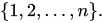
In general, the number of conjugacy classes in the symmetric group is equal to the number of integer partitions of This is because each conjugacy class corresponds to exactly one partition of into cycles, up to permutation of the elements of


The dihedral group consisting of symmetries of a pentagon, has four conjugacy classes:[5]
- The identity element:
- Two conjugacy classes of size 2:
- All the reflections:


For an abelian group, each conjugacy class is a set containing one element (singleton set).
Properties
[edit]- The identity element is always the only element in its class, that is
- If is abelian then for all , i.e. for all (and the converse is also true: if all conjugacy classes are singletons then is abelian).
- If two elements belong to the same conjugacy class (that is, if they are conjugate), then they have the same order. More generally, every statement about can be translated into a statement about because the map is an automorphism of called an inner automorphism. See the next property for an example.
- If and are conjugate, then so are their powers and (Proof: if then ) Thus taking kth powers gives a map on conjugacy classes, and one may consider which conjugacy classes are in its preimage. For example, in the symmetric group, the square of an element of type (3)(2) (a 3-cycle and a 2-cycle) is an element of type (3), therefore one of the power-up classes of (3) is the class (3)(2) (where is a power-up class of ).
- An element lies in the center of if and only if its conjugacy class has only one element, itself. More generally, if denotes the centralizer of i.e., the subgroup consisting of all elements such that then the index is equal to the number of elements in the conjugacy class of (by the orbit-stabilizer theorem).
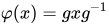
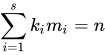
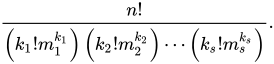
- Take and let be the distinct integers which appear as lengths of cycles in the cycle type of (including 1-cycles). Let be the number of cycles of length in for each (so that ). Then the number of conjugates of is:[1]







![{\displaystyle \left[G:\operatorname {C} _{G}(a)\right]}](https://wikimedia.org/api/rest_v1/media/math/render/svg/c54e724a6727915e7aad698e91d3b239bb663662)





Conjugacy as group action
[edit]For any two elements let This defines a group action of on The orbits of this action are the conjugacy classes, and the stabilizer of a given element is the element's centralizer.[6]

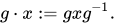

Similarly, we can define a group action of on the set of all subsets of by writing or on the set of the subgroups of

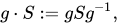
Conjugacy class equation
[edit]If is a finite group, then for any group element the elements in the conjugacy class of are in one-to-one correspondence with cosets of the centralizer This can be seen by observing that any two elements and belonging to the same coset (and hence, for some in the centralizer ) give rise to the same element when conjugating : That can also be seen from the orbit-stabilizer theorem, when considering the group as acting on itself through conjugation, so that orbits are conjugacy classes and stabilizer subgroups are centralizers. The converse holds as well.



Thus the number of elements in the conjugacy class of is the index of the centralizer in ; hence the size of each conjugacy class divides the order of the group.
Furthermore, if we choose a single representative element from every conjugacy class, we infer from the disjointness of the conjugacy classes that where is the centralizer of the element Observing that each element of the center forms a conjugacy class containing just itself gives rise to the class equation:[7] where the sum is over a representative element from each conjugacy class that is not in the center.

![{\displaystyle |G|=\sum _{i}\left[G:\operatorname {C} _{G}(x_{i})\right],}](https://wikimedia.org/api/rest_v1/media/math/render/svg/84e6fbe118330ea572815ea7f8265e2b89cca463)


![{\displaystyle |G|=|{\operatorname {Z} (G)}|+\sum _{i}\left[G:\operatorname {C} _{G}(x_{i})\right],}](https://wikimedia.org/api/rest_v1/media/math/render/svg/62cc4e1e4075cbc2507accafadd5e76795bea819)
Knowledge of the divisors of the group order can often be used to gain information about the order of the center or of the conjugacy classes.

Example
[edit]Consider a finite -group (that is, a group with order where is a prime number and ). We are going to prove that every finite -group has a non-trivial center.


Since the order of any conjugacy class of must divide the order of it follows that each conjugacy class that is not in the center also has order some power of where But then the class equation requires that From this we see that must divide so





In particular, when then is an abelian group since any non-trivial group element is of order or If some element of is of order then is isomorphic to the cyclic group of order hence abelian. On the other hand, if every non-trivial element in is of order hence by the conclusion above then or We only need to consider the case when then there is an element of which is not in the center of Note that includes and the center which does not contain but at least elements. Hence the order of is strictly larger than therefore therefore is an element of the center of a contradiction. Hence is abelian and in fact isomorphic to the direct product of two cyclic groups each of order






Average Centralizer
[edit]Let be a finite group. Consider the group action of on itself given by conjugation. The orbits are the conjugacy classes of and the set of fixed points of an element is the centralizer .

Thus by Burnside's lemma, the number of conjugacy classes is equal to , that is, the average size of the centralizer.

Conjugacy of subgroups and general subsets
[edit]More generally, given any subset ( not necessarily a subgroup), define a subset to be conjugate to if there exists some such that Let be the set of all subsets such that is conjugate to


A frequently used theorem is that, given any subset the index of (the normalizer of ) in equals the cardinality of :


![{\displaystyle |{\operatorname {Cl} (S)}|=[G:N(S)].}](https://wikimedia.org/api/rest_v1/media/math/render/svg/76980e185e63cb1e680005c1e1ab795f9c2db35b)
This follows since, if then if and only if in other words, if and only if are in the same coset of


By using this formula generalizes the one given earlier for the number of elements in a conjugacy class.

The above is particularly useful when talking about subgroups of The subgroups can thus be divided into conjugacy classes, with two subgroups belonging to the same class if and only if they are conjugate. Conjugate subgroups are isomorphic, but isomorphic subgroups need not be conjugate. For example, an abelian group may have two different subgroups which are isomorphic, but they are never conjugate.
Geometric interpretation
[edit]Conjugacy classes in the fundamental group of a path-connected topological space can be thought of as equivalence classes of free loops under free homotopy.
Conjugacy class and irreducible representations in finite group
[edit]In any finite group, the number of nonisomorphic irreducible representations over the complex numbers is precisely the number of conjugacy classes.
See also
[edit]- Topological conjugacy – Concept in topology
- FC-group – Group in group theory mathematics
- Conjugacy-closed subgroup
Notes
[edit]- ^ a b Dummit, David S.; Foote, Richard M. (2004). Abstract Algebra (3rd ed.). John Wiley & Sons. ISBN 0-471-43334-9.
- ^ Lang, Serge (2002). Algebra. Graduate Texts in Mathematics. Springer. ISBN 0-387-95385-X.
- ^ Chen, Evan. "An Infinitely Large Napkin" (PDF). Retrieved 3 September 2025.
- ^ O'Neill, Christopher (January 2023). "Inner-automorphism between the octahedral group and the binary octahedral group".
- ^ Conrad, Keith. "Dihedral groups" (PDF). Retrieved 3 September 2025.
- ^ Grillet (2007), p. 56
- ^ Grillet (2007), p. 57
References
[edit]- Grillet, Pierre Antoine (2007). Abstract algebra. Graduate texts in mathematics. Vol. 242 (2 ed.). Springer. ISBN 978-0-387-71567-4.
External links
[edit]- "Conjugate elements", Encyclopedia of Mathematics, EMS Press, 2001 [1994]
Conjugacy class
View on GrokipediaFundamentals
Definition
In group theory, two elements and in a group are said to be conjugate, written , if there exists an element such that .[2] This operation defines the standard notion of right conjugation in groups.[5] Left conjugation, by contrast, is given by , but the resulting sets of conjugate elements coincide because every group element admits an inverse, so substituting yields the same collection.[6] The conjugacy class of an element , commonly denoted or , is the set of all elements conjugate to , namely .[6] Other notations, such as for the class generated by conjugation from , appear in some contexts.[2] The conjugacy relation is an equivalence relation on the set . Reflexivity holds since for the identity .[6] Symmetry follows because if , then .[2] Transitivity is verified by noting that if and , then .[6]Examples
A concrete example of conjugacy classes arises in the symmetric group , which consists of all permutations of three elements and has order 6. The conjugacy classes in are determined by cycle type: the identity element forms its own class of size 1; the three transpositions , , and form a single class of size 3, as any transposition is conjugate to any other via an appropriate permutation; and the two 3-cycles and form another class of size 2. These classes partition and illustrate how elements of the same cycle structure are conjugate.[2] In the quaternion group of order 8, the conjugacy classes are , , , , and . The center consists of elements that commute with everything, so and each form singleton classes. The remaining elements pair with their negatives under conjugation: for instance, , and similarly for the other pairs, yielding classes of size 2. These five classes reflect the non-abelian structure of .[7] For any abelian group , the conjugacy classes are all singletons for each . This follows because, in an abelian group, elements commute, so for all , meaning no element is conjugate to a distinct one. Consequently, the number of conjugacy classes equals the order of , and this singleton property characterizes abelian groups among all groups.[2] In the general linear group over a field , conjugacy classes correspond precisely to similarity classes of invertible matrices. Two matrices are conjugate if there exists invertible such that , which is the definition of similarity; this equivalence preserves properties like eigenvalues and Jordan form. For example, in , classes include diagonalizable matrices with distinct eigenvalues, scalar matrices, and non-diagonalizable Jordan blocks, each classified by their characteristic polynomials or minimal polynomials.[8]Core Properties
Basic Properties
In group theory, the conjugacy class of an element in a group , denoted , consists of all elements of the form for . These classes partition the group into disjoint subsets, meaning every element of belongs to exactly one conjugacy class, and the classes are pairwise disjoint.[6] The centralizer of in , denoted or , is the subgroup defined by , which is equivalently the set of elements that commute with . The size of the conjugacy class is given by the index of the centralizer in : . This follows from the orbit-stabilizer theorem applied to the conjugation action, where acts as the stabilizer of .[6] The center of the group, , is the union of all singleton conjugacy classes, as each central element satisfies for all , making .[6] Conjugacy classes are invariant under inner automorphisms of , which are the automorphisms of the form for fixed ; applying such an automorphism maps each class to itself.[6]Conjugacy Class Equation
The conjugacy class equation is a fundamental theorem in finite group theory that expresses the order of a finite group as the sum of the orders of its distinct conjugacy classes. Specifically, if is a set of representatives, one from each conjugacy class of , then where denotes the conjugacy class of .[9] This equation arises from applying the orbit-stabilizer theorem to the conjugation action of on itself. For each element , the orbit under this action is precisely the conjugacy class , and the stabilizer is the centralizer of in . The orbit-stabilizer theorem thus yields . Summing this relation over one representative from each conjugacy class partitions into disjoint classes and recovers the class equation.[9] A key implication is that each conjugacy class size divides the order of the group, since is the index of the centralizer in , and thus divides . This divisibility property provides constraints on the possible structures of finite groups.[9] The conjugacy class equation emerged in the 19th-century development of finite group theory, with foundational contributions from Augustin-Louis Cauchy, who introduced the notion of conjugate permutations in 1844.[10]Equation Illustration
To illustrate the conjugacy class equation, consider the dihedral group of order 8, which consists of the symmetries of a square: four rotations and four reflections. This non-abelian group provides a concrete example where the equation (sum over class representatives ) can be computed explicitly, revealing the structure through class sizes greater than 1.[11] The elements of are denoted as (identity), (90° rotation), (180° rotation), (270° rotation), and reflections , , , , satisfying , , and . To determine the conjugacy classes, compute the orbit of each element under conjugation, or equivalently, use the formula , where is the centralizer of .[11] The identity commutes with all elements, so (order 8) and (size 1). The element lies in the center and also commutes with everything, yielding (order 8) and (size 1).[11] For , the centralizer is the rotation subgroup (order 4), since reflections conjugate to (e.g., ), but rotations fix it. Thus, , and . By symmetry, .[11][12] The reflections split into two classes. For (reflection over a horizontal axis), the centralizer is (order 4), as it includes the center and reflections over parallel axes; conjugations by rotations yield , while others map to the other type. Thus, and . Similarly, for (diagonal reflection), (order 4), giving (size 2).[11][12] The conjugacy classes are therefore , , , , and , with sizes 1, 1, 2, 2, 2. The class equation verifies: . The presence of three classes of size 2 highlights the non-abelian nature, as all classes would be singletons in an abelian group.[11][12]Group Action Perspective
Conjugacy as Group Action
The conjugation action provides a natural framework for understanding conjugacy classes through the lens of group actions. Consider a group acting on itself by conjugation, defined by the map where for . This action satisfies the group action axioms: the identity element acts as the identity map, and the action is compatible with the group operation in .[13][14] Under this action, the orbit of an element is the set , which is precisely the conjugacy class of . Thus, the conjugacy classes of partition into the orbits of this conjugation action.[2][13][14] The stabilizer of under this action is the centralizer , the subgroup of elements that commute with . By the orbit-stabilizer theorem, the size of the conjugacy class of is , assuming is finite.[2][14] This action corresponds to the homomorphism given by , whose image is the inner automorphism group and kernel is the center . Consequently, the conjugation action factors through the action of on .[2][14]Subgroups and Subsets
In group theory, the concept of conjugacy extends naturally from individual elements to subgroups. For a subgroup of a group and an element , the conjugate subgroup is defined as .[2] This set is itself a subgroup of isomorphic to , preserving the group structure under conjugation.[15] The conjugacy classes of subgroups arise from the action of by conjugation on the lattice of its subgroups. Specifically, two subgroups and of belong to the same conjugacy class if there exists such that ; the conjugacy class of is then the orbit under this action.[2] A subgroup forms a singleton conjugacy class—meaning it is fixed under conjugation by every element of , so for all —precisely when is normal in .[2][15] This conjugation action applies more broadly to arbitrary subsets of . For a subset and , the conjugate is .[2] The conjugacy classes of such subsets are the orbits under the conjugation action, partitioning the power set of into equivalence classes where subsets are related by relabeling via inner automorphisms.[2] A significant application of subgroup conjugacy appears in the Sylow theorems, which describe the structure of finite groups via their Sylow -subgroups for primes dividing the group order. The second Sylow theorem states that all Sylow -subgroups of a finite group are conjugate to each other, forming a single conjugacy class under the action of by conjugation.[16][17] This conjugacy ensures that Sylow -subgroups are indistinguishable up to relabeling, providing a tool to classify group structures and count such subgroups modulo .[16][18]Interpretations and Applications
Geometric Interpretation
In the general linear group , conjugacy classes correspond to similarity classes of matrices, where two matrices and are conjugate if there exists an invertible matrix such that . Geometrically, this equivalence means that and describe the same linear transformation relative to different bases, preserving the intrinsic structure of eigenspaces and generalized eigenspaces in the vector space . Over algebraically closed fields such as , these classes are determined by the Jordan canonical form, which decomposes the matrix into a block-diagonal arrangement of Jordan blocks; each block visualizes a chain of generalized eigenvectors associated with an eigenvalue, highlighting the dimension of the kernel (geometric multiplicity) and the full eigenspace deficiency relative to diagonalizability. This form provides a spatial analogy to the "shape" of the transformation, where larger blocks indicate longer chains of non-trivial actions beyond mere scaling.[19] In the symmetric group , conjugacy classes are indexed by partitions of corresponding to cycle types, which geometrically represent the permutation as a disjoint union of cycles acting on the set , akin to orbiting subsets or loops in a graphical decomposition. Two permutations belong to the same class if they induce the same pattern of cycle lengths, interpretable as the topology of the permutation's action: for instance, a cycle of length traces a -sided polygon in the functional graph, while multiple cycles of equal length suggest symmetric rearrangements like parallel circuits. This cycle-type classification offers a visual pattern recognition, where the partition visually encodes the "skeleton" of the permutation's dynamics without regard to labeling of elements.[20] A particularly intuitive visualization arises in , isomorphic to the dihedral group of symmetries of an equilateral triangle, where the three conjugacy classes align with geometric transformation types: the identity (cycle type ), the three transpositions (cycle type ) as reflections over altitudes, and the two 3-cycles (cycle type ) as 120° and 240° rotations around the centroid. This separation geometrically distinguishes orientation-preserving motions (rotations, forming the alternating subgroup ) from orientation-reversing flips (reflections), illustrating how conjugacy classes capture distinct "motions" in the symmetry group of a spatial object.[21] For Lie groups, conjugacy classes in the group correspond to adjoint orbits in the Lie algebra under the adjoint action for , providing a differential geometric interpretation as submanifolds foliating . These orbits geometrically represent the "level sets" of the adjoint representation, where each orbit is a homogeneous space diffeomorphic to (with the centralizer), and their symplectic structure (via Kirillov-Kostant-Souriau) endows them with a phase-space analogy, visualizing the decomposition of elements into semisimple and nilpotent parts through coadjoint orbits in . In compact Lie groups, such orbits are compact Kähler manifolds, offering a spatial embedding that highlights the curvature and connectivity induced by the group's exponential map.Representations Connection
In the representation theory of finite groups over the complex numbers, characters play a central role in connecting conjugacy classes to irreducible representations. A character of a representation of a finite group is defined by for , and it is a class function, meaning for all . Thus, the value of is constant on each conjugacy class of , allowing characters to be viewed as functions on the set of conjugacy classes rather than individual elements. The space of all class functions, denoted , forms a vector space of dimension equal to the number of conjugacy classes in .[22] The irreducible characters , where each is the character of an irreducible representation, form an orthonormal basis for with respect to the inner product . Since class functions are constant on conjugacy classes, this inner product can be rewritten as a sum over conjugacy classes: , where the orthogonality yields . Equivalently, the unnormalized orthogonality relation is . This basis property implies that the number of irreducible representations (up to isomorphism) equals the dimension of , which is the number of conjugacy classes in .[23][22][24] The Frobenius-Schur indicator provides further insight into the nature of irreducible representations by detecting whether they are realizable over the real numbers, with a direct computation involving character values on conjugacy classes. For an irreducible character of , the indicator is , which takes values in . This sum groups terms by conjugacy classes of squares , but more importantly, if and only if is real-valued (i.e., for all , hence on all conjugacy classes) and the representation is realizable over with a symmetric invariant bilinear form; if is real-valued but the representation requires quaternions with a skew-symmetric form; and otherwise, indicating no real realization. Real conjugacy classes, those satisfying , are precisely the classes on which all irreducible characters take real values, linking the indicator to the group's real class structure.[25] A key application arises from these relations in counting irreducible representations via averaging over the group. The orthogonality of irreducible characters implies that the regular representation decomposes as a direct sum of each irreducible representation with multiplicity equal to its degree, leading to the identity , where the sum is over irreducible characters. By projecting onto class functions using the inner product (an averaging process), one recovers the basis property and confirms that the number of irreducible representations equals the number of conjugacy classes, a fundamental result in character theory often proved by decomposing the space of class functions. This averaging technique underscores how conjugacy classes parametrize the irreducible representations, enabling explicit computations of character tables for groups like symmetric groups.[23][24]References
- https://groupprops.subwiki.org/wiki/Symmetric_group:S3