
Recent from talks
Cyclic group
Knowledge base stats:
Talk channels stats:
Members stats:
Cyclic group
In abstract algebra, a cyclic group or monogenous group is a group, denoted Cn (also frequently n or Zn, not to be confused with the commutative ring of p-adic numbers), that is generated by a single element. That is, it is a set of invertible elements with a single associative binary operation, and it contains an element g such that every other element of the group may be obtained by repeatedly applying the group operation to g or its inverse. Each element can be written as an integer power of g in multiplicative notation, or as an integer multiple of g in additive notation. This element g is called a generator of the group.

Every infinite cyclic group is isomorphic to the additive group of Z, the integers. Every finite cyclic group of order n is isomorphic to the additive group of Z/nZ, the integers modulo n. Every cyclic group is an abelian group (meaning that its group operation is commutative), and every finitely generated abelian group is a direct product of cyclic groups.
Every cyclic group of prime order is a simple group, which cannot be broken down into smaller groups. In the classification of finite simple groups, one of the three infinite classes consists of the cyclic groups of prime order. The cyclic groups of prime order are thus among the building blocks from which all groups can be built.
For any element g in any group G, one can form the subgroup that consists of all its integer powers: ⟨g⟩ = { gk | k ∈ Z }, called the cyclic subgroup generated by g. The order of g is |⟨g⟩|, the number of elements in ⟨g⟩, conventionally abbreviated as |g|, as ord(g), or as o(g). That is, the order of an element is equal to the order of the cyclic subgroup that it generates.
A cyclic group is a group which is equal to one of its cyclic subgroups: G = ⟨g⟩ for some element g, called a generator of G.
For a finite cyclic group G of order n we have G = {e, g, g2, ... , gn−1}, where e is the identity element and gi = gj whenever i ≡ j (mod n); in particular gn = g0 = e, and g−1 = gn−1. An abstract group defined by this multiplication is often denoted Cn, and we say that G is isomorphic to the standard cyclic group Cn. Such a group is also isomorphic to Z/nZ, the group of integers modulo n with the addition operation, which is the standard cyclic group in additive notation. Under the isomorphism χ defined by χ(gi) = i the identity element e corresponds to 0, products correspond to sums, and powers correspond to multiples.
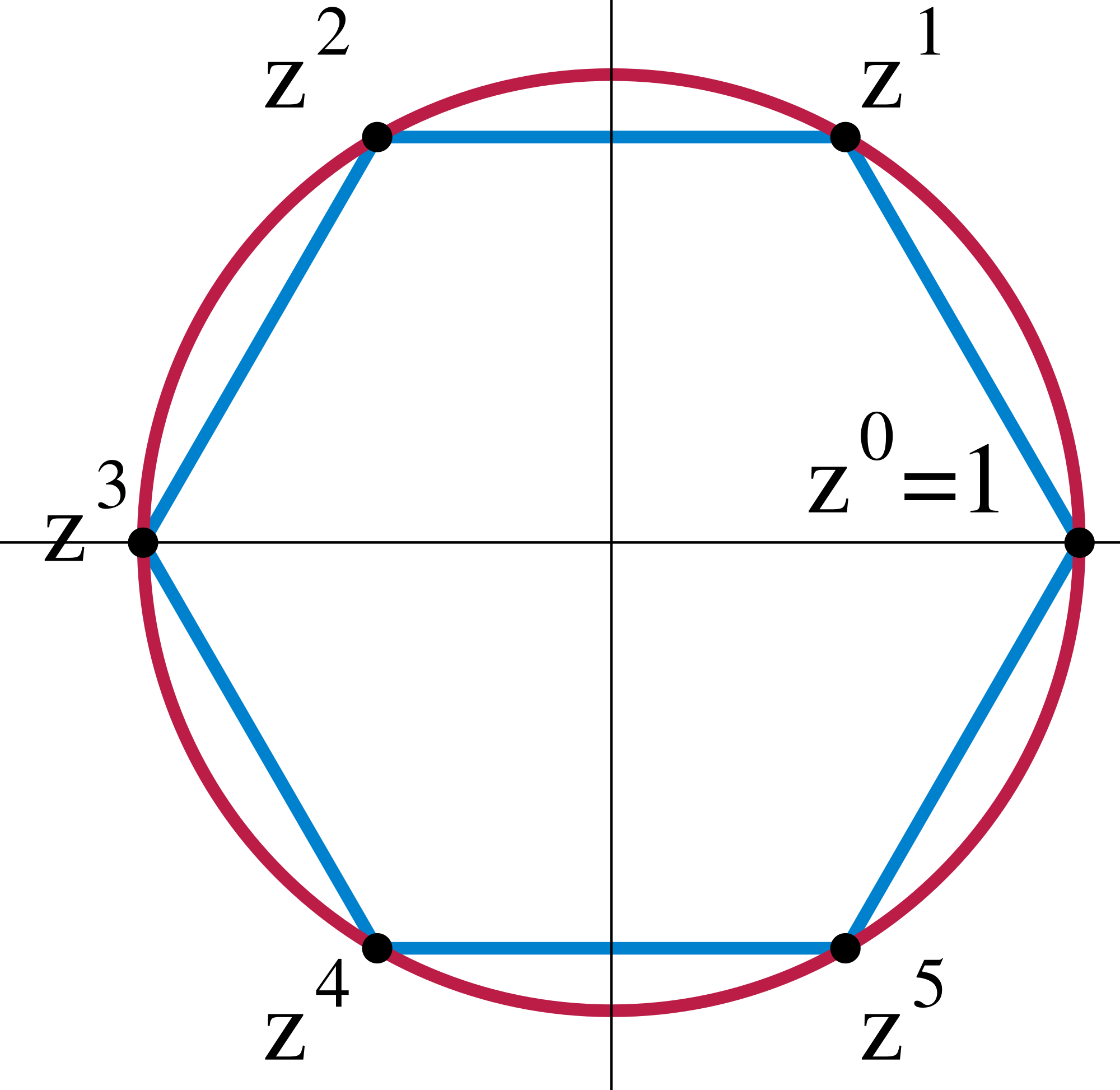
For example, the set of complex 6th roots of unity: forms a group under multiplication. It is cyclic, since it is generated by the primitive root that is, G = ⟨z⟩ = { 1, z, z2, z3, z4, z5 } with z6 = 1. Under a change of letters, this is isomorphic to (structurally the same as) the standard cyclic group of order 6, defined as C6 = ⟨g⟩ = { e, g, g2, g3, g4, g5 } with multiplication gj · gk = gj+k (mod 6), so that g6 = g0 = e. These groups are also isomorphic to Z/6Z = {0, 1, 2, 3, 4, 5} with the operation of addition modulo 6, with zk and gk corresponding to k. For example, 1 + 2 ≡ 3 (mod 6) corresponds to z1 · z2 = z3, and 2 + 5 ≡ 1 (mod 6) corresponds to z2 · z5 = z7 = z1, and so on. Any element generates its own cyclic subgroup, such as ⟨z2⟩ = { e, z2, z4 } of order 3, isomorphic to C3 and Z/3Z; and ⟨z5⟩ = { e, z5, z10 = z4, z15 = z3, z20 = z2, z25 = z } = G, so that z5 has order 6 and is an alternative generator of G.


Instead of the quotient notations Z/nZ, Z/(n), or Z/n, some authors denote a finite cyclic group as Zn, but this clashes with the notation of number theory, where Zp denotes a p-adic number ring, or localization at a prime ideal.
Hub AI
Cyclic group AI simulator
(@Cyclic group_simulator)
Cyclic group
In abstract algebra, a cyclic group or monogenous group is a group, denoted Cn (also frequently n or Zn, not to be confused with the commutative ring of p-adic numbers), that is generated by a single element. That is, it is a set of invertible elements with a single associative binary operation, and it contains an element g such that every other element of the group may be obtained by repeatedly applying the group operation to g or its inverse. Each element can be written as an integer power of g in multiplicative notation, or as an integer multiple of g in additive notation. This element g is called a generator of the group.
Every infinite cyclic group is isomorphic to the additive group of Z, the integers. Every finite cyclic group of order n is isomorphic to the additive group of Z/nZ, the integers modulo n. Every cyclic group is an abelian group (meaning that its group operation is commutative), and every finitely generated abelian group is a direct product of cyclic groups.
Every cyclic group of prime order is a simple group, which cannot be broken down into smaller groups. In the classification of finite simple groups, one of the three infinite classes consists of the cyclic groups of prime order. The cyclic groups of prime order are thus among the building blocks from which all groups can be built.
For any element g in any group G, one can form the subgroup that consists of all its integer powers: ⟨g⟩ = { gk | k ∈ Z }, called the cyclic subgroup generated by g. The order of g is |⟨g⟩|, the number of elements in ⟨g⟩, conventionally abbreviated as |g|, as ord(g), or as o(g). That is, the order of an element is equal to the order of the cyclic subgroup that it generates.
A cyclic group is a group which is equal to one of its cyclic subgroups: G = ⟨g⟩ for some element g, called a generator of G.
For a finite cyclic group G of order n we have G = {e, g, g2, ... , gn−1}, where e is the identity element and gi = gj whenever i ≡ j (mod n); in particular gn = g0 = e, and g−1 = gn−1. An abstract group defined by this multiplication is often denoted Cn, and we say that G is isomorphic to the standard cyclic group Cn. Such a group is also isomorphic to Z/nZ, the group of integers modulo n with the addition operation, which is the standard cyclic group in additive notation. Under the isomorphism χ defined by χ(gi) = i the identity element e corresponds to 0, products correspond to sums, and powers correspond to multiples.
For example, the set of complex 6th roots of unity: forms a group under multiplication. It is cyclic, since it is generated by the primitive root that is, G = ⟨z⟩ = { 1, z, z2, z3, z4, z5 } with z6 = 1. Under a change of letters, this is isomorphic to (structurally the same as) the standard cyclic group of order 6, defined as C6 = ⟨g⟩ = { e, g, g2, g3, g4, g5 } with multiplication gj · gk = gj+k (mod 6), so that g6 = g0 = e. These groups are also isomorphic to Z/6Z = {0, 1, 2, 3, 4, 5} with the operation of addition modulo 6, with zk and gk corresponding to k. For example, 1 + 2 ≡ 3 (mod 6) corresponds to z1 · z2 = z3, and 2 + 5 ≡ 1 (mod 6) corresponds to z2 · z5 = z7 = z1, and so on. Any element generates its own cyclic subgroup, such as ⟨z2⟩ = { e, z2, z4 } of order 3, isomorphic to C3 and Z/3Z; and ⟨z5⟩ = { e, z5, z10 = z4, z15 = z3, z20 = z2, z25 = z } = G, so that z5 has order 6 and is an alternative generator of G.
Instead of the quotient notations Z/nZ, Z/(n), or Z/n, some authors denote a finite cyclic group as Zn, but this clashes with the notation of number theory, where Zp denotes a p-adic number ring, or localization at a prime ideal.
Recent media