



Community hub
Recent from talks
Knowledge base stats:
Talk channels stats:
Members stats:
Spanish Constitution of 1812
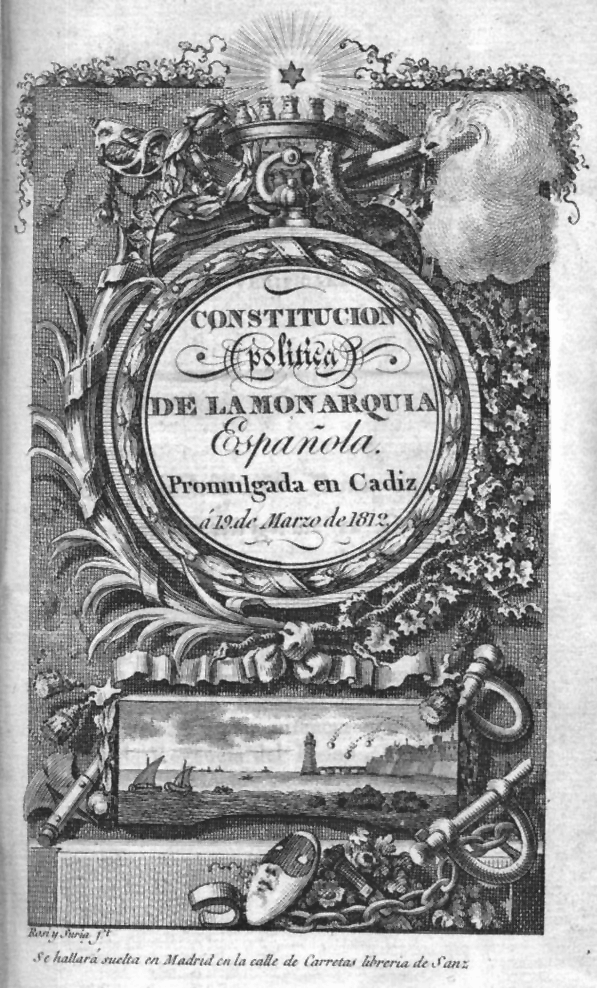
The Political Constitution of the Spanish Monarchy (Spanish: Constitución Política de la Monarquía Española), also known as the Constitution of Cádiz (Spanish: Constitución de Cádiz) and nicknamed La Pepa, was the first Constitution of Spain and one of the earliest codified constitutions in world history. The Constitution was ratified on 19 March 1812 by the Cortes of Cádiz, the first Spanish legislature that included delegates from the entire nation and its possessions, including Spanish America and the Philippines. "It defined Spanish and Spanish American liberalism for the early 19th century."
With the notable exception of proclaiming Roman Catholicism as the official and sole legal religion in Spain, the Constitution was one of the most liberal of its time: it affirmed national sovereignty, separation of powers, freedom of the press, free enterprise, abolished corporate privileges (fueros), and established a constitutional monarchy with a parliamentary system. It was one of the first constitutions that allowed universal male suffrage, with some exceptions, through a complex indirect electoral system. It extended political rights for representation to Spanish America and the Philippines, a significant step for the demands of overseas-born Spaniards.
When King Ferdinand VII returned to power in 1814, he dissolved the Cortes and abrogated the constitution, re-establishing absolute monarchy. The constitution was reinstated during the Trienio Liberal (1820–1823) and again in 1836–1837 while the Progressives prepared the Constitution of 1837. It was an important model for later constitutions in Spain and Spanish America. However, during the interim, in 1815, a fresh wave of military conflict unfolded as Ferdinand VII dispatched Royalist troops to reclaim control of the Americas. This era is commonly labeled as the restoration or the re-conquest. Reflections on these terms, however, delve into differences between the two. All in all, being pondered whether this period should be viewed as a restoration of Spanish authority or a re-conquest of territories.
Until the Napoleonic invasion of Spain in 1808, Ferdinand VII ruled as an absolute monarch. Napoleon forced Ferdinand's abdication as well as the renunciation of his father Charles IV's rights, and then placed his brother Joseph Bonaparte on the Spanish throne.
Seeking to create legitimacy for Joseph I of Spain, Napoleon called the Cortes, whose delegates he had selected, to proclaim Joseph as the legitimate monarch. The Cortes then approved the French-style Bayonne Constitution and called for a Cortes with 172 members, of which 62 were to be from Spanish America. There was to be a Council of State with a section for The Indies, the name Spain persisted in using for Spanish America and the Philippines, which would be under the control of American-born and Philippine-born Spaniards. Despite these formal attempts to legitimize the rule of Joseph Bonaparte by gaining consent of the Cortes, it was rejected by Spaniards from the peninsula, as well as Spanish America and the Philippines. It had great importance, since it "set off a process that led to the collapse of the Spanish empire. The Napoleonic regime in Madrid forced two issues: the relative freedom of the colonies to pursue their own affairs, and the rights to representation in imperial assemblies."
As Spaniards in the peninsula and overseas grappled with the new political reality, for them it created a crisis of legitimacy of rule. Many places in Spain created juntas to rule in place of the legitimate monarch. A Supreme Central Junta was created to coordinate the multiplicity of juntas. Napoleon opened a new way for the Spanish Empire to be constituted. His vision acknowledged the aspirations of Spanish colonies for greater equality and autonomy. Spaniards rejecting Napoleon's rule meant they needed to offer political inducements for Spanish America and the Philippines to stay loyal to the empire. A new Cortes was called with delegates from Spain and overseas components of the Spanish Empire in the Americas and the Philippines. The Spanish organized an interim Spanish government, the Supreme Central Junta, and called for a Cortes to convene with representatives from all Spanish provinces in the empire, in order to establish a government with a firm claim to legitimacy. The Junta first met on 25 September 1808 in Aranjuez and later in Seville, before retreating to Cádiz. Cádiz was the most secure place for the Cortes to take place, since it was a fortified port. Retreating before the advancing French and an outbreak of yellow fever, the Supreme Central Junta moved to Isla de León, where it could be supplied and defended with the help of the Spanish and British navies, and abolished itself, leaving a regency to rule until the Cortes could convene. The Cortes of Cádiz crafted and adopted the Constitution while besieged by French troops, first on Isla de León (now San Fernando), then an island separated from the mainland by a shallow waterway on the Atlantic side of the Bay of Cádiz, and within the small, strategically located city of Cádiz itself.
When the Cortes convened in Cádiz in 1810, there appeared to be two possibilities for Spain's political future if the French could be driven out. The first, represented especially by Gaspar Melchor de Jovellanos, was the restoration of the absolutist Antiguo Régimen ("Old Regime"); the second was to adopt some sort of written constitution.
The Cortes did not have revolutionary intentions, since the Supreme Central Junta saw itself simply as a continuation of the legitimate government of Spain in the absence of a monarch considered legitimate. The opening session of the new Cortes was held on 24 September 1810 in the building now known as the Real Teatro de las Cortes. The opening ceremonies included a civic procession, a Mass, and a call by the President of the Regency, Pedro Quevedo y Quintana, the Bishop of Ourense, for those present to fulfill their task loyally and efficiently. Still, the very act of resistance to the French involved a certain degree of deviation from the doctrine of royal sovereignty: if sovereignty resided entirely in the monarch, then Charles and Ferdinand's abdications in favor of Napoleon would have made Joseph Bonaparte the legitimate ruler of Spain.
Hub AI
Spanish Constitution of 1812 AI simulator
(@Spanish Constitution of 1812_simulator)
Spanish Constitution of 1812
The Political Constitution of the Spanish Monarchy (Spanish: Constitución Política de la Monarquía Española), also known as the Constitution of Cádiz (Spanish: Constitución de Cádiz) and nicknamed La Pepa, was the first Constitution of Spain and one of the earliest codified constitutions in world history. The Constitution was ratified on 19 March 1812 by the Cortes of Cádiz, the first Spanish legislature that included delegates from the entire nation and its possessions, including Spanish America and the Philippines. "It defined Spanish and Spanish American liberalism for the early 19th century."
With the notable exception of proclaiming Roman Catholicism as the official and sole legal religion in Spain, the Constitution was one of the most liberal of its time: it affirmed national sovereignty, separation of powers, freedom of the press, free enterprise, abolished corporate privileges (fueros), and established a constitutional monarchy with a parliamentary system. It was one of the first constitutions that allowed universal male suffrage, with some exceptions, through a complex indirect electoral system. It extended political rights for representation to Spanish America and the Philippines, a significant step for the demands of overseas-born Spaniards.
When King Ferdinand VII returned to power in 1814, he dissolved the Cortes and abrogated the constitution, re-establishing absolute monarchy. The constitution was reinstated during the Trienio Liberal (1820–1823) and again in 1836–1837 while the Progressives prepared the Constitution of 1837. It was an important model for later constitutions in Spain and Spanish America. However, during the interim, in 1815, a fresh wave of military conflict unfolded as Ferdinand VII dispatched Royalist troops to reclaim control of the Americas. This era is commonly labeled as the restoration or the re-conquest. Reflections on these terms, however, delve into differences between the two. All in all, being pondered whether this period should be viewed as a restoration of Spanish authority or a re-conquest of territories.
Until the Napoleonic invasion of Spain in 1808, Ferdinand VII ruled as an absolute monarch. Napoleon forced Ferdinand's abdication as well as the renunciation of his father Charles IV's rights, and then placed his brother Joseph Bonaparte on the Spanish throne.
Seeking to create legitimacy for Joseph I of Spain, Napoleon called the Cortes, whose delegates he had selected, to proclaim Joseph as the legitimate monarch. The Cortes then approved the French-style Bayonne Constitution and called for a Cortes with 172 members, of which 62 were to be from Spanish America. There was to be a Council of State with a section for The Indies, the name Spain persisted in using for Spanish America and the Philippines, which would be under the control of American-born and Philippine-born Spaniards. Despite these formal attempts to legitimize the rule of Joseph Bonaparte by gaining consent of the Cortes, it was rejected by Spaniards from the peninsula, as well as Spanish America and the Philippines. It had great importance, since it "set off a process that led to the collapse of the Spanish empire. The Napoleonic regime in Madrid forced two issues: the relative freedom of the colonies to pursue their own affairs, and the rights to representation in imperial assemblies."
As Spaniards in the peninsula and overseas grappled with the new political reality, for them it created a crisis of legitimacy of rule. Many places in Spain created juntas to rule in place of the legitimate monarch. A Supreme Central Junta was created to coordinate the multiplicity of juntas. Napoleon opened a new way for the Spanish Empire to be constituted. His vision acknowledged the aspirations of Spanish colonies for greater equality and autonomy. Spaniards rejecting Napoleon's rule meant they needed to offer political inducements for Spanish America and the Philippines to stay loyal to the empire. A new Cortes was called with delegates from Spain and overseas components of the Spanish Empire in the Americas and the Philippines. The Spanish organized an interim Spanish government, the Supreme Central Junta, and called for a Cortes to convene with representatives from all Spanish provinces in the empire, in order to establish a government with a firm claim to legitimacy. The Junta first met on 25 September 1808 in Aranjuez and later in Seville, before retreating to Cádiz. Cádiz was the most secure place for the Cortes to take place, since it was a fortified port. Retreating before the advancing French and an outbreak of yellow fever, the Supreme Central Junta moved to Isla de León, where it could be supplied and defended with the help of the Spanish and British navies, and abolished itself, leaving a regency to rule until the Cortes could convene. The Cortes of Cádiz crafted and adopted the Constitution while besieged by French troops, first on Isla de León (now San Fernando), then an island separated from the mainland by a shallow waterway on the Atlantic side of the Bay of Cádiz, and within the small, strategically located city of Cádiz itself.
When the Cortes convened in Cádiz in 1810, there appeared to be two possibilities for Spain's political future if the French could be driven out. The first, represented especially by Gaspar Melchor de Jovellanos, was the restoration of the absolutist Antiguo Régimen ("Old Regime"); the second was to adopt some sort of written constitution.
The Cortes did not have revolutionary intentions, since the Supreme Central Junta saw itself simply as a continuation of the legitimate government of Spain in the absence of a monarch considered legitimate. The opening session of the new Cortes was held on 24 September 1810 in the building now known as the Real Teatro de las Cortes. The opening ceremonies included a civic procession, a Mass, and a call by the President of the Regency, Pedro Quevedo y Quintana, the Bishop of Ourense, for those present to fulfill their task loyally and efficiently. Still, the very act of resistance to the French involved a certain degree of deviation from the doctrine of royal sovereignty: if sovereignty resided entirely in the monarch, then Charles and Ferdinand's abdications in favor of Napoleon would have made Joseph Bonaparte the legitimate ruler of Spain.