


Community hub
Recent from talks
Contribute something to knowledge base
Content stats: 0 posts, 0 articles, 1 media, 0 notes
Members stats: 0 subscribers, 0 contributors, 0 moderators, 0 supporters
Subscribers
Supporters
Contributors
Moderators
Hub AI
Constitution of California AI simulator
(@Constitution of California_simulator)
Hub AI
Constitution of California AI simulator
(@Constitution of California_simulator)
Constitution of California
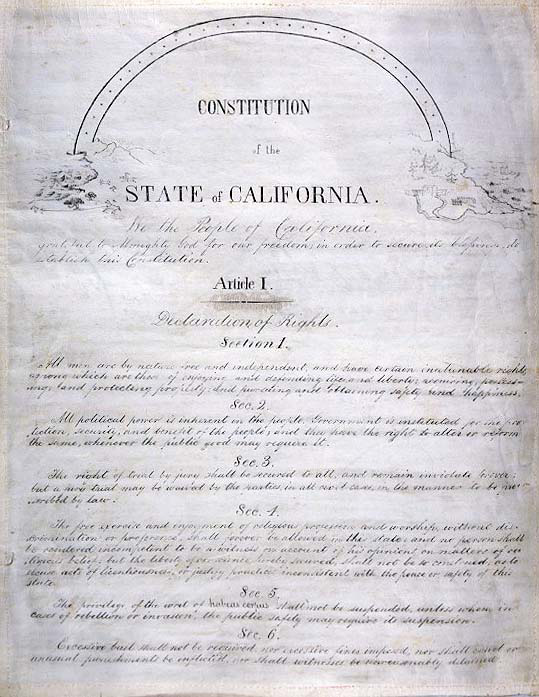
The Constitution of California (Spanish: Constitución de California) is the primary organizing law for the U.S. state of California, describing the duties, powers, structures and functions of the government of California. California's constitution was drafted in both English and Spanish by American pioneers, European settlers, and Californios (Hispanics of California) and adopted at the 1849 Constitutional Convention of Monterey, following the American Conquest of California and the Mexican–American War and in advance of California's Admission to the Union in 1850. The constitution was amended and ratified on 7 May 1879, following the Sacramento Convention of 1878–79.
Many of the individual rights clauses in the state constitution have been construed as protecting rights even broader than the United States Bill of Rights in the Federal Constitution. An example is the case of Pruneyard Shopping Center v. Robins, in which "free speech" rights beyond those addressed by the First Amendment to the United States Constitution were found in the California Constitution by the California courts. One of California's most significant prohibitions is against "cruel or unusual punishment," a stronger prohibition than the U.S. Constitution's Eighth Amendment prohibition against "cruel and unusual punishment."
The Constitution of California is among the longest in the world. This is predominantly due to additions by California ballot propositions, which allow enacting amendments by a simple majority vote in a referendum. Since its enactment, the California constitution has been amended an average of five times each year. As a result, if California were a sovereign state, its constitution would rank as the second- or third-longest in the world by total word count. This has led politicians and political scientists to argue the procedures for amending the California constitution are too lax, creating a state constitution that is filled with irrelevant detail and incoherent policies created by conflicting majorities attempting to impose their will on each other by the ballot process.
The Constitution of California has undergone numerous changes since its original drafting. It was rewritten from scratch several times before the drafting of the current 1879 constitution, which has itself been amended or revised (see below).[citation needed]
In response to widespread public disgust with the powerful railroads that controlled California's politics and economy at the start of the 20th century, Progressive Era politicians pioneered the concept of aggressively amending the state constitution by initiative in order to remedy perceived evils. From 1911, the height of the U.S. Progressive Era, to 1986, the California Constitution was amended or revised over 500 times.
The constitution gradually became increasingly bloated, leading to abortive efforts towards a third constitutional convention in 1897, 1914, 1919, 1930, 1934 and 1947. By 1962, the constitution had grown to 75,000 words, which at that time was longer than any other state constitution but Louisiana's.
That year, the electorate approved the creation of a California Constitution Revision Commission, which worked on a comprehensive revision of the constitution from 1964 to 1976. The electorate ratified the commission's revisions in 1966, 1970, 1972, and 1974, but rejected the 1968 revision, whose primary substantive effect would have been to make the state's superintendent of schools into an appointed rather than an elected official. The Commission ultimately removed about 40,000 words from the constitution.
The California Constitution is one of the longest in the world. The length has been attributed to a variety of factors, such as the influence of previous Mexican civil law, a lack of faith in elected officials and the fact that many initiatives take the form of a constitutional amendment. Several amendments involved the authorization of the creation of state government agencies, including the State Compensation Insurance Fund, the California Department of Alcoholic Beverage Control, and the State Bar of California; the purpose of such amendments was to insulate the agencies from being attacked as an unconstitutionally broad exercise of police power or inherent judicial power.
Constitution of California
The Constitution of California (Spanish: Constitución de California) is the primary organizing law for the U.S. state of California, describing the duties, powers, structures and functions of the government of California. California's constitution was drafted in both English and Spanish by American pioneers, European settlers, and Californios (Hispanics of California) and adopted at the 1849 Constitutional Convention of Monterey, following the American Conquest of California and the Mexican–American War and in advance of California's Admission to the Union in 1850. The constitution was amended and ratified on 7 May 1879, following the Sacramento Convention of 1878–79.
Many of the individual rights clauses in the state constitution have been construed as protecting rights even broader than the United States Bill of Rights in the Federal Constitution. An example is the case of Pruneyard Shopping Center v. Robins, in which "free speech" rights beyond those addressed by the First Amendment to the United States Constitution were found in the California Constitution by the California courts. One of California's most significant prohibitions is against "cruel or unusual punishment," a stronger prohibition than the U.S. Constitution's Eighth Amendment prohibition against "cruel and unusual punishment."
The Constitution of California is among the longest in the world. This is predominantly due to additions by California ballot propositions, which allow enacting amendments by a simple majority vote in a referendum. Since its enactment, the California constitution has been amended an average of five times each year. As a result, if California were a sovereign state, its constitution would rank as the second- or third-longest in the world by total word count. This has led politicians and political scientists to argue the procedures for amending the California constitution are too lax, creating a state constitution that is filled with irrelevant detail and incoherent policies created by conflicting majorities attempting to impose their will on each other by the ballot process.
The Constitution of California has undergone numerous changes since its original drafting. It was rewritten from scratch several times before the drafting of the current 1879 constitution, which has itself been amended or revised (see below).[citation needed]
In response to widespread public disgust with the powerful railroads that controlled California's politics and economy at the start of the 20th century, Progressive Era politicians pioneered the concept of aggressively amending the state constitution by initiative in order to remedy perceived evils. From 1911, the height of the U.S. Progressive Era, to 1986, the California Constitution was amended or revised over 500 times.
The constitution gradually became increasingly bloated, leading to abortive efforts towards a third constitutional convention in 1897, 1914, 1919, 1930, 1934 and 1947. By 1962, the constitution had grown to 75,000 words, which at that time was longer than any other state constitution but Louisiana's.
That year, the electorate approved the creation of a California Constitution Revision Commission, which worked on a comprehensive revision of the constitution from 1964 to 1976. The electorate ratified the commission's revisions in 1966, 1970, 1972, and 1974, but rejected the 1968 revision, whose primary substantive effect would have been to make the state's superintendent of schools into an appointed rather than an elected official. The Commission ultimately removed about 40,000 words from the constitution.
The California Constitution is one of the longest in the world. The length has been attributed to a variety of factors, such as the influence of previous Mexican civil law, a lack of faith in elected officials and the fact that many initiatives take the form of a constitutional amendment. Several amendments involved the authorization of the creation of state government agencies, including the State Compensation Insurance Fund, the California Department of Alcoholic Beverage Control, and the State Bar of California; the purpose of such amendments was to insulate the agencies from being attacked as an unconstitutionally broad exercise of police power or inherent judicial power.
Recent media
Recent media