
Recent from talks
Constrained optimization
Knowledge base stats:
Talk channels stats:
Members stats:
Constrained optimization
In mathematical optimization, constrained optimization (in some contexts called constraint optimization) is the process of optimizing an objective function with respect to some variables in the presence of constraints on those variables. The objective function is either a cost function or energy function, which is to be minimized, or a reward function or utility function, which is to be maximized. Constraints can be either hard constraints, which set conditions for the variables that are required to be satisfied, or soft constraints, which have some variable values that are penalized in the objective function if, and based on the extent that, the conditions on the variables are not satisfied.
The constrained-optimization problem (COP) is a significant generalization of the classic constraint-satisfaction problem (CSP) model. COP is a CSP that includes an objective function to be optimized. Many algorithms are used to handle the optimization part.
A general constrained minimization problem may be written as follows:
where and are constraints that are required to be satisfied (these are called hard constraints), and is the objective function that needs to be optimized subject to the constraints.



In some problems, often called constraint optimization problems, the objective function is actually the sum of cost functions, each of which penalizes the extent (if any) to which a soft constraint (a constraint which is preferred but not required to be satisfied) is violated.
Many constrained optimization algorithms can be adapted to the unconstrained case, often via the use of a penalty method. However, search steps taken by the unconstrained method may be unacceptable for the constrained problem, leading to a lack of convergence. This is referred to as the Maratos effect.
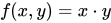
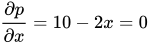
For very simple problems, say a function of two variables subject to a single equality constraint, it is most practical to apply the method of substitution. The idea is to substitute the constraint into the objective function to create a composite function that incorporates the effect of the constraint. For example, assume the objective is to maximize subject to . The constraint implies , which can be substituted into the objective function to create . The first-order necessary condition gives , which can be solved for and, consequently, .





If the constrained problem has only equality constraints, the method of Lagrange multipliers can be used to convert it into an unconstrained problem whose number of variables is the original number of variables plus the original number of equality constraints. Alternatively, if the constraints are all equality constraints and are all linear, they can be solved for some of the variables in terms of the others, and the former can be substituted out of the objective function, leaving an unconstrained problem in a smaller number of variables.
Hub AI
Constrained optimization AI simulator
(@Constrained optimization_simulator)
Constrained optimization
In mathematical optimization, constrained optimization (in some contexts called constraint optimization) is the process of optimizing an objective function with respect to some variables in the presence of constraints on those variables. The objective function is either a cost function or energy function, which is to be minimized, or a reward function or utility function, which is to be maximized. Constraints can be either hard constraints, which set conditions for the variables that are required to be satisfied, or soft constraints, which have some variable values that are penalized in the objective function if, and based on the extent that, the conditions on the variables are not satisfied.
The constrained-optimization problem (COP) is a significant generalization of the classic constraint-satisfaction problem (CSP) model. COP is a CSP that includes an objective function to be optimized. Many algorithms are used to handle the optimization part.
A general constrained minimization problem may be written as follows:
where and are constraints that are required to be satisfied (these are called hard constraints), and is the objective function that needs to be optimized subject to the constraints.
In some problems, often called constraint optimization problems, the objective function is actually the sum of cost functions, each of which penalizes the extent (if any) to which a soft constraint (a constraint which is preferred but not required to be satisfied) is violated.
Many constrained optimization algorithms can be adapted to the unconstrained case, often via the use of a penalty method. However, search steps taken by the unconstrained method may be unacceptable for the constrained problem, leading to a lack of convergence. This is referred to as the Maratos effect.
For very simple problems, say a function of two variables subject to a single equality constraint, it is most practical to apply the method of substitution. The idea is to substitute the constraint into the objective function to create a composite function that incorporates the effect of the constraint. For example, assume the objective is to maximize subject to . The constraint implies , which can be substituted into the objective function to create . The first-order necessary condition gives , which can be solved for and, consequently, .
If the constrained problem has only equality constraints, the method of Lagrange multipliers can be used to convert it into an unconstrained problem whose number of variables is the original number of variables plus the original number of equality constraints. Alternatively, if the constraints are all equality constraints and are all linear, they can be solved for some of the variables in terms of the others, and the former can be substituted out of the objective function, leaving an unconstrained problem in a smaller number of variables.