Hubbry Logo
UtilityUtilityMain
Open search
Utility
Community hub
Utility
logo
7 pages, 0 posts
0 subscribers
Be the first to start a discussion here.
Contribute something
Utility
Utility
from Wikipedia

In economics, utility is a measure of a certain person's satisfaction from a certain state of the world. Over time, the term has been used with at least two meanings.

The relationship between these two kinds of utility functions has been a source of controversy among both economists and ethicists, with most maintaining that the two are distinct but generally related.

Utility function

[edit]

Consider a set of alternatives among which a person has a preference ordering. A utility function represents that ordering if it is possible to assign a real number to each alternative in such a manner that alternative a is assigned a number greater than alternative b if and only if the individual prefers alternative a to alternative b. In this situation, someone who selects the most preferred alternative must also choose one that maximizes the associated utility function.

Suppose James has utility function such that is the number of apples and is the number of chocolates. Alternative A has apples and chocolates; alternative B has apples and chocolates. Putting the values into the utility function yields for alternative A and for B, so James prefers alternative B. In general economic terms, a utility function ranks preferences concerning a set of goods and services.

Gérard Debreu derived the conditions required for a preference ordering to be representable by a utility function.[1] For a finite set of alternatives, these require only that the preference ordering is complete (so the individual can determine which of any two alternatives is preferred or that they are indifferent), and that the preference order is transitive.

Suppose the set of alternatives is not finite (for example, even if the number of goods is finite, the quantity chosen can be any real number on an interval). In that case, a continuous utility function exists representing a consumer's preferences if and only if the consumer's preferences are complete, transitive, and continuous.[2]

Applications

[edit]

Utility can be represented through sets of indifference curve, which are level curves of the function itself and which plot the combination of commodities that an individual would accept to maintain a given level of satisfaction. Combining indifference curves with budget constraints allows for individual demand curves derivation.

A general indifference curve

In an indifference curve, the vertical and horizontal axes represent an individual's consumption of commodity Y and X respectively. All the combinations of commodity X and Y along the same indifference curve are regarded indifferently by individuals, which means all the combinations along an indifference curve result in the same utility value.

Individual and social utility can be construed as the value of a utility function and a social welfare function, respectively. When coupled with production or commodity constraints, by some assumptions, these functions can be used to analyze Pareto efficiency, such as illustrated by Edgeworth boxes in contract curves. Such efficiency is a major concept in welfare economics.

Preference

[edit]

While preferences are the conventional foundation of choice theory in microeconomics, it is often convenient to represent preferences with a utility function. Let X be the consumption set, the set of all mutually exclusive baskets the consumer could consume. The consumer's utility function ranks each possible outcome in the consumption set. If the consumer strictly prefers x to y or is indifferent between them, then .

For example, suppose a consumer's consumption set is X = {nothing, 1 apple,1 orange, 1 apple and 1 orange, 2 apples, 2 oranges}, and his utility function is u(nothing) = 0, u(1 apple) = 1, u(1 orange) = 2, u(1 apple and 1 orange) = 5, u(2 apples) = 2 and u(2 oranges) = 4. Then this consumer prefers 1 orange to 1 apple but prefers one of each to 2 oranges.

In micro-economic models, there is usually a finite set of L commodities, and a consumer may consume an arbitrary amount of each commodity. This gives a consumption set of , and each package is a vector containing the amounts of each commodity. For the example, there are two commodities: apples and oranges. If we say apples are the first commodity, and oranges the second, then the consumption set is and u(0, 0) = 0, u(1, 0) = 1, u(0, 1) = 2, u(1, 1) = 5, u(2, 0) = 2, u(0, 2) = 4 as before. For u to be a utility function on X, however, it must be defined for every package in X, so now the function must be defined for fractional apples and oranges too. One function that would fit these numbers is

Preferences have three main properties:

  • Completeness

Assume an individual has two choices, A and B. By ranking the two choices, one and only one of the following relationships is true: an individual strictly prefers A (A > B); an individual strictly prefers B (B>A); an individual is indifferent between A and B (A = B). Either ab OR ba (OR both) for all (a,b)

  • Transitivity

Individuals' preferences are consistent over bundles. If an individual prefers bundle A to bundle B and bundle B to bundle C, then it can be assumed that the individual prefers bundle A to bundle C. (If ab and bc, then ac for all (a,b,c)).

  • Non-satiation or monotonicity

If bundle A contains all the goods that a bundle B contains, but A also includes more of at least one good than B. The individual prefers A over B.[3] If, for example, bundle A = {1 apple,2 oranges}, and bundle B = {1 apple,1 orange}, then A is preferred over B.

Revealed preference

[edit]

It was recognized that utility could not be measured or observed directly, so instead economists devised a way to infer relative utilities from observed choice. These 'revealed preferences', as termed by Paul Samuelson, were revealed e.g. in people's willingness to pay:

Utility is assumed to be correlative to Desire or Want. It has been argued already that desires cannot be measured directly, but only indirectly, by the outward phenomena which they cause: and that in those cases with which economics is mainly concerned the measure is found by the price which a person is willing to pay for the fulfillment or satisfaction of his desire.[4]: 78 

Functions

[edit]

Utility functions, expressing utility as a function of the amounts of the various goods consumed, are treated as either cardinal or ordinal, depending on whether they are or are not interpreted as providing more information than simply the rank ordering of preferences among bundles of goods, such as information concerning the strength of preferences.

Cardinal

[edit]

Cardinal utility states that the utilities obtained from consumption can be measured and ranked objectively and are representable by numbers.[5] There are fundamental assumptions of cardinal utility. Economic agents should be able to rank different bundles of goods based on their preferences or utilities and sort different transitions between two bundles of goods.[6]

A cardinal utility function can be transformed to another utility function by a positive linear transformation (multiplying by a positive number, and adding some other number); however, both utility functions represent the same preferences.[7]

When cardinal utility is assumed, the magnitude of utility differences is treated as an ethically or behaviorally significant quantity. For example, suppose a cup of orange juice has utility of 120 "utils", a cup of tea has a utility of 80 utils, and a cup of water has a utility of 40 utils. With cardinal utility, it can be concluded that the cup of orange juice is better than the cup of tea by the same amount by which the cup of tea is better than the cup of water. This means that if a person has a cup of tea, they would be willing to take any bet with a probability, p, greater than .5 of getting a cup of juice, with a risk of getting a cup of water equal to 1-p. One cannot conclude, however, that the cup of tea is two-thirds of the goodness of the cup of juice because this conclusion would depend not only on magnitudes of utility differences but also on the "zero" of utility. For example, if the "zero" of utility were located at -40, then a cup of orange juice would be 160 utils more than zero, a cup of tea 120 utils more than zero. Cardinal utility can be considered as the assumption that quantifiable characteristics, such as height, weight, temperature, etc can measure utility.

Neoclassical economics has largely retreated from using cardinal utility functions as the basis of economic behavior. A notable exception is in the context of analyzing choice with conditions of risk (see below).

Sometimes cardinal utility is used to aggregate utilities across persons, to create a social welfare function.

Ordinal

[edit]

Instead of giving actual numbers over different bundles, ordinal utilities are only the rankings of utilities received from different bundles of goods or services.[5] For example, ordinal utility could tell that having two ice creams provide a greater utility to individuals in comparison to one ice cream but could not tell exactly how much extra utility received by the individual. Ordinal utility, it does not require individuals to specify how much extra utility they received from the preferred bundle of goods or services in comparison to other bundles. They are only needed to tell which bundles they prefer.

When ordinal utilities are used, differences in utils (values assumed by the utility function) are treated as ethically or behaviorally meaningless: the utility index encodes a full behavioral ordering between members of a choice set, but tells nothing about the related strength of preferences. For the above example, it would only be possible to say that juice is preferred to tea to water. Thus, ordinal utility utilizes comparisons, such as "preferred to", "no more", "less than", etc.

If a function is ordinal and non-negative, it is equivalent to the function , because taking the square is an increasing monotone (or monotonic) transformation. This means that the ordinal preference induced by these functions is the same (although they are two different functions). In contrast, if is cardinal, it is not equivalent to .

Examples

[edit]

In order to simplify calculations, various alternative assumptions have been made concerning details of human preferences, and these imply various alternative utility functions such as:

Most utility functions used for modeling or theory are well-behaved. They are usually monotonic and quasi-concave. However, it is possible for rational preferences not to be representable by a utility function. An example is lexicographic preferences which are not continuous and cannot be represented by a continuous utility function.[8]

Marginal utility

[edit]

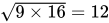
Economists distinguish between total utility and marginal utility. Total utility is the utility of an alternative, an entire consumption bundle or situation in life. The rate of change of utility from changing the quantity of one good consumed is termed the marginal utility of that good. Marginal utility therefore measures the slope of the utility function with respect to the changes of one good.[9] Marginal utility usually decreases with consumption of the good, the idea of "diminishing marginal utility". In calculus notation, the marginal utility of good X is . When a good's marginal utility is positive, additional consumption of it increases utility; if zero, the consumer is satiated and indifferent about consuming more; if negative, the consumer would pay to reduce his consumption.[10]

Law of diminishing marginal utility

[edit]

Rational individuals only consume additional units of goods if it increases the marginal utility. However, the law of diminishing marginal utility means an additional unit consumed brings a lower marginal utility than that carried by the previous unit consumed. For example, drinking one bottle of water makes a thirsty person satisfied; as the consumption of water increases, he may feel begin to feel bad which causes the marginal utility to decrease to zero or even become negative. Furthermore, this is also used to analyze progressive taxes as the greater taxes can result in the loss of utility.

Marginal rate of substitution (MRS)

[edit]

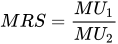
Marginal rate of substitution is the absolute value of the slope of the indifference curve, which measures how much an individual is willing to switch from one good to another. Using a mathematic equation, keeping U(x1,x2) constant. Thus, MRS is how much an individual is willing to pay for consuming a greater amount of x1.

MRS is related to marginal utility. The relationship between marginal utility and MRS is:[9]
Expected utility

[edit]

Expected utility theory deals with the analysis of choices among risky projects with multiple (possibly multidimensional) outcomes.

The St. Petersburg paradox was first proposed by Nicholas Bernoulli in 1713 and solved by Daniel Bernoulli in 1738, although the Swiss mathematician Gabriel Cramer proposed taking the expectation of a square-root utility function of money in an 1728 letter to N. Bernoulli. D. Bernoulli argued that the paradox could be resolved if decision-makers displayed risk aversion and argued for a logarithmic cardinal utility function. (Analysis of international survey data during the 21st century has shown that insofar as utility represents happiness, as for utilitarianism, it is indeed proportional to log of income.)

The first important use of the expected utility theory was that of John von Neumann and Oskar Morgenstern, who used the assumption of expected utility maximization in their formulation of game theory.

In finding the probability-weighted average of the utility from each possible outcome:

Von Neumann–Morgenstern

[edit]

Von Neumann and Morgenstern addressed situations in which the outcomes of choices are not known with certainty, but have probabilities associated with them.

A notation for a lottery is as follows: if options A and B have probability p and 1 − p in the lottery, we write it as a linear combination:

More generally, for a lottery with many possible options:
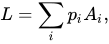
where .

By making some reasonable assumptions about the way choices behave, von Neumann and Morgenstern showed that if an agent can choose between the lotteries, then this agent has a utility function such that the desirability of an arbitrary lottery can be computed as a linear combination of the utilities of its parts, with the weights being their probabilities of occurring.

This is termed the expected utility theorem. The required assumptions are four axioms about the properties of the agent's preference relation over 'simple lotteries', which are lotteries with just two options. Writing to mean 'A is weakly preferred to B' ('A is preferred at least as much as B'), the axioms are:

  1. completeness: For any two simple lotteries and , either or (or both, in which case they are viewed as equally desirable).
  2. transitivity: for any three lotteries , if and , then .
  3. convexity/continuity (Archimedean property): If , then there is a between 0 and 1 such that the lottery is equally desirable as .
  4. independence: for any three lotteries and any probability p, if and only if . Intuitively, if the lottery formed by the probabilistic combination of and is no more preferable than the lottery formed by the same probabilistic combination of and then and only then .

Axioms 3 and 4 enable us to decide about the relative utilities of two assets or lotteries.

In more formal language: A von Neumann–Morgenstern utility function is a function from choices to the real numbers:

which assigns a real number to every outcome in a way that represents the agent's preferences over simple lotteries. Using the four assumptions mentioned above, the agent will prefer a lottery to a lottery if and only if, for the utility function characterizing that agent, the expected utility of is greater than the expected utility of :

.

Of all the axioms, independence is the most often discarded. A variety of generalized expected utility theories have arisen, most of which omit or relax the independence axiom.

Indirect utility

[edit]

An indirect utility function gives the optimal attainable value of a given utility function, which depends on the prices of the goods and the income or wealth level that the individual possesses.

Money

[edit]

One use of the indirect utility concept is the notion of the utility of money. The (indirect) utility function for money is a nonlinear function that is bounded and asymmetric about the origin. The utility function is concave in the positive region, representing the phenomenon of diminishing marginal utility. The boundedness represents the fact that beyond a certain amount money ceases being useful at all, as the size of any economy at that time is itself bounded. The asymmetry about the origin represents the fact that gaining and losing money can have radically different implications both for individuals and businesses. The non-linearity of the utility function for money has profound implications in decision-making processes: in situations where outcomes of choices influence utility by gains or losses of money, which are the norm for most business settings, the optimal choice for a given decision depends on the possible outcomes of all other decisions in the same time-period.[11]

Budget constraints

[edit]
General version of budget constraint

Individuals' consumptions are constrained by their budget allowance. The graph of budget line is a linear, downward-sloping line between X and Y axes. All the bundles of consumption under the budget line allow individuals to consume without using the whole budget as the total budget is greater than the total cost of bundles. If only considers prices and quantities of two goods in one bundle, a budget constraint could be formulated as , where and are prices of the two goods, and are quantities of the two goods.

Constrained utility optimisation

[edit]

Rational consumers wish to maximise their utility. However, as they have budget constraints, a change of price would affect the quantity of demand. There are two factors could explain this situation:

  • Purchasing power. Individuals obtain greater purchasing power when the price of a good decreases. The reduction of the price allows individuals to increase their savings so they could afford to buy other products.
  • Substitution effect. If the price of good A decreases, then the good becomes relatively cheaper with respect to its substitutes. Thus, individuals would consume more of good A as the utility would increase by doing so.

Interpersonal comparisons of utility

[edit]

The concept of interpersonal comparisons of utility refers to the evaluation of satisfaction or well-being across multiple individuals, aiming to determine the relative levels of utility (happiness or benefit) experienced by each person. This concept is widely regarded as problematic in economics, as subjective well-being lacks an objective metric, making direct measurement and comparison between individuals inherently challenging.[12]

Challenges

[edit]

The primary challenge lies in the inability to directly observe or access another individual's internal thoughts and emotions, rendering it impossible to objectively determine whether one person experiences greater utility than another in a given context.[13][14]

Normative aspect

[edit]

Comparing utility between individuals typically depends on subjective judgments and ethical assumptions regarding the nature of "well-being" or "happiness," making such analyses inherently normative rather than purely empirical.[14]

Applications despite limitations

[edit]

Despite the inherent difficulties, certain economic theories, particularly within welfare economics, incorporate interpersonal comparisons of utility to assess the effects of policies on different population groups. However, such analyses are typically conducted with substantial caveats and methodological limitations.[15]

Types of interpersonal utility comparisons

[edit]
  • Utility level: Interpersonal utility comparisons are widely debated, with many economists and philosophers asserting that the inability to fully understand others' mental states renders such comparisons unreliable. A key distinction exists between comparisons of absolute utility levels and differences in utility between individuals. Utilitarianism relies on the comparability of utility differences to optimize a social welfare function, whereas Rawls’s maximin principle depends on the comparability of absolute utility levels. The extent to which interpersonal utility comparisons are considered valid is influenced by whether one adopts an ordinalist or cardinalist interpretation of utility functions.[12]
  • Utility differences: Utility differences refer to the measurable variations in utility levels between individuals, particularly in relation to their ability to perceive changes in well-being. Psychological studies suggest that humans have finite sensitivity, meaning small differences in utility may go unnoticed. This concept, explored by economists such as Francis Edgeworth and Jeremy Bentham, underpins the idea that a "just perceivable" change in utility can serve as a unit of comparison across individuals. The Weak Majority Preference Criterion (WMP) supports interpersonal utility comparisons by prioritizing utility differences that influence the preferences of at least half of a population. This principle leads to a utilitarian social welfare function, where social welfare is determined by the unweighted sum of individual utilities.[15]

Criticism

[edit]

Utility is a subjective measure of satisfaction that differs among individuals based on personal values, experiences, and circumstances. Cultural background, psychological factors, and socio-economic conditions influence how utility is perceived. This variability complicates economic analyses, as utility cannot be objectively measured or directly compared across different individuals.[13]

It is argued that, by being inherently subjective, it is impossible to objectively quantify utility and compare individual levels of well-being. Differences in personal preferences, perceptions, and circumstances prevent the establishment of a universal measurement standard. As a result, economic theories relying on interpersonal utility comparisons face significant methodological and philosophical challenges.[13]

Some argue that making interpersonal utility comparisons can raise ethical issues if it implies that some individuals' happiness is inherently more valuable than others.[16]

Discussion and criticism

[edit]

Cambridge economist Joan Robinson famously criticized utility for being a circular concept: "Utility is the quality in commodities that makes individuals want to buy them, and the fact that individuals want to buy commodities shows that they have utility".[17]: 48  Robinson also stated that because the theory assumes that preferences are fixed this means that utility is not a testable assumption. This is so because if we observe changes of peoples' behavior in relation to a change in prices or a change in budget constraint we can never be sure to what extent the change in behavior was due to the change of price or budget constraint and how much was due to a change of preference.[18][unreliable source] This criticism is similar to that of the philosopher Hans Albert who argued that the ceteris paribus (all else equal) conditions on which the marginalist theory of demand rested rendered the theory itself a meaningless tautology, incapable of being tested experimentally.[19][unreliable source] In essence, a curve of demand and supply (a theoretical line of quantity of a product which would have been offered or requested for given price) is purely ontological and could never have been demonstrated empirically[dubiousdiscuss].

Other questions of what arguments ought to be included in a utility function are difficult to answer, yet seem necessary to understanding utility. Whether people gain utility from coherence of wants, beliefs or a sense of duty is important to understanding their behavior in the utility organon.[20] Likewise, choosing between alternatives is itself a process of determining what to consider as alternatives, a question of choice within uncertainty.[21]

An evolutionary psychology theory is that utility may be better considered as due to preferences that maximized evolutionary fitness in the ancestral environment but not necessarily in the current one.[22]

Measuring utility functions

[edit]

There are many empirical works trying to estimate the form of utility functions of agents with respect to money.[23]

See also

[edit]

References

[edit]

Further reading

[edit]
[edit]
Revisions and contributorsEdit on WikipediaRead on Wikipedia
from Grokipedia
Utility in economics refers to the satisfaction, benefit, or pleasure that a derives from the consumption of goods or services. This concept underpins consumer choice theory, where individuals are assumed to make rational decisions to maximize their total utility given budget constraints. The idea of utility originated in philosophical discussions of and value, particularly with Jeremy Bentham's utilitarian principle in the late , which defined utility as the property in an object that tends to produce benefit, advantage, pleasure, good, or happiness. In , it evolved into a central analytical tool during the marginal revolution of the 1870s, when economists such as , , and introduced to explain value and price formation, shifting focus from labor or cost to subjective satisfaction. This development marked a departure from , emphasizing individual preferences over objective measures of worth. Utility is typically divided into total utility, the overall satisfaction from consuming a certain quantity of a good, and marginal utility, the additional satisfaction gained from consuming one more unit of that good. The of diminishing marginal utility states that as consumption increases, the marginal utility derived from each additional unit tends to decrease, influencing demand curves and consumer behavior. Early theories treated utility as cardinal, implying it could be measured and compared numerically like temperature, but modern predominantly uses ordinal utility, where only the ranking of preferences matters, avoiding the need for precise interpersonal comparisons. Beyond basic consumption, utility theory extends to decision-making under uncertainty through expected utility theory, which posits that individuals choose options based on the weighted average of utilities from possible outcomes, weighted by their probabilities. This framework, formalized by and in 1944, has applications in fields like , , and , though it faces challenges from observed anomalies such as paradoxes.

Introduction and Fundamentals

Definition of Utility

In economics, the concept of utility originated with Daniel Bernoulli's 1738 paper "Exposition of a New Theory on the Measurement of ," where he introduced the term in the context of "moral expectation" to resolve the by evaluating outcomes based on their contribution to personal satisfaction rather than mere monetary value. The idea was later formalized within the philosophical doctrine of by in his 1789 work An Introduction to the Principles of Morals and Legislation, which defined utility as the property of an object or action to produce pleasure, happiness, or benefit while avoiding pain. advanced this framework in his 1861 essay , refining it into the "greatest happiness principle," which posits that the best actions maximize overall pleasure and minimize suffering for the greatest number. Utility is fundamentally a measure of the satisfaction, , or fulfillment that individuals derive from consuming , services, or experiencing outcomes. Unlike physical quantities such as weight or volume, utility is a subjective, psychological construct that ranks preferences ordinally rather than providing absolute numerical values. It captures the perceived value or desirability of choices in economic , emphasizing relative enjoyment over objective measurability. This positive aspect of utility, which typically rises with consumption of beneficial items, stands in contrast to disutility, the dissatisfaction or displeasure arising from effort-intensive activities like labor or undesirable outcomes. Disutility reflects the costs in terms of discomfort or lost leisure that individuals endure, often balancing against the utility gained from wages or results. The notion of utility traces its philosophical roots to , an ancient doctrine tracing back to and the Epicureans, who viewed pleasure as the ultimate good and pain as the chief evil. built upon this by integrating hedonistic principles into ethical and economic reasoning, with Bentham and Mill advocating societal arrangements that optimize total utility to promote collective well-being.

Utility Functions

A utility function U:XRU: X \to \mathbb{R}, where XX is the consumption set representing bundles of goods, provides a numerical representation of a consumer's preferences by assigning a real-valued utility number to each bundle such that bundle xx is preferred to or indifferent with bundle yy U(x)U(y)U(x) \geq U(y). This representation encodes the ordering of preferences without measuring intensity, relying on the ordinal nature of preferences as established by the representation theorem. Utility functions typically satisfy several key properties derived from assumptions on preferences. Monotonicity requires that more of any good is at least as good, and strictly more is better, implying the utility function is non-decreasing and often strictly increasing in each argument. Continuity ensures that small changes in bundles lead to small changes in utility, allowing for smooth indifference surfaces and avoiding discontinuities in preferences. Convexity of preferences, where mixtures of bundles are preferred to extremes, corresponds to quasi-concave utility functions, which in certain contexts relate to risk-averse behavior. Indifference curves illustrate the utility function graphically in a two-good setting, forming level sets where U(x1,x2)=uˉU(x_1, x_2) = \bar{u} for some constant utility level uˉ\bar{u}, with each curve depicting combinations of that yield equivalent satisfaction and revealing trade-offs via their negative . Higher indifference curves represent greater utility levels, and their convexity (bowed inward) reflects diminishing marginal rates of substitution under standard assumptions. The existence of a continuous utility function representing preferences requires the preference relation to satisfy specific axioms: completeness (every pair of bundles is comparable), transitivity (if xyx \succeq y and yzy \succeq z, then xzx \succeq z), and continuity (upper and lower contour sets are closed). These conditions, formalized in Debreu's representation theorem, guarantee a real-valued function that preserves the preference ordering over a connected like the consumption set.

Role in Consumer Theory

In consumer theory, utility serves as the foundational for modeling individual , where rational consumers aim to maximize their total utility from consuming subject to a given . This maximization process determines the optimal bundle of goods, directly generating individual functions that aggregate to market curves, illustrating how prices and influence consumption choices. Price changes in this framework affect consumer behavior through two distinct channels: the and the effect. The captures the change in consumption due to altered relative prices while holding utility constant, as consumers shift toward relatively cheaper to maintain the same satisfaction level (). The effect, in contrast, reflects the adjustment in consumption arising from the effective change in caused by the price shift, influencing demand based on whether are normal or inferior (). These effects together explain the slope and responsiveness of demand curves without requiring interpersonal utility comparisons. Beyond individual choices, utility plays a key role in assessing social welfare through the concept of , an allocation where no individual can achieve higher utility without reducing someone else's utility. This criterion evaluates market outcomes and resource distributions, ensuring that efficient equilibria cannot be improved upon in terms of collective satisfaction without trade-offs. In , utility theory underpins price theory by linking consumer preferences to equilibrium prices, where occurs when supply matches , as formalized in competitive general equilibrium models. This integration explains how decentralized markets achieve , with utility maximization by consumers and by firms leading to socially optimal resource use.

Preference Relations

Ordinal Preferences

Ordinal preferences represent a fundamental concept in economic theory, capturing how individuals rank alternatives, such as bundles of goods, without quantifying the intensity of satisfaction. Formally, an ordinal relation ≽ on a set of alternatives X (e.g., consumption bundles) is a that is complete, meaning for any two alternatives x and y in X, either x ≽ y or y ≽ x (or both); reflexive, meaning x ≽ x for all x in X; and transitive, meaning if x ≽ y and y ≽ z, then x ≽ z for all x, y, z in X. This structure allows for non-numerical comparisons, where one bundle A is preferred to or indifferent from bundle B solely based on . Within this framework, indifference occurs when two alternatives are equally preferred, denoted if and , forming indifference sets or curves that group bundles yielding the same . Strict preference, denoted , arises when but not , indicating a clear where one alternative is unambiguously better. These relations enable the analysis of choice behavior through qualitative orderings rather than measurable differences. A key result is the representation theorem, which states that any continuous ordinal preference relation on a connected and compact subset of can be represented by a continuous utility function u: X → ℝ, where x ≽ y if and only if u(x) ≥ u(y), and such representations are unique up to strictly increasing monotonic transformations. This theorem, established by , ensures that ordinal preferences can be numerically modeled for analytical convenience without implying cardinal measurability. The development of ordinal preferences traces back to Vilfredo Pareto, who in his Manual of Political Economy (1906) emphasized ophelimity as a purely ordinal measure of satisfaction, rejecting interpersonal comparisons to focus on individual rankings for equilibrium analysis. This ordinalist approach was further refined by John R. Hicks and R. G. D. Allen in their 1934 paper, which integrated indifference curves into demand theory, solidifying ordinal utility as the basis for modern consumer theory by avoiding assumptions about utility's numerical intensity.

Revealed Preferences

Revealed preference theory infers an individual's preferences from their observed choices in market settings, positing that if a selects bundle A over bundle B when both are affordable, then A is revealed preferred to B. This approach avoids direct measurement of subjective utility by focusing on behavioral consistency, assuming underlying ordinal preferences that rank alternatives without interpersonal comparisons. introduced this framework in 1938 to operationalize theory without relying on unobservable utility functions, emphasizing choices under budget constraints as the basis for preference revelation. Central to his approach is the Weak Axiom of Revealed Preference (WARP), which ensures consistency by requiring that if bundle A is chosen when B is affordable, then B should not be chosen later when A is affordable, preventing cycles of inconsistent choices. WARP serves as a minimal condition for rational behavior, testable directly from price and quantity data. Subsequent extensions addressed limitations in WARP for more complex preference structures. The Strong Axiom of Revealed Preference (SARP), developed by Hendrik Houthakker in 1950, incorporates transitivity by extending direct revealed preferences through chains of choices, ensuring no cycles in the revealed preference relation for finite datasets. For preferences that are also convex, the Generalized Axiom of Revealed Preference (GARP), formalized by Sidney Afriat in 1967, relaxes SARP's strict transitivity to allow for indirect preferences while maintaining consistency with a concave, monotonic utility function. GARP provides a necessary and sufficient condition for the data to be rationalizable by such a utility representation. These axioms enable applications in empirical , such as testing the of or firm from observed data without presupposing numerical utility values, thereby validating theoretical models against real-world choices. For instance, violations of WARP or GARP in household expenditure surveys can indicate or omitted constraints, informing policy on market efficiency.

Cardinal vs. Ordinal Utility

theory posits that the satisfaction derived from consuming goods and services can be measured quantitatively using fixed numerical units, often referred to as "utils," allowing for precise comparisons of utility levels both within and across individuals. This approach assumes that utility differences are meaningful and invariant under certain transformations, enabling the aggregation of individual utilities to evaluate overall social welfare. Rooted in the utilitarian philosophy of , who in his 1789 work An Introduction to the Principles of Morals and Legislation advocated for maximizing total pleasure minus pain as a cardinal measure applicable to societal decisions, this framework facilitated interpersonal utility comparisons essential for ethical and policy judgments. In contrast, ordinal utility theory maintains that utility need only be ranked in terms of preferences, without requiring measurable intensities or fixed scales; any strictly increasing transformation of the utility function preserves the order of preferences. This perspective, dominant in contemporary since , rejects the need for cardinal measurement, focusing instead on relative rankings to derive and market equilibria. The historical transition from cardinal to ordinal utility occurred in the late 19th and early 20th centuries, driven by challenges to the measurability of subjective satisfaction. Early economists such as in his 1881 Mathematical Psychics and in his 1890 Principles of Economics relied on cardinal utility to analyze marginal increments and consumer equilibrium, assuming utilities could be compared interpersonally for welfare . , in works like his 1906 Manual of Political Economy, initiated the shift by emphasizing ophelimity (a form of ordinal satisfaction) and indifference curves that required only ranking information, arguing that cardinal assumptions were unscientific due to the introspective and non-observable nature of utility. This critique culminated in the 1934 paper by John R. Hicks and R. G. D. Allen, "A Reconsideration of the Theory of Value," which formalized ordinal utility as sufficient for deriving demand functions and consumer theory without invoking unmeasurable intensities. The implications of this debate profoundly influence . supports utilitarian approaches that sum individual utilities for social welfare functions, permitting interpersonal comparisons to justify redistributive policies. , however, restricts evaluations to criteria, where an allocation is optimal if no one can be made better off without making someone worse off, as Pareto improvements rely solely on unanimous orderings without aggregating intensities. This ordinal limitation avoids the ethical and empirical pitfalls of comparing subjective utilities across persons but narrows the scope of normative economics to rather than equity.

Marginal and Derived Concepts

Marginal Utility

Marginal utility refers to the additional satisfaction or benefit a derives from consuming one more unit of a good or service. It is formally defined as the change in total utility resulting from a one-unit increase in the consumption of that good, calculated as the difference in total utility divided by the change in consumed. This concept captures the incremental value of consumption at the margin, distinguishing it from total utility, which measures overall satisfaction from all units consumed. In graphical terms, marginal utility represents the slope of the total utility curve, which generally rises with increased consumption but may flatten or decline at higher quantities, indicating how each additional unit contributes less to overall satisfaction. The total utility curve thus illustrates cumulative benefits, while highlights the rate of change, providing insight into consumer behavior as consumption levels vary. This relationship underscores why consumers adjust quantities consumed based on perceived incremental gains. The concept of plays a pivotal role in achieving consumer equilibrium, where resources are allocated optimally across . At this point, the marginal utility obtained per dollar spent on each good is equal, ensuring no reallocation could increase total utility further. This condition guides decisions on how much to spend on different items given constraints. The idea of marginal utility originated with Hermann Heinrich Gossen, who introduced it in his 1854 work Entwicklung der Gesetze des menschlichen Verkehrs, emphasizing its role in human economic relations, though his contributions were initially overlooked. It achieved widespread recognition during the marginal revolution of the 1870s, independently developed by in The Theory of (1871), in Grundsätze der Volkswirtschaftslehre (1871), and Léon Walras in Éléments d'économie politique pure (1874), who integrated it into value theory and general equilibrium analysis. These foundational texts shifted toward marginal analysis, replacing labor theories of value. Marginal utility is closely linked to the , a key property where additional units yield progressively less satisfaction.

Law of Diminishing Marginal Utility

The law of diminishing marginal utility states that, all else being equal (), the additional satisfaction or benefit derived from consuming successive units of a good or service decreases as consumption increases. This , first formally articulated by Hermann Heinrich Gossen in , builds on the concept of marginal utility, which measures the change in total utility from one additional unit of consumption. Empirical support for the draws from psychological observations of satiation, where repeated exposure to a stimulus reduces its perceived value over time. For instance, consider a hungry person apples: the first apple provides substantial satisfaction, but the second offers less, and by the third or fourth, the additional pleasure diminishes further due to filling the appetite. studies have corroborated this by showing neural responses in the that encode diminishing marginal value across intertemporal choices, aligning with the psychological process of . Theoretically, the law underpins the downward-sloping shape of the in consumer theory, as consumers require lower prices to purchase additional units when each successive unit yields less utility. It also provides a rationale for progressive taxation systems, where higher-income individuals face higher marginal rates because the utility loss from an additional dollar of is smaller for them than for lower-income individuals, promoting greater overall social welfare. While widely applicable, the law has exceptions and critiques. In the case of Giffen goods—rare inferior goods like staple foods for the poor—the strong income effect can lead to increased consumption as prices rise, seemingly violating the expected diminishing pattern derived from , though the core law still holds for non-inferior goods. Similarly, for addictive substances such as alcohol or drugs, initial consumption may yield increasing marginal utility due to , delaying satiation until later stages. Critics note these cases highlight the law's assumptions of rational, non-addictive behavior, limiting its universality in behavioral contexts.

Marginal Rate of Substitution

The (MRS) between two goods, say good xx and good yy, measures the amount of good yy that a is willing to forgo for an additional unit of good xx while maintaining the same level of total utility. This concept captures the trade-off a faces along an and is central to understanding how preferences shape . Formally introduced in the framework by Hicks and Allen, the MRS provides a way to analyze without requiring interpersonal comparisons of utility or cardinal measurements. The can be derived directly from the utility function U(x,y)U(x, y). Along an , utility is held constant at some level Uˉ\bar{U}, so U(x,y)=UˉU(x, y) = \bar{U}. Taking the total differential yields: dU=Uxdx+Uydy=0.dU = \frac{\partial U}{\partial x} \, dx + \frac{\partial U}{\partial y} \, dy = 0. Rearranging for the of the indifference curve gives: dydx=U/xU/y=MUxMUy,\frac{dy}{dx} = -\frac{\partial U / \partial x}{\partial U / \partial y} = -\frac{MU_x}{MU_y}, where MUx=U/xMU_x = \partial U / \partial x and MUy=U/yMU_y = \partial U / \partial y are the marginal utilities of goods xx and yy, respectively. The MRS is then defined as the of this slope: MRSxy=MUxMUy.MRS_{xy} = \frac{MU_x}{MU_y}. This formulation shows that the MRS is simply the ratio of the marginal utilities of the two goods, reflecting how the additional satisfaction from each good influences the trade-off rate. A key property of the MRS arises from the convexity of consumer preferences, which implies that indifference curves are bowed toward the origin. Under convex preferences—corresponding to a quasi-concave utility function—the MRS diminishes as the quantity of good xx increases relative to good yy. This diminishing MRS means that a consumer becomes less willing to sacrifice units of yy for additional units of xx as their consumption of xx rises, promoting balanced consumption bundles. The condition for diminishing MRS is that the second cross-partial derivative satisfies MRSxyx<0\frac{\partial MRS_{xy}}{\partial x} < 0, ensuring the curvature of the indifference curve. In equilibrium, the marginal rate of substitution equals the ratio of the prices of the two goods, signifying that the consumer's subjective trade-off matches the market's objective trade-off.

Advanced Utility Frameworks

Expected Utility Theory

Expected utility theory addresses decision-making under uncertainty by evaluating choices based on the weighted average of utilities from possible outcomes, where weights are the probabilities of those outcomes. This framework extends the concept of utility from deterministic settings to lotteries or risky prospects, allowing individuals to compare options involving chance. The theory posits that rational agents maximize their expected utility rather than expected monetary value, resolving anomalies in probabilistic choices. The foundations of expected utility theory trace back to Daniel Bernoulli's 1738 paper, "Exposition of a New Theory on the Measurement of Risk," which resolved the St. Petersburg paradox—a puzzle where a game's infinite expected monetary value contrasts with finite willingness to pay. The paradox, posed by Nicolaus Bernoulli in 1713, involves a coin-flip game where payoffs double with each tails until heads appears, yielding an unbounded expected value but intuitively low stakes. Bernoulli proposed that utility diminishes with wealth, using a logarithmic utility function to compute a finite expected utility of approximately 1.98 ducats for an initial stake, explaining why players reject high-entry-fee versions. This insight shifted focus from monetary expectations to utility expectations, laying the groundwork for handling risk. The theory was later axiomatized by von Neumann and Morgenstern in 1944. In the basic setup, the expected utility EUEU of a lottery with outcomes xix_i and probabilities pip_i (where pi=1\sum p_i = 1) is given by: EU=ipiu(xi)EU = \sum_i p_i u(x_i) where u()u(\cdot) is the utility function. This formula captures how decision-makers weigh potential utilities by their likelihood, preferring the lottery with the highest EUEU. For instance, Bernoulli applied it to the St. Petersburg game with u(w)=ln(w)u(w) = \ln(w), yielding a finite value despite infinite monetary expectation. Risk attitudes in expected utility theory are determined by the curvature of the utility function: concave functions (u(x)<0u''(x) < 0) indicate risk aversion, where individuals prefer a certain outcome to a risky one with the same expected value, per Jensen's inequality; linear functions denote risk neutrality; and convex functions (u(x)>0u''(x) > 0) signify risk-loving behavior. Bernoulli's logarithmic utility exemplifies risk aversion, as its concavity reflects diminishing marginal utility of wealth. Applications of expected utility theory prominently feature and decisions. In , risk-averse individuals pay premiums to avoid large losses, as the certain small cost yields higher expected utility than the probabilistic severe downside, assuming concave utility. Conversely, appeals to risk-loving or locally convex utility segments, where small bets offer potential gains outweighing low probabilities of loss, explaining participation despite negative . These behaviors highlight how expected utility rationalizes seemingly contradictory choices under .

Von Neumann–Morgenstern Utility

The Von Neumann–Morgenstern (VNM) utility framework provides an axiomatic basis for representing preferences over lotteries or risky prospects through expected utility, distinguishing it from by requiring a cardinal scale to account for attitudes toward risk. This approach was formalized in the seminal 1944 book Theory of Games and Economic Behavior by and , which laid the groundwork for modern under uncertainty. Unlike purely ordinal representations suitable for certain outcomes, VNM utility revives cardinal measurement to handle probabilistic mixtures, enabling the quantification of risk preferences. The foundation of VNM utility rests on four key axioms that ensure rational preferences over lotteries. The completeness axiom requires that for any two lotteries L1L_1 and L2L_2, either L1L2L_1 \succsim L_2, L2L1L_2 \succsim L_1, or both (indifference). The transitivity axiom states that if L1L2L_1 \succsim L_2 and L2L3L_2 \succsim L_3, then L1L3L_1 \succsim L_3. The continuity axiom posits that if L1L2L3L_1 \succ L_2 \succ L_3, there exists a probability p(0,1)p \in (0,1) such that the mixture pL1+(1p)L3L2p L_1 + (1-p) L_3 \sim L_2, ensuring intermediate preferences can be achieved through convex combinations. Finally, the independence axiom guarantees no preference reversal in mixtures: if L1L2L_1 \succ L_2, then for any L3L_3 and p(0,1]p \in (0,1], pL1+(1p)L3pL2+(1p)L3p L_1 + (1-p) L_3 \succ p L_2 + (1-p) L_3. These axioms collectively impose a structure of rationality that precludes inconsistencies in probabilistic choices. Under these axioms, the VNM theorem guarantees the existence of a utility function uu such that preferences over lotteries are represented by expected utility: for a lottery LL yielding outcome xix_i with probability pip_i, the value is piu(xi)\sum p_i u(x_i). This representation is unique up to a positive affine transformation, meaning any equivalent function takes the form u(x)=a+bu(x)u'(x) = a + b u(x) where b>0b > 0, preserving the cardinal nature essential for comparing risky prospects. The framework thus axiomatizes expected utility theory, providing a normative standard for decision-making under risk. A key implication of VNM utility is its justification for probability weighting in rational decisions, allowing agents to evaluate gambles based on objective probabilities rather than subjective distortions, which supports consistent across diverse scenarios.

Indirect Utility Functions

The , often denoted as V(p,m)V(\mathbf{p}, m), captures the maximum level of utility a consumer can achieve given a vector of prices p\mathbf{p} and mm. Formally, it is defined as the solution to the 's maximization problem: V(p,m)=maxxU(x)subject topxm,V(\mathbf{p}, m) = \max_{\mathbf{x}} U(\mathbf{x}) \quad \text{subject to} \quad \mathbf{p} \cdot \mathbf{x} \leq m, where U(x)U(\mathbf{x}) is the direct utility function over consumption bundle x\mathbf{x}. This function shifts the focus from quantities consumed to observable market conditions, prices and , providing a value measure of welfare under constraints. Key of the include its monotonicity and scaling behavior. Specifically, V(p,m)V(\mathbf{p}, m) is non-increasing in each pip_i because higher prices reduce the feasible consumption set, thereby lowering the maximum attainable utility; conversely, it is non-decreasing in mm as greater resources expand consumption possibilities. Additionally, V(p,m)V(\mathbf{p}, m) exhibits homogeneity of degree zero in p\mathbf{p} and mm, meaning V(λp,λm)=V(p,m)V(\lambda \mathbf{p}, \lambda m) = V(\mathbf{p}, m) for any λ>0\lambda > 0, reflecting that proportional changes in prices and income leave relative affordability unchanged. These ensure the function's consistency with economic and facilitate its use in analysis. A fundamental link between the and observable demand behavior is provided by , which derives Marshallian demand functions directly from V(p,m)V(\mathbf{p}, m). For the ii-th good, the demand is given by xi(p,m)=V(p,m)/piV(p,m)/m.x_i(\mathbf{p}, m) = -\frac{\partial V(\mathbf{p}, m) / \partial p_i}{\partial V(\mathbf{p}, m) / \partial m}. This identity, named after economist René Roy, establishes that the ratio of the marginal effect of price on maximum utility to the marginal effect of income on maximum utility equals the optimal consumption quantity. It serves as a bridge for empirical estimation, allowing demands to be recovered from estimated indirect utilities. The derivation of relies on the , which simplifies the analysis of the by focusing on the direct impact of parameters on the objective without accounting for endogenous responses in the choice variables. Applying the to the Lagrangian of the utility maximization yields the partial derivatives: the with respect to pip_i equals λxi-\lambda x_i^*, where λ\lambda is the of and xix_i^* is the optimal , while the with respect to mm equals λ\lambda. Dividing these expressions produces the demand function, confirming the identity under standard regularity conditions like differentiability and interior solutions.

Applications and Optimization

Budget Constraints

In consumer theory, the delineates the feasible set of consumption bundles that an individual can afford given their and the prices of . It represents the boundary beyond which purchases are not possible without exceeding available resources, assuming the consumer spends their entire . The standard linear budget constraint arises when goods are priced linearly and there are no other restrictions. For a consumer with income mm and prices p=(p1,p2,,pn)p = (p_1, p_2, \dots, p_n) for goods x=(x1,x2,,xn)x = (x_1, x_2, \dots, x_n), the constraint is given by pxmp \cdot x \leq m, where \cdot denotes the dot product. This forms a hyperplane in nn-dimensional space, with the equality px=mp \cdot x = m defining the budget line. The intercepts on each axis are m/pim / p_i for good ii, indicating the maximum quantity of that good purchasable if all income is spent on it alone. Budget constraints can exhibit kinks or nonlinearities when real-world frictions intervene, such as government or pricing schemes. imposes upper limits on , creating a kinked boundary where the feasible set is truncated beyond the ration level, forcing the to reallocate spending. discounts, conversely, introduce convex kinks by lowering the effective after a threshold purchase, expanding the feasible set nonlinearly and altering consumption incentives. In settings with initial endowments, such as exchange economies, the budget constraint adjusts to reflect the value of owned resources. If the consumer starts with endowment e=(e1,e2,,en)e = (e_1, e_2, \dots, e_n), the constraint becomes p(xe)0p \cdot (x - e) \leq 0, meaning net expenditures cannot exceed the market value of the endowment. This formulation shifts the budget line outward by the endowment's worth, allowing consumption beyond pure income purchases. Changes in prices cause the budget constraint to pivot or shift, which is central to analyzing demand responses in the Slutsky framework. A price increase for one good steepens the budget line's slope (rotating inward from the intercept), reducing affordability and combining substitution and income effects on consumption.

Constrained Utility Maximization

Constrained utility maximization represents the foundational optimization problem in consumer theory, where an individual selects a consumption bundle to achieve the highest possible utility level given limited resources. This framework assumes a consumer with a continuous, strictly increasing, and quasi-concave utility function U(x)U(x), where xx is a vector of quantities of goods, facing prices pp and income mm. The problem is to solve maxxU(x)\max_x U(x) subject to the budget constraint pxmp \cdot x \leq m and non-negativity x0x \geq 0. To solve this under the assumption of an interior solution (where x>0x > 0), the method of Lagrange multipliers is employed. The Lagrangian is constructed as L(x,λ)=U(x)+λ(mpx)\mathcal{L}(x, \lambda) = U(x) + \lambda (m - p \cdot x), where λ>0\lambda > 0 is the multiplier representing the of income. The first-order necessary conditions for a maximum are obtained by setting the partial derivatives to zero: Lxi=U(x)xiλpi=0i=1,,n\frac{\partial \mathcal{L}}{\partial x_i} = \frac{\partial U(x)}{\partial x_i} - \lambda p_i = 0 \quad \forall i = 1, \dots, n Lλ=mpx=0\frac{\partial \mathcal{L}}{\partial \lambda} = m - p \cdot x = 0 These imply U(x)xi=λpi\frac{\partial U(x)}{\partial x_i} = \lambda p_i for each good ii, meaning the marginal utility per dollar spent is equalized across all goods at the optimum. For a two-good case, the tangency condition can be derived by dividing the first-order conditions for x1x_1 and x2x_2: U/x1U/x2=p1p2\frac{\partial U / \partial x_1}{\partial U / \partial x_2} = \frac{p_1}{p_2} The left side is the marginal rate of substitution (MRS), which equals the price ratio at the optimal bundle, ensuring the indifference curve is tangent to the budget line. This condition holds under the second-order sufficiency requirement that the bordered Hessian is negative semi-definite, confirming a maximum. The solution yields the Marshallian demand functions xi(p,m)x_i(p, m), which describe how optimal consumption varies with prices and . Comparative statics analyze these effects: an increase in mm raises demand for normal goods (positive income effect) but may lower it for inferior goods. A price change for good ii, say pip_i, decomposes into a substitution effect (movement along the , always negative for own-price) and an income effect (shift due to real change). The captures this: xipj=hipjxjxim\frac{\partial x_i}{\partial p_j} = \frac{\partial h_i}{\partial p_j} - x_j \frac{\partial x_i}{\partial m}, where hih_i is the Hicksian (compensated) demand; for i=ji = j, the substitution term reinforces the . When interior solution assumptions fail—such as when U/xipi<λ\frac{\partial U / \partial x_i}{p_i} < \lambda for some ii at the boundary—the optimum occurs at a corner, where xi=0x_i = 0 and the budget is exhausted on other goods. In such cases, the Kuhn-Tucker conditions generalize the first-order setup, requiring Uxiλpi\frac{\partial U}{\partial x_i} \leq \lambda p_i with equality only if xi>0x_i > 0. Corner solutions arise with non-homothetic preferences or when goods are not essential, leading to zero consumption of some items despite positive .

Utility in Welfare Economics

In welfare economics, utility serves as a foundational concept for evaluating resource allocations and policy outcomes across society, emphasizing interpersonal comparisons and aggregate well-being. A central benchmark is Pareto optimality, which defines an efficient allocation where no individual can be made better off without making at least one other individual worse off. This criterion, originally articulated by in his analysis of economic equilibria, avoids direct interpersonal utility comparisons by focusing solely on unanimous improvements or the absence of feasible enhancements. To aggregate individual utilities into a societal measure, economists employ , which map allocations to a scalar value of overall welfare. The utilitarian social welfare function, which sums individual utilities, assumes to enable such aggregation and aims to maximize total welfare, as formalized in early modern . In contrast, the Rawlsian social welfare function adopts a maximin approach, prioritizing the utility of the least advantaged individual to promote equity, as proposed in John Rawls's framework for . These functions provide normative tools for assessing whether an allocation enhances social welfare beyond mere . Compensation tests extend Pareto criteria to practical policy evaluation by considering potential rather than actual improvements. The Kaldor-Hicks criterion deems a change socially desirable if the gainers could hypothetically compensate the losers and still remain better off, allowing for efficiency gains without requiring actual transfers. This approach, developed by and John R. Hicks, facilitates the analysis of interventions like policies or projects where strict Pareto improvements are rare. The second welfare theorem reinforces the role of utility in achieving desirable outcomes, stating that any Pareto optimal allocation can be supported as a competitive equilibrium through appropriate initial endowments and lump-sum transfers. Proven within the Arrow-Debreu general equilibrium framework, this theorem implies that redistributive mechanisms can attain without distorting market incentives, provided convexity and other standard assumptions hold.

Measurement and Empirical Challenges

Approaches to Measuring Utility

Direct methods for measuring utility involve eliciting individuals' stated preferences through surveys or experiments, aiming to quantify subjective satisfaction or value directly. One prominent approach is (CV), a survey-based technique where respondents indicate their (WTP) for non-market goods, such as environmental preservation, by imagining a hypothetical market. Developed in the and refined through extensive application, CV provides monetary estimates of utility derived from public goods, with studies showing its validity in capturing economic value when carefully designed to minimize biases like hypothetical bias. For instance, in , CV has been used to assess the utility of clean air, where respondents' WTP reflects their perceived benefit, though results can vary by elicitation format (e.g., open-ended vs. dichotomous choice questions). Indirect methods infer utility from observed behaviors or s, avoiding direct introspection by linking choices to underlying preferences. In , the time trade-off (TTO) method measures utility by asking individuals how many years of perfect they would trade for a shorter life in a suboptimal health state, yielding (QALY) weights on a 0-1 scale. Originating in the , TTO assumes constant proportional trade-off and has been standardized in protocols like the EuroQol Group's valuation, where population surveys produce utility tariffs for cost-effectiveness analyses. These approaches often build on revealed preferences, inferring utility from actual or simulated choices rather than statements. Neuroeconomic tools offer a biological lens on utility by correlating brain activity with decision processes. Functional magnetic resonance imaging (fMRI) scans reveal neural activations in regions like the ventral during reward anticipation, providing proxies for experienced utility in risky choices. Pioneering studies, such as those examining decision vs. experienced utility, demonstrate that fMRI signals can distinguish between anticipated and realized satisfaction, with BOLD responses scaling to subjective value. This method, advanced in the early 2000s, complements behavioral data by identifying neural markers of utility, though it faces challenges in and interpersonal translation. A core theoretical hurdle in utility measurement is interpersonal comparability, which complicates aggregation across individuals for social welfare analysis. Arrow's impossibility theorem (1951) demonstrates that no non-dictatorial social choice function can satisfy basic fairness axioms (unrestricted domain, Pareto efficiency, independence of irrelevant alternatives) without assuming comparable utilities, rendering direct summation or averaging problematic in diverse populations. This implication underscores practical limits in empirical utility metrics, as varying scales of personal satisfaction defy consistent interpersonal scaling without additional normative assumptions.

Revealed Preference in Empirics

Revealed preference methods in empirics rely on observed consumer choices, such as household expenditure data, to test for consistency with utility maximization without imposing parametric forms on preferences. A foundational econometric tool is the Afriat inequalities, which provide necessary and sufficient conditions for a finite to be rationalized by a concave, monotonic, and continuous utility function. These inequalities translate the Generalized of Revealed Preference (GARP) into a system of linear constraints that can be checked computationally; violations indicate inconsistencies with optimizing behavior in the data. In practice, economists apply this to household surveys, such as the U.S. Consumer Expenditure Survey, where GARP tests reveal that a majority of households (often over 80%) exhibit rationalizable patterns, though violations increase with aggregation across diverse groups. Nonparametric estimation builds on these tests to recover underlying utility representations directly from demand observations. By solving the Afriat inequalities as a problem, researchers construct piecewise-linear utility functions that fit the data while satisfying axioms, allowing for flexible inference on substitution patterns and elasticities. Varian's algorithms enable efficient for datasets with multiple and observations, providing bounds on unobservable parameters like income elasticities without assuming specific functional forms. This approach has been widely adopted in demand system analysis, as it avoids misspecification biases common in parametric models like the Almost Ideal Demand System. In evaluation, techniques facilitate the calculation of consumer surplus changes under interventions like reforms or new product introductions. Varian's methods derive exact or approximate welfare measures by integrating over bounds on the , yielding compensating or equivalent variation estimates that are robust to unobserved heterogeneity. For instance, in assessing the impact of fuel taxes, these bounds quantify surplus losses for households based on observed and vehicle demands, informing cost-benefit analyses without relying on hypothetical valuations. Modern extensions incorporate dynamics and heterogeneity using to address intertemporal choices and individual differences. In dynamic settings, revealed preference characterizations extend GARP to time-series observations, testing for rationalizability under budget constraints across periods and recovering time-separable utility functions. For heterogeneity, nonparametric tests on panel datasets identify varying preference structures across consumers, such as differing risk attitudes in financial choices, by checking subset-specific GARP compliance and constructing individualized utility bounds. These advances, applied to longitudinal surveys like the Panel Study of Income Dynamics, enhance predictions for policy scenarios involving evolving markets or demographic shifts.

Limitations in Quantification

In theory, which dominates modern economic analysis, the utility function represents preferences solely through their , with no invariant numerical differences between alternatives. This ordinal nature implies that any strictly increasing transformation of the utility function yields an equivalent representation of preferences, rendering the choice of numerical scale arbitrary and preventing the assignment of unique, meaningful quantities to utility levels. As emphasized, such measurability is beyond the scope of economic science, as it conflates empirical analysis with unverifiable psychological intensities. Interpersonal comparisons of utility exacerbate quantification challenges, as there exists no to equate the satisfaction derived from across different individuals without imposing normative assumptions. Robbins argued that such comparisons require ethical judgments about the equivalence of subjective experiences, which lie outside objective economic inquiry and cannot be empirically validated. This limitation implies that aggregate welfare measures, which often rely on summing or averaging individual utilities, lack a firm quantitative foundation, as the units of utility remain incommensurable between persons. Utility functions are not static but evolve dynamically due to and formation, further undermining precise quantification over time. In formation models, current utility depends on consumption relative to a lagged "habit stock," causing to shift as past behaviors alter reference points, which introduces path-dependence that defies consistent numerical tracking. For instance, Fuhrer (2000) demonstrates how this mechanism generates persistent effects in consumption dynamics, making intertemporal utility comparisons reliant on unverifiable assumptions about persistence parameters. similarly erodes initial utility gains from income changes, as individuals readjust baselines, complicating efforts to measure sustained . Empirical data constraints, particularly in incomplete markets and with unobserved heterogeneity, pose additional barriers to quantifying utility. Incomplete markets restrict agents' ability to trade all risks, leading to suboptimal allocations that obscure the mapping from observed choices to underlying preferences and bias utility inferences. Magill and Quinzii (2002) highlight how these frictions in general equilibrium models with incomplete asset markets create aggregation issues, where equilibrium prices fail to reveal full utility structures due to uninsurable idiosyncratic shocks. Unobserved heterogeneity compounds this by introducing unmeasured variation in preferences across agents, which standard data cannot disentangle from noise, resulting in biased parameter estimates in utility maximization models. For example, in demand systems, random coefficients capturing such heterogeneity are essential yet challenging to identify without rich panel data.

Criticisms and Modern Developments

Neoclassical Assumptions Critiqued

The neoclassical utility theory rests on several foundational assumptions, including the rationality of decision-makers who maximize expected utility under risk, as formalized in von Neumann-Morgenstern theory. However, these assumptions have faced significant critiques for failing to capture observed human behavior. A seminal challenge came from the Allais paradox, which demonstrates violations of the independence axiom—a core requirement for expected utility theory stating that preferences should remain consistent when adding identical outcomes to all options in a choice set. In Allais's 1953 experiments, participants preferred a certain $1 million over a 10% chance of $5 million (and 90% chance of nothing), yet reversed this preference when the certain option was replaced by an 11% chance of $1 million (and 89% chance of nothing) against a 10% chance of $5 million (and 90% chance of nothing)—revealing inconsistency that undermines the axiom's predictive power. Further critiques target the stability of preferences, assuming they are complete (every pair of options is comparable) and transitive (if A is preferred to B and B to C, then A to C). Experimental evidence has repeatedly shown these properties do not hold in practice. Tversky's 1969 studies on pairwise choices revealed intransitivities, where subjects cycled preferences in ways that created "" opportunities, contradicting transitivity. Similarly, Kahneman and Tversky's 1979 work on highlighted incompleteness, as people often avoid or delay choices under , leaving options unranked and challenging the completeness assumption. These findings, drawn from controlled lab settings, indicate that preferences are context-dependent and prone to framing effects, eroding the stability central to neoclassical models. The archetype of —a fully rational, self-interested utility maximizer—has been particularly lambasted for oversimplifying human motivation by ignoring contextual, emotional, and social influences. Critics argue this model neglects how emotions like regret or envy alter choices, as evidenced in Slovic's 1995 review of decision research showing that affective responses often override utility calculations. Social norms also disrupt pure ; for instance, Fehr and Schmidt's 1999 inequality aversion model demonstrates that people forgo utility gains to punish unfairness, a behavior unexplained by standard utility without additional parameters. This critique posits that promotes an unrealistic view of agency, sidelining and heuristic-driven decisions observed in real-world scenarios. From feminist and institutional perspectives, utility theory is faulted for overlooking power dynamics and entrenched habits that shape preferences beyond individual choice. Feminist economists like Nelson (1993) contend that the model treats s as innate and stable, ignoring how gender-based power imbalances—such as unequal household —influence utility derivations, often embedding patriarchal norms into economic analysis. Institutionalists, including Hodgson (2007), argue that habits and routines, formed through social institutions, render utility functions path-dependent and non-replicable, as experimental variations in cultural contexts yield divergent orderings that defy universal assumptions. These critiques emphasize that utility's atomistic focus marginalizes structural factors, leading to biased policy implications in areas like labor markets and .

Behavioral Economics Alternatives

Behavioral economics has developed several alternatives to expected utility theory to better account for observed decision-making anomalies under risk. These models address violations like the by incorporating psychological elements such as reference points and distorted perceptions of probabilities and outcomes. , introduced by Kahneman and Tversky in 1979, posits that individuals evaluate outcomes relative to a reference point rather than in absolute terms, leading to reference dependence. The theory features a value function that is concave for gains and convex for losses, reflecting diminishing sensitivity, and exhibits where losses loom larger than equivalent gains—typically by a factor of about 2.25. This S-shaped value function explains behaviors like risk-seeking in losses and risk-aversion in gains. Rank-dependent utility, proposed by Quiggin in 1982, modifies expected utility by applying a probability weighting function that distorts objective probabilities based on their rank order of outcomes. Low probabilities of gains are overweighted, while high probabilities are underweighted, and the reverse holds for losses, capturing phenomena such as the common ratio effect and Allais violations without altering the utility function itself. This approach generalizes earlier ideas like anticipated utility to handle cumulative probabilities. Regret theory, developed by Loomes and Sugden in 1982, integrates anticipated and rejoicing into choice evaluation, where the utility of an option depends not only on its outcomes but also on how they compare to those of forgone alternatives across states of the world. Choices are made to minimize expected regret, defined as the difference between the chosen and unchosen outcomes weighted by a regret-rejoicing function, thus explaining inconsistencies like preference reversals without relying on probability distortions. Empirical support for these models extends beyond lab settings to field experiments in finance and policy. In finance, prospect theory explains the disposition effect, where investors sell winning stocks too early and hold losers too long, as evidenced by analyses of brokerage data showing loss aversion influencing trading patterns. Rank-dependent utility has been validated in field studies of smallholder farmers' crop insurance decisions in Ghana, where probability weighting fits observed risk preferences better than expected utility. Regret theory finds application in policy contexts, such as health insurance choices, where anticipated regret over coverage gaps influences enrollment behaviors, as explored in experimental studies. Overall, a comprehensive review confirms these non-expected utility models accommodate real-world anomalies in diverse domains. Recent 2024-2025 research, including ergodicity economics critiques, further challenges expected utility by showing that time-averaged utility growth differs from ensemble expectations, impacting long-term decision models.

Interdisciplinary Extensions

In , the concept of utility has been adapted into decision-making models that evaluate choices across multiple dimensions, such as multi-attribute utility theory (MAUT). MAUT formalizes preferences by constructing a utility function that aggregates evaluations of various attributes, enabling rational selection among alternatives like consumer products or policy options. This approach, rooted in von Neumann-Morgenstern utility theory, has been applied to psychological assessments of and value trade-offs, where individuals assign weights to attributes based on subjective importance. For instance, in clinical decision support, MAUT helps patients weigh treatment benefits against side effects, promoting more informed choices. In philosophy, utility reemerges in ethical frameworks like , where actions are judged by their capacity to maximize overall well-being. , a prominent utilitarian philosopher, extends this to , advocating resource allocation that prioritizes high-impact interventions for global issues such as and animal suffering. , including his 1972 essay "," argues that moral obligations demand impartial consideration of utility across sentient beings, influencing movements that quantify charitable effectiveness through expected utility gains. This adaptation treats utility not as individual preference but as a metric for ethical , emphasizing long-term societal benefits. Environmental economics incorporates utility to address , particularly by modeling where current decisions account for generations' welfare. Utility functions are extended to include environmental amenities and resource stocks, ensuring that present consumption does not diminish utility levels, as formalized in the Hartwick rule for sustainable resource extraction. For example, discounting utilities at rates reflecting in preferences helps balance with ecological preservation, as explored in analyses of climate policy impacts. This approach critiques pure market utility by embedding ethical constraints, promoting policies like carbon pricing that internalize environmental costs for sustained global utility. In and , utility functions serve as objective measures in (RL), guiding agents to optimize behaviors through reward maximization. In RL frameworks, an agent's policy is trained to select actions that yield the highest expected utility, akin to economic choice under uncertainty, as detailed in foundational texts on the discipline. Seminal applications include multi-objective RL, where utility aggregation resolves conflicts among goals, enabling scalable solutions in and game AI. Recent advancements, such as utility-based paradigms in multi-agent systems, enhance coordination by aligning individual utilities with collective outcomes. Post-2020 research has integrated utility concepts by linking signaling to reward prediction errors, interpreting phasic bursts as neural correlates of utility updates in decision processes. Studies using in demonstrate that modulates value learning in the , refining models of how the computes subjective utility from outcomes. For instance, precise release in the encodes confidence in choices, providing a biological basis for utility maximization akin to economic agents. This convergence suggests acts as a signal for adaptive utility , bridging computational theories with empirical data.

References

Add your contribution
Related Hubs
Contribute something
User Avatar
No comments yet.