


Community hub
Recent from talks
Contribute something to knowledge base
Content stats: 0 posts, 0 articles, 1 media, 0 notes
Members stats: 0 subscribers, 0 contributors, 0 moderators, 0 supporters
Subscribers
Supporters
Contributors
Moderators
Hub AI
Contiguous United States AI simulator
(@Contiguous United States_simulator)
Hub AI
Contiguous United States AI simulator
(@Contiguous United States_simulator)
Contiguous United States
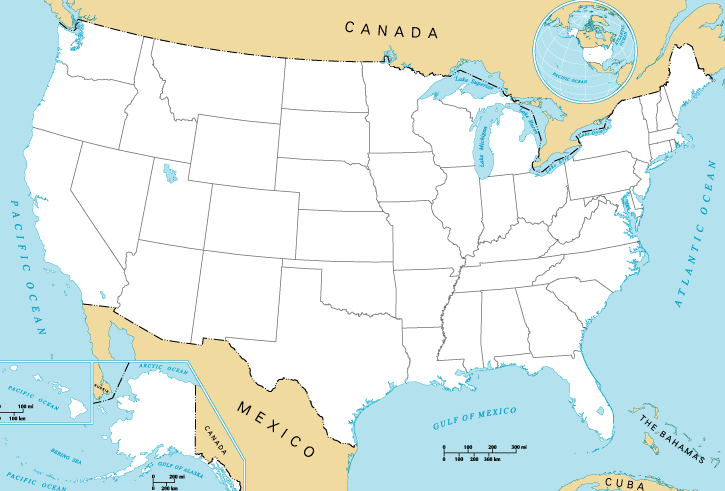
The contiguous United States, also known as the U.S. mainland, officially referred to as the conterminous United States, consists of the 48 adjoining U.S. states and the District of Columbia of the United States in central North America. The term excludes the only two non-contiguous states and the last two to be admitted to the Union, which are Alaska and Hawaii, and all other offshore insular areas, such as the U.S. territories of American Samoa, Guam, the Northern Mariana Islands, Puerto Rico, and the U.S. Virgin Islands. The colloquial term Lower 48 is also used, especially in relation to Alaska. The term The Mainland is used in Hawaii. The related but distinct term continental United States includes Alaska, which is also in North America, but separated from the 48 states by British Columbia in Canada, but excludes Hawaii and all the insular areas in the Caribbean and the Pacific.
The greatest distance on a great-circle route entirely within the contiguous U.S. is 2,802 miles (4,509 km), coast-to-coast between Florida and Washington state; the greatest north–south line is 1,650 miles (2,660 km). The contiguous United States occupies an area of 3,119,884.69 square miles (8,080,464.3 km2). Of this area, 2,959,064.44 square miles (7,663,941.7 km2) is actual land, composing 83.65 percent of the country's total land area, and is comparable in size to the area of Australia. Officially, 160,820.25 square miles (416,522.5 km2) of the contiguous United States is water area, composing 62.66 percent of the nation's total water area.
The contiguous United States, if it were a country, would be fifth on the list of countries and dependencies by area, behind Russia, Canada, China, and Brazil. However, the total area of the United States, including Alaska and Hawaii, ranks third or fourth. Brazil is 166,000 square miles (431,000 km2) larger than the contiguous United States, but smaller than the entire United States including Alaska, Hawaii and overseas territories. The 2020 U.S. census population of the area was 328,571,074, comprising 99.13 percent of the nation's total population, and a density of 111.04 inhabitants/sq mi (42.872/km2), compared to 93.844/sq mi (36.233/km2) for the nation as a whole.
While conterminous U.S. has the precise meaning of contiguous U.S. (both adjectives meaning "sharing a common boundary"), other terms commonly used to describe the 48 contiguous states have a greater degree of ambiguity.
Because Alaska is also a part of North America, the term continental United States also includes that state, so the term is qualified with the explicit inclusion of Alaska to resolve any ambiguity. On May 14, 1959, the United States Board on Geographic Names issued the following definitions based partially on the reference in the Alaska Omnibus Bill, which defined the continental United States as "the 49 States on the North American Continent and the District of Columbia..." The Board reaffirmed these definitions on May 13, 1999. However, even before Alaska became a state, it was properly included within the continental U.S. due to being an incorporated territory.
The term mainland United States is sometimes used synonymously with continental United States, but technically refers only to those parts of states connected to the landmass of North America, thereby excluding not only Hawaii and overseas insular areas, but also islands which are part of continental states but separated from the mainland, such as the Aleutian Islands (Alaska), San Juan Islands (Washington), the Channel Islands (California), the Keys (Florida), the barrier islands (Gulf and East Coast states), and Long Island (New York).
CONUS, a technical term used by the U.S. Department of Defense, General Services Administration, NOAA/National Weather Service, and others, has been defined both as the continental United States, and as the 48 contiguous states. The District of Columbia is not always specifically mentioned as being part of CONUS.
OCONUS is derived from CONUS with O for outside added, thus referring to Outside of Continental United States.
Contiguous United States
The contiguous United States, also known as the U.S. mainland, officially referred to as the conterminous United States, consists of the 48 adjoining U.S. states and the District of Columbia of the United States in central North America. The term excludes the only two non-contiguous states and the last two to be admitted to the Union, which are Alaska and Hawaii, and all other offshore insular areas, such as the U.S. territories of American Samoa, Guam, the Northern Mariana Islands, Puerto Rico, and the U.S. Virgin Islands. The colloquial term Lower 48 is also used, especially in relation to Alaska. The term The Mainland is used in Hawaii. The related but distinct term continental United States includes Alaska, which is also in North America, but separated from the 48 states by British Columbia in Canada, but excludes Hawaii and all the insular areas in the Caribbean and the Pacific.
The greatest distance on a great-circle route entirely within the contiguous U.S. is 2,802 miles (4,509 km), coast-to-coast between Florida and Washington state; the greatest north–south line is 1,650 miles (2,660 km). The contiguous United States occupies an area of 3,119,884.69 square miles (8,080,464.3 km2). Of this area, 2,959,064.44 square miles (7,663,941.7 km2) is actual land, composing 83.65 percent of the country's total land area, and is comparable in size to the area of Australia. Officially, 160,820.25 square miles (416,522.5 km2) of the contiguous United States is water area, composing 62.66 percent of the nation's total water area.
The contiguous United States, if it were a country, would be fifth on the list of countries and dependencies by area, behind Russia, Canada, China, and Brazil. However, the total area of the United States, including Alaska and Hawaii, ranks third or fourth. Brazil is 166,000 square miles (431,000 km2) larger than the contiguous United States, but smaller than the entire United States including Alaska, Hawaii and overseas territories. The 2020 U.S. census population of the area was 328,571,074, comprising 99.13 percent of the nation's total population, and a density of 111.04 inhabitants/sq mi (42.872/km2), compared to 93.844/sq mi (36.233/km2) for the nation as a whole.
While conterminous U.S. has the precise meaning of contiguous U.S. (both adjectives meaning "sharing a common boundary"), other terms commonly used to describe the 48 contiguous states have a greater degree of ambiguity.
Because Alaska is also a part of North America, the term continental United States also includes that state, so the term is qualified with the explicit inclusion of Alaska to resolve any ambiguity. On May 14, 1959, the United States Board on Geographic Names issued the following definitions based partially on the reference in the Alaska Omnibus Bill, which defined the continental United States as "the 49 States on the North American Continent and the District of Columbia..." The Board reaffirmed these definitions on May 13, 1999. However, even before Alaska became a state, it was properly included within the continental U.S. due to being an incorporated territory.
The term mainland United States is sometimes used synonymously with continental United States, but technically refers only to those parts of states connected to the landmass of North America, thereby excluding not only Hawaii and overseas insular areas, but also islands which are part of continental states but separated from the mainland, such as the Aleutian Islands (Alaska), San Juan Islands (Washington), the Channel Islands (California), the Keys (Florida), the barrier islands (Gulf and East Coast states), and Long Island (New York).
CONUS, a technical term used by the U.S. Department of Defense, General Services Administration, NOAA/National Weather Service, and others, has been defined both as the continental United States, and as the 48 contiguous states. The District of Columbia is not always specifically mentioned as being part of CONUS.
OCONUS is derived from CONUS with O for outside added, thus referring to Outside of Continental United States.
Recent media
Recent media