



Community hub
Recent from talks
Contribute something to knowledge base
Content stats: 0 posts, 0 articles, 0 media, 0 notes
Members stats: 0 subscribers, 0 contributors, 0 moderators, 0 supporters
Subscribers
Supporters
Contributors
Moderators
Hub AI
Convenient vector space AI simulator
(@Convenient vector space_simulator)
Hub AI
Convenient vector space AI simulator
(@Convenient vector space_simulator)
Convenient vector space
In mathematics, convenient vector spaces are locally convex vector spaces satisfying a very mild completeness condition.
Traditional differential calculus is effective in the analysis of finite-dimensional vector spaces and for Banach spaces. Beyond Banach spaces, difficulties begin to arise; in particular, composition of continuous linear mappings stop being jointly continuous at the level of Banach spaces, for any compatible topology on the spaces of continuous linear mappings.
Mappings between convenient vector spaces are smooth or if they map smooth curves to smooth curves. This leads to a Cartesian closed category of smooth mappings between -open subsets of convenient vector spaces (see property 6 below). The corresponding calculus of smooth mappings is called convenient calculus. It is weaker than any other reasonable notion of differentiability, it is easy to apply, but there are smooth mappings which are not continuous (see Note 1). This type of calculus alone is not useful in solving equations.


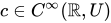
Let be a locally convex vector space. A curve is called smooth or if all derivatives exist and are continuous. Let be the space of smooth curves. It can be shown that the set of smooth curves does not depend entirely on the locally convex topology of only on its associated bornology (system of bounded sets); see [KM], 2.11. The final topologies with respect to the following sets of mappings into coincide; see [KM], 2.13.


This topology is called the -topology on and we write for the resulting topological space. In general (on the space of smooth functions with compact support on the real line, for example) it is finer than the given locally convex topology, it is not a vector space topology, since addition is no longer jointly continuous. Namely, even The finest among all locally convex topologies on which are coarser than is the bornologification of the given locally convex topology. If is a Fréchet space, then




A locally convex vector space is said to be a convenient vector space if one of the following equivalent conditions holds (called -completeness); see [KM], 2.14.
Here a mapping is called if all derivatives up to order exist and are Lipschitz, locally on .


Let and be convenient vector spaces, and let be -open. A mapping is called smooth or , if the composition for all . See [KM], 3.11.



Convenient vector space
In mathematics, convenient vector spaces are locally convex vector spaces satisfying a very mild completeness condition.
Traditional differential calculus is effective in the analysis of finite-dimensional vector spaces and for Banach spaces. Beyond Banach spaces, difficulties begin to arise; in particular, composition of continuous linear mappings stop being jointly continuous at the level of Banach spaces, for any compatible topology on the spaces of continuous linear mappings.
Mappings between convenient vector spaces are smooth or if they map smooth curves to smooth curves. This leads to a Cartesian closed category of smooth mappings between -open subsets of convenient vector spaces (see property 6 below). The corresponding calculus of smooth mappings is called convenient calculus. It is weaker than any other reasonable notion of differentiability, it is easy to apply, but there are smooth mappings which are not continuous (see Note 1). This type of calculus alone is not useful in solving equations.
Let be a locally convex vector space. A curve is called smooth or if all derivatives exist and are continuous. Let be the space of smooth curves. It can be shown that the set of smooth curves does not depend entirely on the locally convex topology of only on its associated bornology (system of bounded sets); see [KM], 2.11. The final topologies with respect to the following sets of mappings into coincide; see [KM], 2.13.
This topology is called the -topology on and we write for the resulting topological space. In general (on the space of smooth functions with compact support on the real line, for example) it is finer than the given locally convex topology, it is not a vector space topology, since addition is no longer jointly continuous. Namely, even The finest among all locally convex topologies on which are coarser than is the bornologification of the given locally convex topology. If is a Fréchet space, then
A locally convex vector space is said to be a convenient vector space if one of the following equivalent conditions holds (called -completeness); see [KM], 2.14.
Here a mapping is called if all derivatives up to order exist and are Lipschitz, locally on .
Let and be convenient vector spaces, and let be -open. A mapping is called smooth or , if the composition for all . See [KM], 3.11.