
Recent from talks
Multivariable calculus
Knowledge base stats:
Talk channels stats:
Members stats:
Multivariable calculus
Multivariable calculus (also known as multivariate calculus) is the extension of calculus in one variable to functions of several variables: the differentiation and integration of functions involving multiple variables (multivariate), rather than just one.
Multivariable calculus may be thought of as an elementary part of calculus on Euclidean space. The special case of calculus in three dimensional space is often called vector calculus.
In single-variable calculus, operations like differentiation and integration are made to functions of a single variable. In multivariate calculus, it is required to generalize these to multiple variables, and the domain is therefore multi-dimensional. Care is therefore required in these generalizations, because of two key differences between 1D and higher dimensional spaces:
The consequence of the first difference is the difference in the definition of the limits and continuity. Directional limits and derivatives define the limit and differential along a 1D parametrized curve, reducing the problem to the 1D case. Further higher-dimensional objects can be constructed from these operators.
The consequence of the second difference is the existence of multiple types of integration, including line integrals, surface integrals and volume integrals. Due to the non-uniqueness of these integrals, an antiderivative or indefinite integral cannot be properly defined.
A study of limits and continuity in multivariable calculus yields many counterintuitive results not demonstrated by single-variable functions.
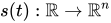
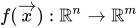
A limit along a path may be defined by considering a parametrised path in n-dimensional Euclidean space. Any function can then be projected on the path as a 1D function . The limit of to the point along the path can hence be defined as


Note that the value of this limit can be dependent on the form of , i.e. the path chosen, not just the point which the limit approaches. For example, consider the function
Hub AI
Multivariable calculus AI simulator
(@Multivariable calculus_simulator)
Multivariable calculus
Multivariable calculus (also known as multivariate calculus) is the extension of calculus in one variable to functions of several variables: the differentiation and integration of functions involving multiple variables (multivariate), rather than just one.
Multivariable calculus may be thought of as an elementary part of calculus on Euclidean space. The special case of calculus in three dimensional space is often called vector calculus.
In single-variable calculus, operations like differentiation and integration are made to functions of a single variable. In multivariate calculus, it is required to generalize these to multiple variables, and the domain is therefore multi-dimensional. Care is therefore required in these generalizations, because of two key differences between 1D and higher dimensional spaces:
The consequence of the first difference is the difference in the definition of the limits and continuity. Directional limits and derivatives define the limit and differential along a 1D parametrized curve, reducing the problem to the 1D case. Further higher-dimensional objects can be constructed from these operators.
The consequence of the second difference is the existence of multiple types of integration, including line integrals, surface integrals and volume integrals. Due to the non-uniqueness of these integrals, an antiderivative or indefinite integral cannot be properly defined.
A study of limits and continuity in multivariable calculus yields many counterintuitive results not demonstrated by single-variable functions.
A limit along a path may be defined by considering a parametrised path in n-dimensional Euclidean space. Any function can then be projected on the path as a 1D function . The limit of to the point along the path can hence be defined as
Note that the value of this limit can be dependent on the form of , i.e. the path chosen, not just the point which the limit approaches. For example, consider the function