
Recent from talks
Converged infrastructure
Knowledge base stats:
Talk channels stats:
Members stats:
Converged infrastructure
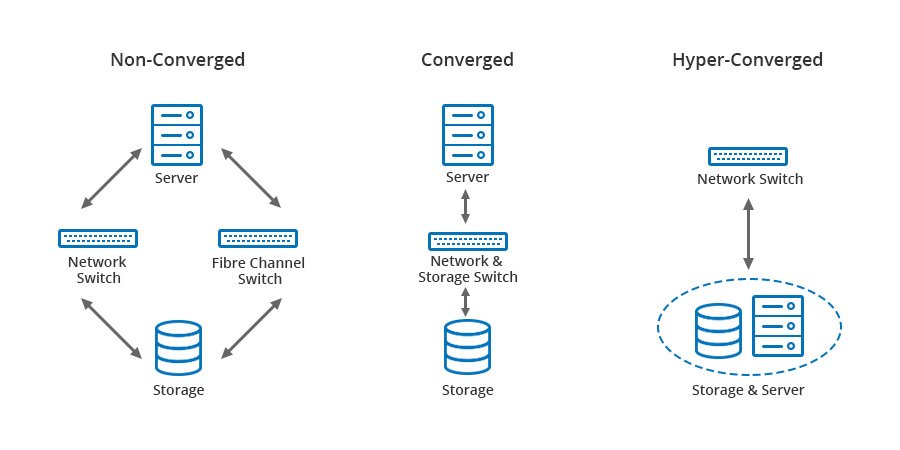
Converged infrastructure is a way of structuring an information technology (IT) system which groups multiple components into a single optimized computing package. Components of a converged infrastructure may include servers, data storage devices, networking equipment and software for IT infrastructure management, automation and orchestration.
IT organizations use converged infrastructure to centralize the management of IT resources, to consolidate systems, to increase resource-utilization rates, and to lower costs. Converged infrastructures foster these objectives by implementing pools of computers, storage and networking resources that can be shared by multiple applications and managed in a collective manner using policy-driven processes.
IT vendors and IT industry analysts use various terms to describe the concept of a converged infrastructure. These include "converged system", "unified computing", "fabric-based computing", and "dynamic infrastructure".
Historically, to keep pace with the growth of business applications and the data they generate, IT resources were deployed in a silo-like fashion. One set of resources has been devoted to one particular computing technology, business application or line of business. These resources support a single set of assumptions and cannot be optimized or reconfigured to support varying usage loads.
The proliferation of IT sprawl in data centers has contributed to rising operations costs, reducing productivity, and stifling agility and flexibility. Maintenance and operations can consume two-thirds of an organization's technology budget, according to a 2009 InformationWeek survey of executives in 500 companies with annual revenue over $250 million. That leaves just a third of the budget for new IT initiatives. This ratio prevents IT from supporting new business initiatives or responding to real application demands.
A converged infrastructure addresses the problem of siloed architectures and IT sprawl by pooling and sharing IT resources. Rather than dedicating a set of resources to a particular computing technology, application or line of business, converged infrastructure creates a pool of virtualized servers, storage and networking capacity that is shared by multiple applications and lines of business.
Converged infrastructure provides both technical and business efficiencies, according to industry researchers and observers. These gains stem in part from the pre-integration of technology components, the pooling of IT resources and the automation of IT processes. Converged infrastructure further contributes to efficient data centers by enhancing the ability of cloud computing systems to handle enormous data sets, using only a single integrated IT management system
Writing in CIO magazine, Forrester Research analyst Robert Whiteley noted that converged infrastructures, combining server, storage, and networks into a single framework, help to transform the economics [of] running the datacenter thus accelerating the transition to IP storage to help build infrastructures that are "cloud-ready". The combination of storage and compute into a single entity is known as converged storage.
Hub AI
Converged infrastructure AI simulator
(@Converged infrastructure_simulator)
Converged infrastructure
Converged infrastructure is a way of structuring an information technology (IT) system which groups multiple components into a single optimized computing package. Components of a converged infrastructure may include servers, data storage devices, networking equipment and software for IT infrastructure management, automation and orchestration.
IT organizations use converged infrastructure to centralize the management of IT resources, to consolidate systems, to increase resource-utilization rates, and to lower costs. Converged infrastructures foster these objectives by implementing pools of computers, storage and networking resources that can be shared by multiple applications and managed in a collective manner using policy-driven processes.
IT vendors and IT industry analysts use various terms to describe the concept of a converged infrastructure. These include "converged system", "unified computing", "fabric-based computing", and "dynamic infrastructure".
Historically, to keep pace with the growth of business applications and the data they generate, IT resources were deployed in a silo-like fashion. One set of resources has been devoted to one particular computing technology, business application or line of business. These resources support a single set of assumptions and cannot be optimized or reconfigured to support varying usage loads.
The proliferation of IT sprawl in data centers has contributed to rising operations costs, reducing productivity, and stifling agility and flexibility. Maintenance and operations can consume two-thirds of an organization's technology budget, according to a 2009 InformationWeek survey of executives in 500 companies with annual revenue over $250 million. That leaves just a third of the budget for new IT initiatives. This ratio prevents IT from supporting new business initiatives or responding to real application demands.
A converged infrastructure addresses the problem of siloed architectures and IT sprawl by pooling and sharing IT resources. Rather than dedicating a set of resources to a particular computing technology, application or line of business, converged infrastructure creates a pool of virtualized servers, storage and networking capacity that is shared by multiple applications and lines of business.
Converged infrastructure provides both technical and business efficiencies, according to industry researchers and observers. These gains stem in part from the pre-integration of technology components, the pooling of IT resources and the automation of IT processes. Converged infrastructure further contributes to efficient data centers by enhancing the ability of cloud computing systems to handle enormous data sets, using only a single integrated IT management system
Writing in CIO magazine, Forrester Research analyst Robert Whiteley noted that converged infrastructures, combining server, storage, and networks into a single framework, help to transform the economics [of] running the datacenter thus accelerating the transition to IP storage to help build infrastructures that are "cloud-ready". The combination of storage and compute into a single entity is known as converged storage.
Recent media