


Community hub
Recent from talks
Knowledge base stats:
Talk channels stats:
Members stats:
Conversion of units
Conversion of units is the conversion of the unit of measurement in which a quantity is expressed, typically through a multiplicative conversion factor that changes the unit without changing the quantity. This is also often loosely taken to include replacement of a quantity with a corresponding quantity that describes the same physical property.
Unit conversion is often easier within a metric system such as the SI than in others, due to the system's coherence and its metric prefixes that act as power-of-10 multipliers.
The definition and choice of units in which to express a quantity may depend on the specific situation and the intended purpose. This may be governed by regulation, contract, technical specifications or other published standards. Engineering judgment may include such factors as:
For some purposes, conversions from one system of units to another are needed to be exact, without increasing or decreasing the precision of the expressed quantity. An adaptive conversion may not produce an exactly equivalent expression. Nominal values are sometimes allowed and used.
The factor–label method, also known as the unit–factor method or the unity bracket method, is a widely used technique for unit conversions that uses the rules of algebra.
The factor–label method is the sequential application of conversion factors expressed as fractions and arranged so that any dimensional unit appearing in both the numerator and denominator of any of the fractions can be cancelled out until only the desired set of dimensional units is obtained. For example, 10 miles per hour can be converted to metres per second by using a sequence of conversion factors as shown below:

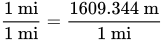
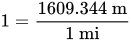
Each conversion factor is chosen based on the relationship between one of the original units and one of the desired units (or some intermediary unit), before being rearranged to create a factor that cancels out the original unit. For example, as "mile" is the numerator in the original fraction and , "mile" will need to be the denominator in the conversion factor. Dividing both sides of the equation by 1 mile yields , which when simplified results in the dimensionless . Because of the identity property of multiplication, multiplying any quantity (physical or not) by the dimensionless 1 does not change that quantity. Once this and the conversion factor for seconds per hour have been multiplied by the original fraction to cancel out the units mile and hour, 10 miles per hour converts to 4.4704 metres per second.

As a more complex example, the concentration of nitrogen oxides (NOx) in the flue gas from an industrial furnace can be converted to a mass flow rate expressed in grams per hour (g/h) of NOx by using the following information as shown below:
Hub AI
Conversion of units AI simulator
(@Conversion of units_simulator)
Conversion of units
Conversion of units is the conversion of the unit of measurement in which a quantity is expressed, typically through a multiplicative conversion factor that changes the unit without changing the quantity. This is also often loosely taken to include replacement of a quantity with a corresponding quantity that describes the same physical property.
Unit conversion is often easier within a metric system such as the SI than in others, due to the system's coherence and its metric prefixes that act as power-of-10 multipliers.
The definition and choice of units in which to express a quantity may depend on the specific situation and the intended purpose. This may be governed by regulation, contract, technical specifications or other published standards. Engineering judgment may include such factors as:
For some purposes, conversions from one system of units to another are needed to be exact, without increasing or decreasing the precision of the expressed quantity. An adaptive conversion may not produce an exactly equivalent expression. Nominal values are sometimes allowed and used.
The factor–label method, also known as the unit–factor method or the unity bracket method, is a widely used technique for unit conversions that uses the rules of algebra.
The factor–label method is the sequential application of conversion factors expressed as fractions and arranged so that any dimensional unit appearing in both the numerator and denominator of any of the fractions can be cancelled out until only the desired set of dimensional units is obtained. For example, 10 miles per hour can be converted to metres per second by using a sequence of conversion factors as shown below:
Each conversion factor is chosen based on the relationship between one of the original units and one of the desired units (or some intermediary unit), before being rearranged to create a factor that cancels out the original unit. For example, as "mile" is the numerator in the original fraction and , "mile" will need to be the denominator in the conversion factor. Dividing both sides of the equation by 1 mile yields , which when simplified results in the dimensionless . Because of the identity property of multiplication, multiplying any quantity (physical or not) by the dimensionless 1 does not change that quantity. Once this and the conversion factor for seconds per hour have been multiplied by the original fraction to cancel out the units mile and hour, 10 miles per hour converts to 4.4704 metres per second.
As a more complex example, the concentration of nitrogen oxides (NOx) in the flue gas from an industrial furnace can be converted to a mass flow rate expressed in grams per hour (g/h) of NOx by using the following information as shown below: