
Recent from talks
Conway polyhedron notation
Knowledge base stats:
Talk channels stats:
Members stats:
Conway polyhedron notation
In geometry and topology, Conway polyhedron notation, invented by John Horton Conway and promoted by George W. Hart, is used to describe polyhedra based on a seed polyhedron modified by various prefix operations.
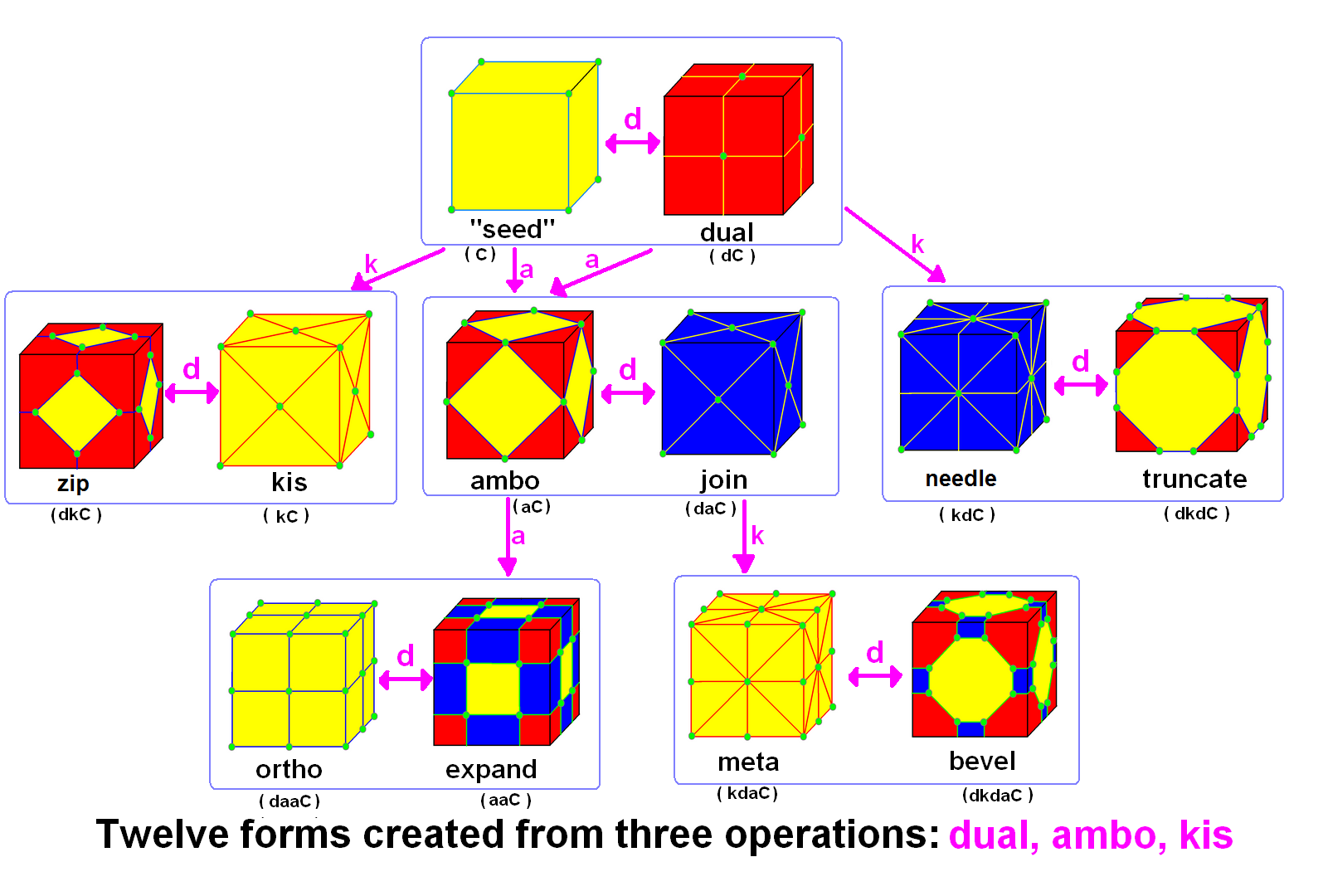
Conway and Hart extended the idea of using operators, like truncation as defined by Kepler, to build related polyhedra of the same symmetry. For example, tC represents a truncated cube, and taC, parsed as t(aC), is (topologically) a truncated cuboctahedron. The simplest operator dual swaps vertex and face elements; e.g., a dual cube is an octahedron: dC = O. Applied in a series, these operators allow many higher order polyhedra to be generated. Conway defined the operators a (ambo), b (bevel), d (dual), e (expand), g (gyro), j (join), k (kis), m (meta), o (ortho), s (snub), and t (truncate), while Hart added r (reflect) and p (propellor). Later implementations named further operators, sometimes referred to as "extended" operators. Conway's basic operations are sufficient to generate the Archimedean and Catalan solids from the Platonic solids. Some basic operations can be made as composites of others: for instance, ambo applied twice is the expand operation (aa = e), while a truncation after ambo produces bevel (ta = b).
Polyhedra can be studied topologically, in terms of how their vertices, edges, and faces connect together, or geometrically, in terms of the placement of those elements in space. Different implementations of these operators may create polyhedra that are geometrically different but topologically equivalent. These topologically equivalent polyhedra can be thought of as one of many embeddings of a polyhedral graph on the sphere. Unless otherwise specified, in this article (and in the literature on Conway operators in general) topology is the primary concern. Polyhedra with genus 0 (i.e. topologically equivalent to a sphere) are often put into canonical form to avoid ambiguity.
In Conway's notation, operations on polyhedra are applied like functions, from right to left. For example, a cuboctahedron is an ambo cube, i.e. , and a truncated cuboctahedron is . Repeated application of an operator can be denoted with an exponent: j2 = o. In general, Conway operators are not commutative.


Individual operators can be visualized in terms of fundamental domains (or chambers), as below. Each right triangle is a fundamental domain. Each white chamber is a rotated version of the others, and so is each colored chamber. For achiral operators, the colored chambers are a reflection of the white chambers, and all are transitive. In group terms, achiral operators correspond to dihedral groups Dn where n is the number of sides of a face, while chiral operators correspond to cyclic groups Cn lacking the reflective symmetry of the dihedral groups. Achiral and chiral operators are also called local symmetry-preserving operations (LSP) and local operations that preserve orientation-preserving symmetries (LOPSP), respectively. LSPs should be understood as local operations that preserve symmetry, not operations that preserve local symmetry. Again, these are symmetries in a topological sense, not a geometric sense: the exact angles and edge lengths may differ.
Hart introduced the reflection operator r, that gives the mirror image of the polyhedron. This is not strictly a LOPSP, since it does not preserve orientation: it reverses it, by exchanging white and red chambers. r has no effect on achiral polyhedra aside from orientation, and rr = S returns the original polyhedron. An overline can be used to indicate the other chiral form of an operator: s = rsr.
An operation is irreducible if it cannot be expressed as a composition of operators aside from d and r. The majority of Conway's original operators are irreducible: the exceptions are e, b, o, and m.
The relationship between the number of vertices, edges, and faces of the seed and the polyhedron created by the operations listed in this article can be expressed as a matrix . When x is the operator, are the vertices, edges, and faces of the seed (respectively), and are the vertices, edges, and faces of the result, then


Hub AI
Conway polyhedron notation AI simulator
(@Conway polyhedron notation_simulator)
Conway polyhedron notation
In geometry and topology, Conway polyhedron notation, invented by John Horton Conway and promoted by George W. Hart, is used to describe polyhedra based on a seed polyhedron modified by various prefix operations.
Conway and Hart extended the idea of using operators, like truncation as defined by Kepler, to build related polyhedra of the same symmetry. For example, tC represents a truncated cube, and taC, parsed as t(aC), is (topologically) a truncated cuboctahedron. The simplest operator dual swaps vertex and face elements; e.g., a dual cube is an octahedron: dC = O. Applied in a series, these operators allow many higher order polyhedra to be generated. Conway defined the operators a (ambo), b (bevel), d (dual), e (expand), g (gyro), j (join), k (kis), m (meta), o (ortho), s (snub), and t (truncate), while Hart added r (reflect) and p (propellor). Later implementations named further operators, sometimes referred to as "extended" operators. Conway's basic operations are sufficient to generate the Archimedean and Catalan solids from the Platonic solids. Some basic operations can be made as composites of others: for instance, ambo applied twice is the expand operation (aa = e), while a truncation after ambo produces bevel (ta = b).
Polyhedra can be studied topologically, in terms of how their vertices, edges, and faces connect together, or geometrically, in terms of the placement of those elements in space. Different implementations of these operators may create polyhedra that are geometrically different but topologically equivalent. These topologically equivalent polyhedra can be thought of as one of many embeddings of a polyhedral graph on the sphere. Unless otherwise specified, in this article (and in the literature on Conway operators in general) topology is the primary concern. Polyhedra with genus 0 (i.e. topologically equivalent to a sphere) are often put into canonical form to avoid ambiguity.
In Conway's notation, operations on polyhedra are applied like functions, from right to left. For example, a cuboctahedron is an ambo cube, i.e. , and a truncated cuboctahedron is . Repeated application of an operator can be denoted with an exponent: j2 = o. In general, Conway operators are not commutative.
Individual operators can be visualized in terms of fundamental domains (or chambers), as below. Each right triangle is a fundamental domain. Each white chamber is a rotated version of the others, and so is each colored chamber. For achiral operators, the colored chambers are a reflection of the white chambers, and all are transitive. In group terms, achiral operators correspond to dihedral groups Dn where n is the number of sides of a face, while chiral operators correspond to cyclic groups Cn lacking the reflective symmetry of the dihedral groups. Achiral and chiral operators are also called local symmetry-preserving operations (LSP) and local operations that preserve orientation-preserving symmetries (LOPSP), respectively. LSPs should be understood as local operations that preserve symmetry, not operations that preserve local symmetry. Again, these are symmetries in a topological sense, not a geometric sense: the exact angles and edge lengths may differ.
Hart introduced the reflection operator r, that gives the mirror image of the polyhedron. This is not strictly a LOPSP, since it does not preserve orientation: it reverses it, by exchanging white and red chambers. r has no effect on achiral polyhedra aside from orientation, and rr = S returns the original polyhedron. An overline can be used to indicate the other chiral form of an operator: s = rsr.
An operation is irreducible if it cannot be expressed as a composition of operators aside from d and r. The majority of Conway's original operators are irreducible: the exceptions are e, b, o, and m.
The relationship between the number of vertices, edges, and faces of the seed and the polyhedron created by the operations listed in this article can be expressed as a matrix . When x is the operator, are the vertices, edges, and faces of the seed (respectively), and are the vertices, edges, and faces of the result, then
Recent media