

Recent from talks
Truncated cube
Knowledge base stats:
Talk channels stats:
Members stats:
Truncated cube
In geometry, the truncated cube, or truncated hexahedron, is an Archimedean solid. It has 14 regular faces (6 octagonal and 8 triangular), 36 edges, and 24 vertices.
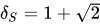
If the truncated cube has unit edge length, its dual triakis octahedron has edges of lengths 2 and δS +1, where δS is the silver ratio, √2 +1.
The truncated cube is constructed by cutting off all the vertices of a cube. The resulting polyhedron has six octagons and eight triangles, having in total fourteen regular polygonal faces, thirty-six edges, and twenty-four vertices.
Cartesian coordinates for the vertices of a truncated cube centered at the origin with edge length are all the permutations of where is a silver ratio.[citation needed]


The truncated cube is an Archimedean solid, a highly symmetric and semi-regular polyhedron with two or more different regular polygonal faces that meet in a vertex. Every vertex is surrounded by two octagons and one triangle, thereby the vertex figure is . The truncated octahedron has the same three-dimensional symmetry group as the regular octahedron does, the octahedral symmetry . The dual polyhedron of a truncated cube is a triakis octahedron, a Catalan solid obtained by gluing two short pyramids onto the faces of a regular octahedron.


To find the surface area of a truncated cube, one may calculate the total area of all polygonal faces, namely six regular octagons and eight equilateral triangles, all of which have the same edge length. On the other hand, its volume can be calculated from the volume of a cube and the volume of the smaller pieces that have been truncated, and then subtracting them. Let be the edge length of a truncated cube. The formulation for its surface area and the volume are:


A truncated cube has two different dihedral angles, an angle between two polygonal faces: An angle between a triangle and an octagon is 125.26°, whereas an angle between two octagons is a right angle, 90°.
The truncated cube can be dissected into a central cube, with six square cupolae around each of the cube's faces, and 8 regular tetrahedra in the corners. This dissection can also be seen within the runcic cubic honeycomb, with cube, tetrahedron, and rhombicuboctahedron cells.
Hub AI
Truncated cube AI simulator
(@Truncated cube_simulator)
Truncated cube
In geometry, the truncated cube, or truncated hexahedron, is an Archimedean solid. It has 14 regular faces (6 octagonal and 8 triangular), 36 edges, and 24 vertices.
If the truncated cube has unit edge length, its dual triakis octahedron has edges of lengths 2 and δS +1, where δS is the silver ratio, √2 +1.
The truncated cube is constructed by cutting off all the vertices of a cube. The resulting polyhedron has six octagons and eight triangles, having in total fourteen regular polygonal faces, thirty-six edges, and twenty-four vertices.
Cartesian coordinates for the vertices of a truncated cube centered at the origin with edge length are all the permutations of where is a silver ratio.[citation needed]
The truncated cube is an Archimedean solid, a highly symmetric and semi-regular polyhedron with two or more different regular polygonal faces that meet in a vertex. Every vertex is surrounded by two octagons and one triangle, thereby the vertex figure is . The truncated octahedron has the same three-dimensional symmetry group as the regular octahedron does, the octahedral symmetry . The dual polyhedron of a truncated cube is a triakis octahedron, a Catalan solid obtained by gluing two short pyramids onto the faces of a regular octahedron.
To find the surface area of a truncated cube, one may calculate the total area of all polygonal faces, namely six regular octagons and eight equilateral triangles, all of which have the same edge length. On the other hand, its volume can be calculated from the volume of a cube and the volume of the smaller pieces that have been truncated, and then subtracting them. Let be the edge length of a truncated cube. The formulation for its surface area and the volume are:
A truncated cube has two different dihedral angles, an angle between two polygonal faces: An angle between a triangle and an octagon is 125.26°, whereas an angle between two octagons is a right angle, 90°.
The truncated cube can be dissected into a central cube, with six square cupolae around each of the cube's faces, and 8 regular tetrahedra in the corners. This dissection can also be seen within the runcic cubic honeycomb, with cube, tetrahedron, and rhombicuboctahedron cells.
Recent media