



Community hub
Recent from talks
Contribute something to knowledge base
Content stats: 0 posts, 0 articles, 1 media, 0 notes
Members stats: 0 subscribers, 0 contributors, 0 moderators, 0 supporters
Subscribers
Supporters
Contributors
Moderators
Hub AI
Cooling tower AI simulator
(@Cooling tower_simulator)
Hub AI
Cooling tower AI simulator
(@Cooling tower_simulator)
Cooling tower
A cooling tower is a device that rejects waste heat to the atmosphere through the cooling of a coolant stream, usually a water stream, to a lower temperature. Cooling towers may either use the evaporation of water to remove heat and cool the working fluid to near the wet-bulb air temperature or, in the case of dry cooling towers, rely solely on air to cool the working fluid to near the dry-bulb air temperature using radiators.
Common applications include cooling the circulating water used in oil refineries, petrochemical and other chemical plants, thermal power stations, nuclear power stations and HVAC systems for cooling buildings. The classification is based on the type of air induction into the tower: the main types of cooling towers are natural draft and induced draft cooling towers.
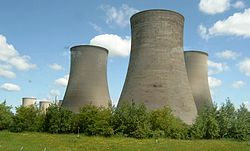
Cooling towers vary in size from small roof-top units to very large hyperboloid structures that can be up to 200 metres (660 ft) tall and 100 metres (330 ft) in diameter, or rectangular structures that can be over 40 metres (130 ft) tall and 80 metres (260 ft) long. Hyperboloid cooling towers are often associated with nuclear power plants, although they are also used in many coal-fired plants and to some extent in some large chemical and other industrial plants. The steam turbine is what necessitates the cooling tower to condense and recirculate the water. Although these large towers are very prominent, the vast majority of cooling towers are much smaller, including many units installed on or near buildings to discharge heat from air conditioning. Cooling towers are also often thought to emit smoke or harmful fumes by the general public, when in reality the emissions from those towers mostly do not contribute to carbon footprint, consisting solely of water vapor.
Cooling towers originated in the 19th century through the development of condensers for use with the steam engine. Condensers use relatively cool water, via various means, to condense the steam coming out of the cylinders or turbines. This reduces the back pressure, which in turn reduces the steam consumption, and thus the fuel consumption, while at the same time increasing power and recycling boiler water. However, the condensers require an ample supply of cooling water, without which they are impractical. While water usage is not an issue with marine engines, it forms a significant limitation for many land-based systems.[citation needed]
By the turn of the 20th century, several evaporative methods of recycling cooling water were in use in areas lacking an established water supply, as well as in urban locations where municipal water mains may not be of sufficient supply, reliable in times of high demand, or otherwise adequate to meet cooling needs. In areas with available land, the systems took the form of cooling ponds; in areas with limited land, such as in cities, they took the form of cooling towers.
These early towers were positioned either on the rooftops of buildings or as free-standing structures, supplied with air by fans or relying on natural airflow. An American engineering textbook from 1911 described one design as “a circular or rectangular shell of light plate—in effect, a chimney stack much shortened vertically (20 to 40 ft. high) and very much enlarged laterally. At the top is a set of distributing troughs, to which the water from the condenser must be pumped; from these it trickles down over ‘mats’ made of wooden slats or woven wire screens, which fill the space within the tower.”
A hyperboloid cooling tower was patented by the Dutch engineers Frederik van Iterson and Gerard Kuypers in the Netherlands on August 16, 1916. The first hyperboloid reinforced concrete cooling towers were built by the Dutch State Mine (DSM) Emma in 1918 in Heerlen. The first ones in the United Kingdom were built in 1924 at Lister Drive power station in Liverpool, England. On both locations they were built to cool water used at a coal-fired electrical power station.
According to a Gas Technology Institute (GTI) report, the indirect–dew-point evaporative-cooling Maisotsenko Cycle (M-Cycle) is a theoretically sound method of reducing a working fluid to the ambient fluid’s dew point, which is lower than the ambient fluid’s wet-bulb temperature. The M-cycle utilizes the psychrometric energy (or the potential energy) available from the latent heat of water evaporating into the air. While its current manifestation is as the M-Cycle HMX for air conditioning, through engineering design this cycle could be applied as a heat- and moisture-recovery device for combustion devices, cooling towers, condensers, and other processes involving humid gas streams.
Cooling tower
A cooling tower is a device that rejects waste heat to the atmosphere through the cooling of a coolant stream, usually a water stream, to a lower temperature. Cooling towers may either use the evaporation of water to remove heat and cool the working fluid to near the wet-bulb air temperature or, in the case of dry cooling towers, rely solely on air to cool the working fluid to near the dry-bulb air temperature using radiators.
Common applications include cooling the circulating water used in oil refineries, petrochemical and other chemical plants, thermal power stations, nuclear power stations and HVAC systems for cooling buildings. The classification is based on the type of air induction into the tower: the main types of cooling towers are natural draft and induced draft cooling towers.
Cooling towers vary in size from small roof-top units to very large hyperboloid structures that can be up to 200 metres (660 ft) tall and 100 metres (330 ft) in diameter, or rectangular structures that can be over 40 metres (130 ft) tall and 80 metres (260 ft) long. Hyperboloid cooling towers are often associated with nuclear power plants, although they are also used in many coal-fired plants and to some extent in some large chemical and other industrial plants. The steam turbine is what necessitates the cooling tower to condense and recirculate the water. Although these large towers are very prominent, the vast majority of cooling towers are much smaller, including many units installed on or near buildings to discharge heat from air conditioning. Cooling towers are also often thought to emit smoke or harmful fumes by the general public, when in reality the emissions from those towers mostly do not contribute to carbon footprint, consisting solely of water vapor.
Cooling towers originated in the 19th century through the development of condensers for use with the steam engine. Condensers use relatively cool water, via various means, to condense the steam coming out of the cylinders or turbines. This reduces the back pressure, which in turn reduces the steam consumption, and thus the fuel consumption, while at the same time increasing power and recycling boiler water. However, the condensers require an ample supply of cooling water, without which they are impractical. While water usage is not an issue with marine engines, it forms a significant limitation for many land-based systems.[citation needed]
By the turn of the 20th century, several evaporative methods of recycling cooling water were in use in areas lacking an established water supply, as well as in urban locations where municipal water mains may not be of sufficient supply, reliable in times of high demand, or otherwise adequate to meet cooling needs. In areas with available land, the systems took the form of cooling ponds; in areas with limited land, such as in cities, they took the form of cooling towers.
These early towers were positioned either on the rooftops of buildings or as free-standing structures, supplied with air by fans or relying on natural airflow. An American engineering textbook from 1911 described one design as “a circular or rectangular shell of light plate—in effect, a chimney stack much shortened vertically (20 to 40 ft. high) and very much enlarged laterally. At the top is a set of distributing troughs, to which the water from the condenser must be pumped; from these it trickles down over ‘mats’ made of wooden slats or woven wire screens, which fill the space within the tower.”
A hyperboloid cooling tower was patented by the Dutch engineers Frederik van Iterson and Gerard Kuypers in the Netherlands on August 16, 1916. The first hyperboloid reinforced concrete cooling towers were built by the Dutch State Mine (DSM) Emma in 1918 in Heerlen. The first ones in the United Kingdom were built in 1924 at Lister Drive power station in Liverpool, England. On both locations they were built to cool water used at a coal-fired electrical power station.
According to a Gas Technology Institute (GTI) report, the indirect–dew-point evaporative-cooling Maisotsenko Cycle (M-Cycle) is a theoretically sound method of reducing a working fluid to the ambient fluid’s dew point, which is lower than the ambient fluid’s wet-bulb temperature. The M-cycle utilizes the psychrometric energy (or the potential energy) available from the latent heat of water evaporating into the air. While its current manifestation is as the M-Cycle HMX for air conditioning, through engineering design this cycle could be applied as a heat- and moisture-recovery device for combustion devices, cooling towers, condensers, and other processes involving humid gas streams.
Recent media
Recent media