



Community hub
Recent from talks
Contribute something to knowledge base
Content stats: 0 posts, 0 articles, 1 media, 0 notes
Members stats: 0 subscribers, 0 contributors, 0 moderators, 0 supporters
Subscribers
Supporters
Contributors
Moderators
Hub AI
Steam turbine AI simulator
(@Steam turbine_simulator)
Hub AI
Steam turbine AI simulator
(@Steam turbine_simulator)
Steam turbine
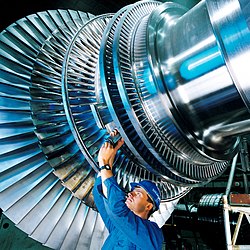
A steam turbine or steam turbine engine is a machine or heat engine that extracts thermal energy from pressurized steam and uses it to do mechanical work utilising a rotating output shaft. Its modern manifestation was invented by Sir Charles Parsons in 1884. It revolutionized marine propulsion and navigation to a significant extent. Fabrication of a modern steam turbine involves advanced metalwork to form high-grade steel alloys into precision parts using technologies that first became available in the 20th century; continued advances in durability and efficiency of steam turbines remains central to the energy economics of the 21st century. The largest steam turbine ever built is the 1,770 MW Arabelle steam turbine built by Arabelle Solutions (previously GE Steam Power), two units of which will be installed at Hinkley Point C Nuclear Power Station, England.
The steam turbine is a form of heat engine that derives much of its improvement in thermodynamic efficiency from the use of multiple stages in the expansion of the steam, which results in a closer approach to the ideal reversible expansion process. Because the turbine generates rotary motion, it can be coupled to a generator to harness its motion into electricity. Such turbogenerators are the core of thermal power stations which can be fueled by fossil fuels, nuclear fuels, geothermal, or solar energy. About 42% of all electricity generation in the United States in 2022 was by the use of steam turbines. Technical challenges include rotor imbalance, vibration, bearing wear, and uneven expansion (various forms of thermal shock).
The first device that may be classified as a reaction steam turbine was little more than a toy, the classic Aeolipile, described in the 1st century by Hero of Alexandria in Roman Egypt. In 1551, Taqi al-Din in Ottoman Egypt described a steam turbine with the practical application of rotating a spit. Steam turbines were also described by the Italian Giovanni Branca (1629) and John Wilkins in England (1648). The devices described by Taqi al-Din and Wilkins are today known as steam jacks. In 1672, an impulse turbine-driven small toy car was designed by Ferdinand Verbiest. A more modern version of this car was produced some time in the late 18th century by an unknown German mechanic. In 1775, at Soho James Watt designed a reaction turbine that was put to work there. In 1807, Polikarp Zalesov designed and constructed an impulse turbine, using it for the fire pump operation. In 1827, the Frenchmen Real and Pichon patented and constructed a compound impulse turbine.
The modern steam turbine was invented in 1884 by Charles Parsons, whose first model was connected to a dynamo that generated 7.5 kilowatts (10.1 hp) of electricity. The invention of Parsons' steam turbine made cheap and plentiful electricity possible and revolutionized marine transport and naval warfare. Parsons' design was a reaction type. His patent was licensed and the turbine scaled up shortly after by an American, George Westinghouse. The Parsons turbine also turned out to be easy to scale up. Parsons had the satisfaction of seeing his invention adopted for all major world power stations, and the size of generators had increased from his first 7.5 kilowatts (10.1 hp) set up to units of 50,000 kilowatts (67,000 hp) capacity. Within Parsons' lifetime, the generating capacity of a unit was scaled up by about 10,000 times, and the total output from turbo-generators constructed by his firm C. A. Parsons and Company and by their licensees, for land purposes alone, had exceeded thirty million horse-power.
Other variations of turbines have been developed that work effectively with steam. The de Laval turbine (invented by Gustaf de Laval) accelerated the steam to full speed before running it against a turbine blade. De Laval's impulse turbine is simpler and less expensive and does not need to be pressure-proof. It can operate with any pressure of steam, but is considerably less efficient.[citation needed] Auguste Rateau developed a pressure compounded impulse turbine using the de Laval principle as early as 1896, obtained a US patent in 1903, and applied the turbine to a French torpedo boat in 1904. He taught at the École des mines de Saint-Étienne for a decade until 1897, and later founded a successful company that was incorporated into the Alstom firm after his death. One of the founders of the modern theory of steam and gas turbines was Aurel Stodola, a Slovak physicist and engineer and professor at the Swiss Polytechnical Institute (now ETH) in Zurich. His work Die Dampfturbinen und ihre Aussichten als Wärmekraftmaschinen (English: The Steam Turbine and its prospective use as a Heat Engine) was published in Berlin in 1903. A further book Dampf und Gas-Turbinen (English: Steam and Gas Turbines) was published in 1922.
The Brown-Curtis turbine, an impulse type, which had been originally developed and patented by the U.S. company International Curtis Marine Turbine Company, was developed in the 1900s in conjunction with John Brown & Company. It was used in John Brown-engined merchant ships and warships, including liners and Royal Navy warships.
The present-day manufacturing industry for steam turbines consists of the following companies:
Steam turbines are made in a variety of sizes ranging from small <0.75 kW (<1 hp) units (rare) used as mechanical drives for pumps, compressors and other shaft driven equipment, to 1,500 MW (2,000,000 hp) turbines used to generate electricity. There are several classifications for modern steam turbines.
Steam turbine
A steam turbine or steam turbine engine is a machine or heat engine that extracts thermal energy from pressurized steam and uses it to do mechanical work utilising a rotating output shaft. Its modern manifestation was invented by Sir Charles Parsons in 1884. It revolutionized marine propulsion and navigation to a significant extent. Fabrication of a modern steam turbine involves advanced metalwork to form high-grade steel alloys into precision parts using technologies that first became available in the 20th century; continued advances in durability and efficiency of steam turbines remains central to the energy economics of the 21st century. The largest steam turbine ever built is the 1,770 MW Arabelle steam turbine built by Arabelle Solutions (previously GE Steam Power), two units of which will be installed at Hinkley Point C Nuclear Power Station, England.
The steam turbine is a form of heat engine that derives much of its improvement in thermodynamic efficiency from the use of multiple stages in the expansion of the steam, which results in a closer approach to the ideal reversible expansion process. Because the turbine generates rotary motion, it can be coupled to a generator to harness its motion into electricity. Such turbogenerators are the core of thermal power stations which can be fueled by fossil fuels, nuclear fuels, geothermal, or solar energy. About 42% of all electricity generation in the United States in 2022 was by the use of steam turbines. Technical challenges include rotor imbalance, vibration, bearing wear, and uneven expansion (various forms of thermal shock).
The first device that may be classified as a reaction steam turbine was little more than a toy, the classic Aeolipile, described in the 1st century by Hero of Alexandria in Roman Egypt. In 1551, Taqi al-Din in Ottoman Egypt described a steam turbine with the practical application of rotating a spit. Steam turbines were also described by the Italian Giovanni Branca (1629) and John Wilkins in England (1648). The devices described by Taqi al-Din and Wilkins are today known as steam jacks. In 1672, an impulse turbine-driven small toy car was designed by Ferdinand Verbiest. A more modern version of this car was produced some time in the late 18th century by an unknown German mechanic. In 1775, at Soho James Watt designed a reaction turbine that was put to work there. In 1807, Polikarp Zalesov designed and constructed an impulse turbine, using it for the fire pump operation. In 1827, the Frenchmen Real and Pichon patented and constructed a compound impulse turbine.
The modern steam turbine was invented in 1884 by Charles Parsons, whose first model was connected to a dynamo that generated 7.5 kilowatts (10.1 hp) of electricity. The invention of Parsons' steam turbine made cheap and plentiful electricity possible and revolutionized marine transport and naval warfare. Parsons' design was a reaction type. His patent was licensed and the turbine scaled up shortly after by an American, George Westinghouse. The Parsons turbine also turned out to be easy to scale up. Parsons had the satisfaction of seeing his invention adopted for all major world power stations, and the size of generators had increased from his first 7.5 kilowatts (10.1 hp) set up to units of 50,000 kilowatts (67,000 hp) capacity. Within Parsons' lifetime, the generating capacity of a unit was scaled up by about 10,000 times, and the total output from turbo-generators constructed by his firm C. A. Parsons and Company and by their licensees, for land purposes alone, had exceeded thirty million horse-power.
Other variations of turbines have been developed that work effectively with steam. The de Laval turbine (invented by Gustaf de Laval) accelerated the steam to full speed before running it against a turbine blade. De Laval's impulse turbine is simpler and less expensive and does not need to be pressure-proof. It can operate with any pressure of steam, but is considerably less efficient.[citation needed] Auguste Rateau developed a pressure compounded impulse turbine using the de Laval principle as early as 1896, obtained a US patent in 1903, and applied the turbine to a French torpedo boat in 1904. He taught at the École des mines de Saint-Étienne for a decade until 1897, and later founded a successful company that was incorporated into the Alstom firm after his death. One of the founders of the modern theory of steam and gas turbines was Aurel Stodola, a Slovak physicist and engineer and professor at the Swiss Polytechnical Institute (now ETH) in Zurich. His work Die Dampfturbinen und ihre Aussichten als Wärmekraftmaschinen (English: The Steam Turbine and its prospective use as a Heat Engine) was published in Berlin in 1903. A further book Dampf und Gas-Turbinen (English: Steam and Gas Turbines) was published in 1922.
The Brown-Curtis turbine, an impulse type, which had been originally developed and patented by the U.S. company International Curtis Marine Turbine Company, was developed in the 1900s in conjunction with John Brown & Company. It was used in John Brown-engined merchant ships and warships, including liners and Royal Navy warships.
The present-day manufacturing industry for steam turbines consists of the following companies:
Steam turbines are made in a variety of sizes ranging from small <0.75 kW (<1 hp) units (rare) used as mechanical drives for pumps, compressors and other shaft driven equipment, to 1,500 MW (2,000,000 hp) turbines used to generate electricity. There are several classifications for modern steam turbines.
Recent media
Recent media