


Community hub
Cooper test
View on WikipediaThe Cooper test is a physical fitness test that measures an individual's cardiovascular endurance. It was created for the United States Armed Forces by physician Kenneth H. Cooper in 1968.[1][2][3] The test is performed by running as long a distance as possible within 12 minutes. The results are based on the distance the participant ran, their age, and their gender.
The test is more difficult to complete in larger groups. For athletes, the length of the run is considered to be that of a short distance run, since everything above 3 km is rated "long distance"—which means the runner will primarily use their "red", slow oxidative muscle cells.[4]
Interpretation of results
[edit]The following is an example of the many tables that exist for the test:
| Age | M/F | Excellent | Above Average | Average | Below Average | Poor |
|---|---|---|---|---|---|---|
| 11-12 | M | > 2600 m | 2250–2600 m | 2050–2250 m | 1950–2050 m | < 1950m |
| F | > 1950 m | 1750–1950 m | 1500–1750 m | 1300–1500 m | < 1300 m | |
| 13-14 | M | > 2700 m | 2400–2700 m | 2200–2399 m | 2100–2199 m | < 2100 m |
| F | > 2000 m | 1900–2000 m | 1600–1899 m | 1500–1599 m | < 1500 m | |
| 15-16 | M | > 2800 m | 2500–2800 m | 2300–2499 m | 2200–2299 m | < 2200 m |
| F | > 2100 m | 2000–2100 m | 1700–1999 m | 1600–1699 m | < 1600 m | |
| 17-19 | M | > 3000 m | 2700–3000 m | 2500–2699 m | 2300–2499 m | < 2300 m |
| F | > 2300 m | 2100–2300 m | 1800–2099 m | 1700–1799 m | < 1700 m | |
| 20-29 | M | > 2800 m | 2400–2800 m | 2200–2399 m | 1600–2199 m | < 1600 m |
| F | > 2700 m | 2200–2700 m | 1800–2199 m | 1500–1799 m | < 1500 m | |
| 30-39 | M | > 2700 m | 2300–2700 m | 1900–2299 m | 1500–1899 m | < 1500 m |
| F | > 2500 m | 2000–2500 m | 1700–1999 m | 1400–1699 m | < 1400 m | |
| 40-49 | M | > 2500 m | 2100–2500 m | 1700–2099 m | 1400–1699 m | < 1400 m |
| F | > 2300 m | 1900–2300 m | 1500–1899 m | 1200–1499 m | < 1200 m | |
| 50+ | M | > 2400 m | 2000–2400 m | 1600–1999 m | 1300–1599 m | < 1300 m |
| F | > 2200 m | 1700–2200 m | 1400–1699 m | 1100–1399 m | < 1100 m |
| Gender | Excellent | Above Average | Average | Below Average | Poor |
|---|---|---|---|---|---|
| Male | > 3700 m | 3400–3700 m | 3100–3399 m | 2800–3099 m | < 2800 m |
| Female | > 3000 m | 2700–3000 m | 2400–2699 m | 2100–2399 m | < 2100 m |
VO2 max estimate
[edit] | This section may be too technical for most readers to understand. (July 2025) |
The results can be correlated with VO2 max by inverting the linear regression values presented in the original publication.[5]
Formula:
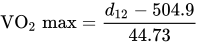
where d12 is distance (in metres) covered in 12 minutes, alternatively

where d(miles)12 is distance (in miles) covered in 12 minutes.
Practical use
[edit]When used in a military, it is difficult to administer the test and monitor the results. Not all military bases have a running track, and tracking soldiers' laps and positions after 12 minutes may be considered difficult. Testing is easier to administer when the distance is fixed and the finishing time is measured. In his original book, Cooper also provided an alternate version of the test, based on the time to complete a 1.5 mile run.[1]
Most armies and police agencies of the world use a fixed distance. For example, the British Army uses 1.5 miles, the Australian Army uses 2.4 kilometers, the United States Army uses 2 miles, and the United States Marine Corps uses 3 miles. For each base, the course is measured and local corrections (elevation, conditions, etc.) are applied. Soldiers are sent off in waves, and timed over the finish line by some PTIs with a stopwatch.
For personal trainers, the Cooper test is a reliable and repeatable method for measuring a client's progress when carried out on a treadmill.
As a standard test, this test should to be performed only under standard conditions:
- Between 50 and 75 °F (10 to 25 °C) with 75% maximum humidity.
- On a standard 400 m Tartan track or similar.
- The candidate should not suffer from respiratory problems.
The test formula given by Cooper is not considered to be useful for untrained pupils.[6] Regression analysis, in a study of sedentary male subjects, revealed a significant correlation (r = 0.93, P<0.001) with direct VO2Max measurements with a modified formula:

where d(kilometers)12 is distance (in kilometers) covered in 12 minutes.[7]
Football referees
[edit]The Cooper test was one of the most commonly used fitness tests to measure the fitness levels of both amateur and professional football referees, including referees from the FA (English Football Association). More recently, many countries have decided to stop relying on the Cooper Test, claiming that the Cooper test does not correlate well to a real football match, where players run short sprints rather than at a regular pace. Thus it may not truly indicate if a referee will be able to perform well in a football match. All FIFA referees are now required to pass the HI Intensity Fitness Test. National associations are gradually requiring some of their top-tier officials to do the HI Intensity Fitness Test also. Lower level referees are often given a choice to either perform the HI Intensity Fitness Test or the Cooper Test. Nevertheless, the recent trend seems to indicate that the Cooper Test is slowly being phased out.[8][9][10]
See also
[edit]References
[edit]- ^ a b Cooper, Kenneth H. (January 1969). Aerobics. Bantam Books. ISBN 978-0-553-14490-1.
- ^ "Cooper Aerobics - Dr. Kenneth Cooper". Archived from the original on 2010-10-11. Retrieved 2010-06-19.
- ^ "Cooper Test: A 12-Minute Run to Check Aerobic Fitness". Archived from the original on 2016-03-06. Retrieved 2010-06-19.
- ^ van der Zwaard, Stephan; Brocherie, Franck; Jaspers, Richard T. (2021). "Under the Hood: Skeletal Muscle Determinants of Endurance Performance". Frontiers in Sports and Active Living. 3 719434. doi:10.3389/fspor.2021.719434. ISSN 2624-9367. PMC 8371266. PMID 34423293.
- ^ Cooper, Kenneth H. (15 January 1968). "A Means of Assessing Maximal Oxygen Intake: Correlation Between Field and Treadmill Testing". JAMA. 203 (3): 203. doi:10.1001/jama.1968.03140030033008. ISSN 0098-7484.
- ^ Library of the Heidelberg University: Evaluation of the COOPER-Tests from a performance-physiological perspective Retrieved 3 July 2014
- ^ Bandyopadhyay, A. (2015). "Validity of cooper's 12-minute run test for estimation of maximum oxygen uptake in male university students". Biology of Sport. 32 (1): 59–63. doi:10.5604/20831862.1127283 (inactive 1 August 2025). PMC 4314605. PMID 25729151. S2CID 16427810.
{{cite journal}}: CS1 maint: DOI inactive as of August 2025 (link) Retrieved 7 Jun 2024 - ^ Bartha, C. et, al. (Jan 2009). "Fitness test results of Hungarian and international-level soccer referees and assistants". The Journal of Strength & Conditioning Research. 23 (1): 121–6. doi:10.1519/JSC.0b013e31818ebb84. PMID 19125100. S2CID 40841714.
{{cite journal}}: CS1 maint: multiple names: authors list (link) - ^ Park, Madison (4 June 2010). "World Cup referees outrun players". CNN.com. Archived from the original on 19 August 2012. Retrieved 27 July 2012.
- ^ Morrison, Jim (22 June 2010). "How to Train a World Cup Referee". Smithsonian.com. Archived from the original on 27 September 2013. Retrieved 27 July 2012.
Cooper test
View on GrokipediaHistory and Development
Origins in Military Fitness
The Cooper test was developed in 1968 by Dr. Kenneth H. Cooper, a lieutenant colonel and physician in the United States Air Force, specifically to assess cardiovascular endurance among airmen at Lackland Air Force Base in Texas.[2] Working as director of the Aerospace Medical Laboratory, Cooper designed the test as a practical alternative to laboratory-based maximal treadmill assessments, which were time-consuming and resource-intensive for evaluating large groups.[4] Cooper's initiative was driven by alarming rates of coronary heart disease among young Air Force personnel, including pilots and astronauts, coupled with the need for efficient fitness screening during the Cold War era, when the service included approximately 765,000 active-duty members whose aerobic capacities were largely unmeasured.[2][5] He aimed to promote preventive medicine through aerobic exercise, recognizing its potential to mitigate heart disease risks in a high-stakes military environment.[6] The test measures the distance run in 12 minutes as a proxy for VO2 max, the body's maximal oxygen uptake during intense exercise. Early validation involved testing over 5,000 Air Force personnel in Cooper's broader preventive medicine research, with a key study on 115 officers and airmen who completed the 12-minute run under supervised conditions on a flat track, followed by treadmill VO2 max evaluations that demonstrated a strong correlation of 0.897 between run distance and aerobic capacity.[7] These efforts confirmed the test's reliability for field use without specialized equipment. Initially, the Cooper test saw informal application in Air Force training programs to monitor and enhance personnel fitness, predating its formal publication in the Journal of the American Medical Association and subsequent military-wide integration.[2]Standardization and Publication
Following its initial development for the United States Air Force, the Cooper test underwent formal standardization through rigorous validation studies correlating field performance with laboratory-measured maximal oxygen intake (VO2 max). In a study of 115 male personnel, the distance covered in 12 minutes demonstrated a strong correlation (r = 0.897) with treadmill-based VO2 max, establishing the test's reliability as a non-laboratory aerobic fitness assessment.[8] The test protocol was first detailed and popularized in Kenneth H. Cooper's seminal 1968 book Aerobics, which provided standardized guidelines for the 12-minute run, including instructions for administration on a flat track under controlled conditions to ensure consistent results.[9] This publication marked a pivotal shift, extending the test from military use to public health and fitness applications by emphasizing its accessibility for estimating cardiovascular endurance without specialized equipment.[2] In the 1970s, the test was refined through ongoing research at the newly founded Cooper Institute, which conducted longitudinal studies to validate and expand its applicability across diverse populations, solidifying its role as a benchmark for aerobic capacity evaluation.[2] The American College of Sports Medicine (ACSM) incorporated the Cooper test into its inaugural Guidelines for Exercise Testing and Prescription in 1975, recommending it as a practical field test for general fitness protocols alongside other submaximal assessments.[10] Cooper further advanced the test's norms in his 1977 follow-up book The Aerobics Way: New Data on the World's Most Popular Exercise Program, which presented updated performance standards based on accumulated data from thousands of participants, enhancing its utility for tracking fitness improvements over time.[11]Procedure and Administration
Step-by-Step Instructions
To conduct the Cooper test accurately, participants should be healthy adolescents and adults capable of performing sustained aerobic effort. A suitable location is a flat, measured 400-meter running track to ensure consistent pacing and distance tracking, though alternatives like a treadmill or measured path may be used if a track is unavailable.[12] The test measures aerobic capacity by determining the maximum distance covered in 12 minutes, which correlates with VO2 max estimation.[2]Preparation
- Perform a warm-up consisting of 5 to 10 minutes of light jogging, dynamic stretches, or similar low-intensity activities to prepare the cardiovascular system and muscles, reducing injury risk.[12][13]
- Screen participants for health risks using a pre-test questionnaire; obtain medical clearance from a physician for individuals with cardiovascular conditions, respiratory issues, or other contraindications.[14][12]
- Ensure proper hydration by encouraging participants to drink water before starting, and advise consuming a light meal with carbohydrates 2 hours prior if needed.[12]
- Place markers or cones at regular intervals (e.g., every 100 meters) along the track for easy distance monitoring.[13]
Execution
- Instruct the participant to run or walk continuously at their maximum sustainable pace for exactly 12 minutes, aiming to cover the greatest possible distance without stopping.[13][12]
- Start a precise timer (stopwatch or app) upon the participant's signal to begin, and provide verbal encouragement throughout to maintain effort, such as announcing remaining time at intervals.[12]
- For low-fitness individuals, allow predominant walking if running is unsustainable, but emphasize pushing to the limit of effort.[13]
Measurement
- At the 12-minute mark, immediately stop the timer and record the total distance covered in meters, typically by counting completed laps and adding any partial distance.[13][12]
- Note any deviations, such as if walking predominated, to contextualize the result for interpretation.[13]
Safety Guidelines
The test should be supervised by trained personnel to monitor for signs of distress, such as excessive fatigue or chest pain, and allow immediate cessation if needed.[14] Post-test, participants should cool down with 5-10 minutes of walking and stretching to aid recovery.[12] Avoid testing in extreme weather conditions that could exacerbate dehydration or heat stress.[14]Common Errors to Avoid
Select even, non-slippery terrain to prevent tripping or inconsistent effort; uneven surfaces can skew distance accuracy.[12] Use a reliable timing device to ensure the full 12 minutes are observed without early termination, as premature stopping underestimates performance.[13] Inadequate warm-up or lack of motivation can also compromise results, so clear instructions and encouragement are essential.[12]Required Equipment and Conditions
The Cooper test is designed for simplicity, requiring only basic equipment to ensure accurate measurement of distance covered in 12 minutes. Essential items include a stopwatch or timer precise to the nearest second for timing the test duration and a flat, measured running course, ideally a standard 400-meter oval track, or an alternative flat surface calibrated with a measuring tape or surveyor's wheel to verify distance accuracy.[2][13][15] Optional equipment can facilitate smoother administration without altering the test's core validity. Marker cones or flags help define course boundaries, particularly on non-track surfaces, while recording sheets allow administrators to log participant data efficiently; a heart rate monitor may provide supplementary insights into effort levels but is not integral to distance-based scoring.[13] Optimal environmental conditions are crucial for test reliability and participant safety, minimizing external variables that could influence performance. The test should occur in mild weather conditions.[2] Participants must wear non-slip athletic footwear suitable for running on the chosen surface and lightweight, breathable clothing to support unrestricted movement; testing in extreme heat or cold is contraindicated due to risks of dehydration, hypothermia, or inaccurate results.[12] For group administration, a multi-lane track enables simultaneous testing of multiple participants to streamline large-scale assessments, such as in sports teams or fitness programs, with administrators using a whistle or audible signal for synchronized starts and finishes to maintain fairness.[2][16] To accommodate accessibility needs or inclement weather, the test can be adapted indoors on a treadmill programmed to a constant speed that equates to the outdoor pace, typically with a 1% incline to replicate terrain resistance and ensure comparable distance coverage.[17][18]Interpretation of Results
VO2 Max Estimation Formula
The VO2 max estimation formula for the Cooper test is derived from regression analysis conducted in Dr. Kenneth H. Cooper's original studies, which correlated the distance covered during the 12-minute run with directly measured VO2 max in a laboratory setting for military personnel. The formula, applicable to both males and females, is given by the equation:Fitness Level Classifications
The fitness level classifications for the Cooper test categorize estimated VO2 max values (in mL/kg/min) into performance levels that account for age and gender differences, enabling individuals to gauge their aerobic fitness relative to population norms. These classifications were derived from large-scale data collected at the Cooper Clinic, reflecting research conducted in the 1980s, and provide benchmarks for assessing cardiovascular endurance.[19] The categories—very poor, poor, fair, good, excellent, and superior—represent increasing levels of aerobic capacity, with higher VO2 max values indicating superior fitness. Norms are segmented by age groups starting from adolescence through older adulthood, recognizing that VO2 max naturally declines with age. The following tables outline these classifications for females and males, based on Cooper Institute standards revised in 1997.[19][20]Female VO2 Max Classifications (mL/kg/min)
| Age Group | Very Poor | Poor | Fair | Good | Excellent | Superior |
|---|---|---|---|---|---|---|
| 13-19 | <25.0 | 25.0-30.9 | 31.0-34.9 | 35.0-38.9 | 39.0-41.9 | >41.9 |
| 20-29 | <23.6 | 23.6-28.9 | 29.0-32.9 | 33.0-36.9 | 37.0-41.0 | >41.0 |
| 30-39 | <22.8 | 22.8-26.9 | 27.0-31.4 | 31.5-35.6 | 35.7-40.0 | >40.0 |
| 40-49 | <21.0 | 21.0-24.4 | 24.5-28.9 | 29.0-32.8 | 32.9-36.9 | >36.9 |
| 50-59 | <20.2 | 20.2-22.7 | 22.8-26.9 | 27.0-31.4 | 31.5-35.7 | >35.7 |
| 60+ | <17.5 | 17.5-20.1 | 20.2-24.4 | 24.5-30.2 | 30.3-31.4 | >31.4 |
Male VO2 Max Classifications (mL/kg/min)
| Age Group | Very Poor | Poor | Fair | Good | Excellent | Superior |
|---|---|---|---|---|---|---|
| 13-19 | <35.0 | 35.0-38.3 | 38.4-45.1 | 45.2-50.9 | 51.0-55.9 | >55.9 |
| 20-29 | <33.0 | 33.0-36.4 | 36.5-42.4 | 42.5-46.4 | 46.5-52.4 | >52.4 |
| 30-39 | <31.5 | 31.5-35.4 | 35.5-40.9 | 41.0-44.9 | 45.0-49.4 | >49.4 |
| 40-49 | <30.2 | 30.2-33.5 | 33.6-38.9 | 39.0-43.7 | 43.8-48.0 | >48.0 |
| 50-59 | <26.1 | 26.1-30.9 | 31.0-35.7 | 35.8-40.9 | 41.0-45.3 | >45.3 |
| 60+ | <20.5 | 20.5-26.0 | 26.1-32.2 | 32.3-36.4 | 36.5-44.2 | >44.2 |