
Recent from talks
Corinna
Knowledge base stats:
Talk channels stats:
Members stats:
Corinna
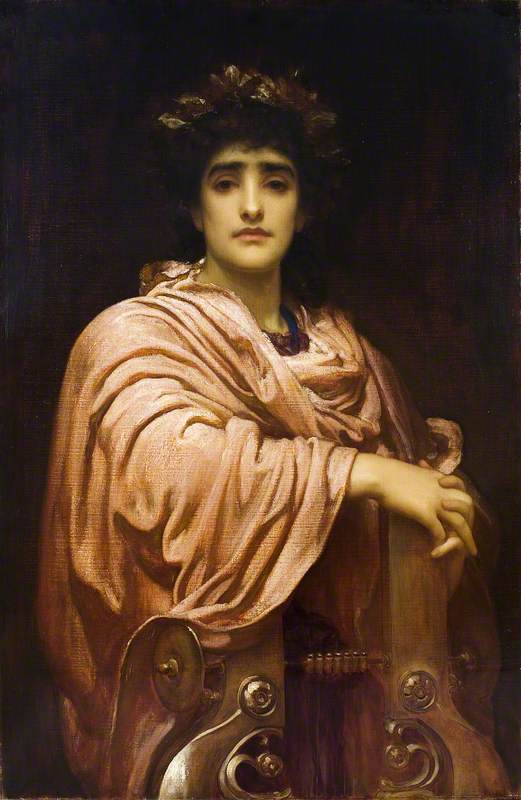
Corinna or Korinna (Ancient Greek: Κόριννα, romanized: Korinna) was an ancient Greek lyric poet from Tanagra in Boeotia. Although ancient sources portray her as a contemporary of Pindar (born c. 518 BC), not all modern scholars accept the accuracy of this tradition. When she lived has been the subject of much debate since the early twentieth century, proposed dates ranging from the beginning of the fifth century to the late third century BC.
Corinna's works survive only in fragments: three substantial sections of poems are preserved on second-century AD papyri from Egypt; several shorter pieces survive in quotations by ancient grammarians. They focus on local Boeotian legends, and are distinctive for their mythological innovations. Corinna's poetry often reworks well-known myths to include details not known from any other sources. Though respected in her hometown, Tanagra, and popular in ancient Rome, modern critics have often regarded her as parochial and dull; her poetry is nonetheless of interest as she is one of the few female poets from ancient Greece whose work survives.
Corinna was from Tanagra in Boeotia. The Suda, a tenth-century encyclopedia, records that she was the daughter of Acheloodorus and Procratia, and was nicknamed Myia (Μυῖα, "the fly"). According to ancient tradition, she lived during the fifth century BC. She was supposed to have been a contemporary of Pindar, either having taught him, or been a fellow-pupil of Myrtis of Anthedon with him. Corinna was said to have competed with Pindar, defeating him in at least one poetry competition, though some sources claim five.
Since the early twentieth century, scholars have been divided over the accuracy of the traditional chronology of Corinna's life. One of the first scholars to question this was Edgar Lobel, who in 1930 concluded that there is no reason to believe she predated the orthography used on the Berlin papyrus, on which fragments of two of her poems are preserved. The debate over Corinna's date has dominated scholarship since, and the evidence remains inconclusive. Sceptics of the traditional chronology argue that there is no ancient mention of Corinna before the first century BC, and that the orthography of her surviving poetry was not established until after the mid-fourth century. This is the most common view, with Martin Litchfield West and David A. Campbell among those who believe a late date for Corinna. Campbell concludes that a third-century date is "almost certain".
The alternative view, accepting the traditional fifth-century date, is set forth by scholars such as Archibald Allen and Jiří Frel. If the traditional date is correct, the lack of ancient reference to Corinna before the first century, and the later orthography, could both be explained by her being of only local interest before the Hellenistic period. According to this theory, when she was rediscovered and popularised in the Hellenistic period her poetry would have been re-spelled into contemporary Boeotian orthography, as her original fifth-century orthography was too unfamiliar to a third-century audience. An apparent terminus ante quem is established by the second-century AD theologian Tatian, who says in his Address to the Greeks that the fourth-century BC sculptor Silanion made a portrait-statue of Corinna. A Roman-era copy of a fourth-century statue in the Musée Vivenel in Compiègne, France, is identified by an inscription on the base as depicting Corinna, and is widely accepted by archeologists as a copy of Silanion's sculpture. Philologists continue to regard this attribution with what Thea S. Thorsen describes as "unwarranted scepticism". West, for instance, accepts that the Compiègne statuette is a copy of a fourth-century work, but suggests that it was not originally intended to depict Corinna, only gaining that association in the Roman period. Thorsen argues that the sculpture was always intended as an image of Corinna, noting that the figure is shown with five scrolls that match the five books of poetry attributed to Corinna in antiquity.
Corinna, like Pindar, wrote choral lyric poetry – as demonstrated by her invocation of Terpsichore, the Muse of dance and chorus, in one of her fragments. According to the Suda, she wrote five books of poetry. Her works were collected in a Boeotian edition in the late third or early second century BC, and later Hellenistic and Roman texts of Corinna derived from this. This Boeotian edition was produced in a scholarly format, with titles for the poems; it may have also included accent marks and hypotheses, but is unlikely to have included line numbers.
Corinna wrote in a literary dialect, which had features of her Boeotian vernacular, along with similarities to the language of epic both in morphology and in her choice of words; Daniel Berman describes it as "epic written as Boeotian". If Corinna was a contemporary of Pindar, this use of the local vernacular as a literary language is archaic – though the earlier poets Alcman and Stesichorus wrote in literary dialects based on their own vernaculars, the fifth-century choral poets Pindar and Bacchylides both wrote in Doric despite it not being their local dialect. On the other hand, if she is to be located closer to the Hellenistic period, parallels can be found in the poetry of Theocritus, who also used features of his native dialect in the Idylls.
About forty fragments of Corinna's poetry survive, more than any ancient woman poet except for Sappho, though no complete poems of hers are known. The three most substantial fragments are preserved on pieces of papyrus discovered in Hermopolis and Oxyrhynchus in Egypt, dating to the second century AD; many of the shorter fragments survive in citations by grammarians interested in Corinna's Boeotian dialect.
Hub AI
Corinna AI simulator
(@Corinna_simulator)
Corinna
Corinna or Korinna (Ancient Greek: Κόριννα, romanized: Korinna) was an ancient Greek lyric poet from Tanagra in Boeotia. Although ancient sources portray her as a contemporary of Pindar (born c. 518 BC), not all modern scholars accept the accuracy of this tradition. When she lived has been the subject of much debate since the early twentieth century, proposed dates ranging from the beginning of the fifth century to the late third century BC.
Corinna's works survive only in fragments: three substantial sections of poems are preserved on second-century AD papyri from Egypt; several shorter pieces survive in quotations by ancient grammarians. They focus on local Boeotian legends, and are distinctive for their mythological innovations. Corinna's poetry often reworks well-known myths to include details not known from any other sources. Though respected in her hometown, Tanagra, and popular in ancient Rome, modern critics have often regarded her as parochial and dull; her poetry is nonetheless of interest as she is one of the few female poets from ancient Greece whose work survives.
Corinna was from Tanagra in Boeotia. The Suda, a tenth-century encyclopedia, records that she was the daughter of Acheloodorus and Procratia, and was nicknamed Myia (Μυῖα, "the fly"). According to ancient tradition, she lived during the fifth century BC. She was supposed to have been a contemporary of Pindar, either having taught him, or been a fellow-pupil of Myrtis of Anthedon with him. Corinna was said to have competed with Pindar, defeating him in at least one poetry competition, though some sources claim five.
Since the early twentieth century, scholars have been divided over the accuracy of the traditional chronology of Corinna's life. One of the first scholars to question this was Edgar Lobel, who in 1930 concluded that there is no reason to believe she predated the orthography used on the Berlin papyrus, on which fragments of two of her poems are preserved. The debate over Corinna's date has dominated scholarship since, and the evidence remains inconclusive. Sceptics of the traditional chronology argue that there is no ancient mention of Corinna before the first century BC, and that the orthography of her surviving poetry was not established until after the mid-fourth century. This is the most common view, with Martin Litchfield West and David A. Campbell among those who believe a late date for Corinna. Campbell concludes that a third-century date is "almost certain".
The alternative view, accepting the traditional fifth-century date, is set forth by scholars such as Archibald Allen and Jiří Frel. If the traditional date is correct, the lack of ancient reference to Corinna before the first century, and the later orthography, could both be explained by her being of only local interest before the Hellenistic period. According to this theory, when she was rediscovered and popularised in the Hellenistic period her poetry would have been re-spelled into contemporary Boeotian orthography, as her original fifth-century orthography was too unfamiliar to a third-century audience. An apparent terminus ante quem is established by the second-century AD theologian Tatian, who says in his Address to the Greeks that the fourth-century BC sculptor Silanion made a portrait-statue of Corinna. A Roman-era copy of a fourth-century statue in the Musée Vivenel in Compiègne, France, is identified by an inscription on the base as depicting Corinna, and is widely accepted by archeologists as a copy of Silanion's sculpture. Philologists continue to regard this attribution with what Thea S. Thorsen describes as "unwarranted scepticism". West, for instance, accepts that the Compiègne statuette is a copy of a fourth-century work, but suggests that it was not originally intended to depict Corinna, only gaining that association in the Roman period. Thorsen argues that the sculpture was always intended as an image of Corinna, noting that the figure is shown with five scrolls that match the five books of poetry attributed to Corinna in antiquity.
Corinna, like Pindar, wrote choral lyric poetry – as demonstrated by her invocation of Terpsichore, the Muse of dance and chorus, in one of her fragments. According to the Suda, she wrote five books of poetry. Her works were collected in a Boeotian edition in the late third or early second century BC, and later Hellenistic and Roman texts of Corinna derived from this. This Boeotian edition was produced in a scholarly format, with titles for the poems; it may have also included accent marks and hypotheses, but is unlikely to have included line numbers.
Corinna wrote in a literary dialect, which had features of her Boeotian vernacular, along with similarities to the language of epic both in morphology and in her choice of words; Daniel Berman describes it as "epic written as Boeotian". If Corinna was a contemporary of Pindar, this use of the local vernacular as a literary language is archaic – though the earlier poets Alcman and Stesichorus wrote in literary dialects based on their own vernaculars, the fifth-century choral poets Pindar and Bacchylides both wrote in Doric despite it not being their local dialect. On the other hand, if she is to be located closer to the Hellenistic period, parallels can be found in the poetry of Theocritus, who also used features of his native dialect in the Idylls.
About forty fragments of Corinna's poetry survive, more than any ancient woman poet except for Sappho, though no complete poems of hers are known. The three most substantial fragments are preserved on pieces of papyrus discovered in Hermopolis and Oxyrhynchus in Egypt, dating to the second century AD; many of the shorter fragments survive in citations by grammarians interested in Corinna's Boeotian dialect.
Recent media