Hubbry Logo
Cornaredo StadiumCornaredo StadiumMain
Open search
Cornaredo Stadium
Community hub
Cornaredo Stadium
logo
8 pages, 0 posts
0 subscribers
Be the first to start a discussion here.
Cornaredo Stadium
Cornaredo Stadium
from Wikipedia

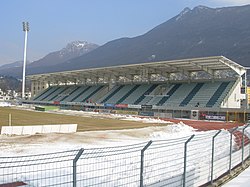
Cornaredo Stadium is a multi-purpose stadium in Lugano, Switzerland. It is used mostly for football matches. It is a home ground of FC Lugano. The stadium has a capacity of 6,330. During the 1954 FIFA World Cup, it hosted one game.

Key Information

During the spring of 2008, the political authorities of Lugano announced a plan to renew the stadium to fulfil the Swiss Football League requirements for Super League stadiums, however, the works never commenced.

1954 FIFA World Cup

[edit]
Italy 4 – 1 Belgium
Pandolfini 41' (pen.)
Galli 48'
Frignani 58'
Lorenzi 78'
Report Anoul 81'
Cornaredo Stadium, Lugano
Attendance: 26,000
Referee: Carl Erich Steiner (Austria)

See also

[edit]

References

[edit]
[edit]
Revisions and contributorsEdit on WikipediaRead on Wikipedia
from Grokipedia
Cornaredo Stadium (Italian: Stadio di Cornaredo), located at Via Trevano 100 in , , is a historic multi-purpose venue primarily used for football matches and as the longtime home ground of . The stadium officially opened on August 26, 1951, with playing their first match there shortly after, a 7–0 victory over ; its official inauguration came on November 25, 1951, with an international friendly between and that drew a record 32,500 spectators. Constructed in anticipation of the , it hosted one group stage match during the tournament. Originally boasting a capacity of around 10,500–15,000, it was reduced to approximately 6,000 seats following safety upgrades in 2015 to comply with standards, but currently operates at 4,900 seats in a temporary configuration as of November 2025. As of November 2025, Cornaredo Stadium is in a transitional phase, with partial demolition complete as part of the broader Polo Sportivo degli Eventi (PSE) project, which includes the construction of the new AIL Arena to replace it as FC Lugano's home; the arena is scheduled for handover on November 28, 2025, with additional facilities completing phase 1 by December 2026. The club currently plays matches in a temporary built by NÜSSLİ, ensuring continuity during the redevelopment. This evolution marks the end of Cornaredo's seven-decade era while preserving its legacy as Lugano's sporting heart.

Location and facilities

Site and ownership

Cornaredo Stadium was situated in Lugano, within the Ticino canton of Switzerland, at coordinates 46°01′25″N 8°57′42″E. The venue occupied a site at Via Trevano 100, 6900 Lugano, integrated into the city's urban fabric and bordered by residential neighborhoods to the north and east. This positioning placed it amid a densely populated area, facilitating its role as a community focal point while embedding it within Lugano's compact metropolitan layout. As of November 2025, the original stadium has been partially demolished as part of the Polo Sportivo degli Eventi (PSE) project, with remaining facilities including a skatepark, synthetic fields for field hockey and community use, and a grass training field for FC Lugano. The stadium was owned by the City of Lugano (Città di Lugano) since its inauguration in 1951, with ownership encompassing full property rights and associated infrastructure. Management responsibilities were shared between the Lugano City Council and FC Lugano, the primary tenant, under a lease agreement that outlined operational duties. Public funding supported maintenance and upgrades, reflecting its status as a municipal asset reliant on taxpayer resources for sustainability and enhancements. Accessibility to the stadium emphasized public transport options, given its proximity to central Lugano. The Lugano SBB railway station lay approximately 2 km away, from which visitors could connect via bus lines 4, 6, or 19, with services running frequently to stops such as Resega and Via Ciani/Cornaredo. Additional daily lines included 3 and 7, while weekday options encompassed 19, 441, and 462; FC Lugano provided free public transport for match ticket holders to promote sustainable travel. Road access was via Via Trevano from the A2 highway's Lugano North exit, though on-site parking was limited to around 1,200 spaces across lots like Stadio Sud Ovest (220 spots) and Resega (410 spots). Nearby Park & Ride facilities, such as Cornaredo Resega with 400 spaces and shuttle line S, further encouraged eco-friendly alternatives. The stadium integrated seamlessly into Lugano's urban sports landscape as part of the broader Centro sportivo Cornaredo, adjacent to facilities like the Eisstadion Resega ice rink, a skatepark, and synthetic fields for community use. This adjacency enhanced its connectivity within a multi-sport hub, serving as the largest open-air arena in Italian-speaking Switzerland and underscoring its regional prominence.

Structure and capacity

Cornaredo Stadium featured a rectangular pitch measuring 105 meters in length by 68 meters in width, covered with natural grass and surrounded by a running track. The open-air venue was designed with four stands enclosing the field, including the Curva Nord, a dedicated section for ultras supporters. Basic amenities included changing rooms for teams and a press area to accommodate media coverage. Upon its opening, the stadium offered an initial capacity of approximately 35,000 spectators. For major events such as a match during the 1954 FIFA World Cup (Italy vs. Belgium), temporary expansions allowed the venue to accommodate up to 36,000 attendees. By the 2000s, adherence to safety standards—incorporating features like protective barriers, emergency exits, and upgraded seating—necessitated a reduction in capacity to a fully seated configuration of 6,330. Floodlighting was installed in later years to meet league requirements for evening fixtures. The stadium's city ownership facilitated ongoing maintenance of its core structure throughout its operational life.

History

Construction and opening

The construction of Cornaredo Stadium was prompted by the need to replace the outdated Campo Marzio ground, with initial planning dating back to 1942 when the municipality of Lugano selected a site in the Cornaredo area—previously considered for agricultural and other uses—for a new sports facility to serve the city's growing football community. The project accelerated after Switzerland was awarded hosting rights for the 1954 FIFA World Cup in 1946, with Lugano designated as one of six venues, necessitating municipal investment in a modern stadium capable of handling international crowds despite some political opposition over land use. Site preparation involved clearing municipal land near the cemetery and adapting the terrain for multi-purpose use, including football and athletics. Construction commenced around 1950 and was completed within the year, resulting in a structure designed primarily for football with covered stands and open terracing to accommodate up to 15,000 spectators at the time. The stadium symbolized the post-World War II revival of sports in , reflecting regional efforts to rebuild community infrastructure and promote local identity through athletics. The stadium's initial opening occurred on August 26, 1951, marked by a friendly match between FC Lugano and FC Chiasso, which the hosts won 7-0, drawing a large local crowd to celebrate the new venue. An official inauguration for broader use followed on November 25, 1951, with an international friendly between Switzerland and Italy ending in a 1-1 draw, attended by 32,500 spectators and highlighting the facility's readiness for high-profile events. From the outset, Cornaredo Stadium served as the primary home for (formerly AC Lugano), hosting the club's matches starting in the 1951-52 season and establishing it as the central hub for professional football in southern Switzerland.

Renovations and expansions

In preparation for the 1954 FIFA World Cup, which Switzerland hosted, the stadium saw early expansions in the 1950s, including additions to the stands that increased its temporary capacity to approximately 26,000. This allowed it to host the group stage match between Italy and Belgium on June 20, 1954, which drew an attendance of 24,000 spectators. Starting in the 1980s, the City of Lugano, as the ongoing owner of the municipal facility, undertook several improvements to the stadium and surrounding sports center, constructing new areas that defined its modern layout. These updates continued into the late 1990s, when discussions emerged for further renovations and expansions, driven by FC Lugano's successes in European competitions and Switzerland's bid for . In line with evolving Swiss football regulations on safety, subsequent modifications in the 1990s and early 2000s included the installation of additional seating to replace standing areas, enhancing spectator security. In 2008, city authorities proposed a comprehensive renovation project to bring the stadium into compliance with Swiss Super League standards, featuring a fully covered roof and an increase in permanent seating to around 10,000. However, the initiative faced delays due to funding challenges and urban planning disputes, ultimately stalling without full implementation. Maintenance efforts persisted through the 2000s and into the early 2010s, encompassing periodic resurfacing of the pitch and repairs to aging stands; the last significant work occurred in 2015, when upgrades to meet Swiss Football League safety requirements reduced the capacity from 10,500 to about 6,000 all-seated positions.

Demolition and replacement

In 2018, the city of Lugano announced plans to redevelop the Cornaredo area into a comprehensive urban sports and events center, including a new stadium to replace the aging Cornaredo facility, which no longer met Swiss Super League and UEFA standards due to its outdated infrastructure. Despite earlier renovations aimed at extending its usability, these efforts ultimately proved insufficient to address long-term needs, paving the way for full decommissioning. Demolition commenced in July 2023 with the removal of the east stand, known as the Monte Brè grandstand, to clear space for the new development. Full site clearance is projected to be completed by mid-2025, enabling seamless progress on construction while FC Lugano continues home matches using temporary stands installed on the existing pitch. The replacement venue, named AIL Arena and situated in the Lugano suburb of Cornaredo, was designed by Spanish firm Cruz y Ortiz Arquitectos in partnership with local studio Giraudi Radczuweit architetti. It features a capacity of approximately 8,150 fully covered seats, prioritizing fan comfort and multi-purpose functionality for football and other events. Construction proceeds in phases: the stadium itself is slated for completion by December 2025, followed by the multi-use sports arena (capacity around 3,000-4,000) in 2026, and the broader complex—including service buildings, parking, and residential towers—by 2028. In November 2025, the City Council submitted a credit request of 80 million francs for the purchase of the Sports Hall. This project signifies the end of Cornaredo Stadium's 74-year legacy, which began with its opening in 1951 as FC Lugano's home ground. In August 2025, FC Lugano finalized a lease agreement with the city to serve as the primary tenant of the new facility, ensuring continuity for the club amid the transition.

Usage and events

Primary tenants

The primary tenant of Cornaredo Stadium has been FC Lugano since its inauguration in 1951, when the venue hosted the club's opening match against FC Chiasso. Founded in 1908, the club encountered severe financial challenges in 2003, resulting in bankruptcy and its reformation as AC Lugano; it merged with FC Malcantone Agno in 2004 and reverted to its original name, FC Lugano, in 2008 to mark its centenary. Throughout its tenure at Cornaredo, FC Lugano has competed in various tiers of Swiss football, experiencing multiple promotions and demotions, including a return to the Swiss Super League following promotion at the end of the 2014-2015 season under owner Angelo Renzetti. The stadium's capacity of approximately 6,000 seats has adequately met the club's requirements for top-flight matches during this period. The venue primarily served as the base for FC Lugano's home league matches, training sessions, and club-related events, fostering a strong connection with supporters. Average attendance in later years ranged from 3,000 to 4,000, reflecting steady fan engagement despite the stadium's modest size. The club's passionate fan culture, centered in the Curva Nord section, has been a hallmark of matchdays, with dedicated groups enhancing the atmosphere through chants and displays. FC Lugano's relationship with Cornaredo underscored financial dependencies on the city of Lugano, from which the club rented the facility, while also contributing to the local economy via matchday revenues, employment, and community activities. As part of broader municipal sports infrastructure, the tenancy supported regional vitality over seven decades. Amid the stadium's demolition and replacement project spanning 2023 to 2025, FC Lugano operated from temporary stands at the site, including a reduced-capacity setup of 4,872 seats following partial demolition of the east stand in 2024. As of November 2025, the club continues to play at this temporary facility, with the full transition to the new AIL Arena scheduled for the 2026/27 season following its handover on November 28, 2025.

International matches

Cornaredo Stadium has played a limited role in international football, with its sole major fixture being a group stage match of the 1954 FIFA World Cup. On 20 June 1954, Italy secured a 4–1 victory over Belgium in Group 4, with goals from Egisto Pandolfini (penalty, 39'), Carlo Galli (45'), Amleto Frignani (57'), and Benito Lorenzi (75') for Italy, and Léopold Anoul (81') for Belgium; the match was refereed by Erich Steiner and drew an attendance of 24,000. Built in 1951 specifically in anticipation of Switzerland hosting the World Cup, the stadium underwent temporary expansions and infrastructure adjustments to comply with FIFA's standards, boosting its capacity from an initial around 15,000 to approximately 35,000–36,000 for the tournament. This encounter was one of 26 matches across six Swiss venues during the fifth edition of the World Cup, offering Lugano a fleeting international prominence as the tournament unfolded from 16 June to 4 July. No other FIFA World Cup or UEFA European Championship fixtures for national teams have been held there, reflecting the venue's constraints in capacity and facilities compared to larger modern stadia. The 1954 match nonetheless elevated local enthusiasm and pride in the region, marking a high point in the stadium's global exposure.

Other events

The Stadio Cornaredo, as part of the larger Centro Sportivo Cornaredo complex, has supported a range of non-football activities focused on community and amateur sports. The site's synthetic and grass fields have been utilized for youth training programs and regional tournaments in disciplines such as field hockey, providing accessible spaces for local clubs and young athletes. The facility includes a 100-meter sprint track dedicated to athletics, available for training and local meets organized by the SAL Lugano athletics club, though access is restricted to members to ensure safety and maintenance. These events typically draw smaller crowds of several hundred participants and spectators, emphasizing community engagement over large-scale competitions. Occasional cultural events have also taken place at the stadium, including open-air music performances by local bands during the 1970s and 1980s, which leveraged the open space for temporary staging setups accommodating 5,000 to 10,000 attendees. Such uses were sporadic, reflecting the venue's multi-purpose design before its primary focus shifted to football amid aging infrastructure in the 2000s.

References

Add your contribution
Related Hubs
User Avatar
No comments yet.