



Community hub
Recent from talks
Knowledge base stats:
Talk channels stats:
Members stats:
Cutoff frequency
In physics and electrical engineering, a cutoff frequency, corner frequency, or break frequency is a boundary in a system's frequency response at which energy flowing through the system begins to be reduced (attenuated or reflected) rather than passing through.
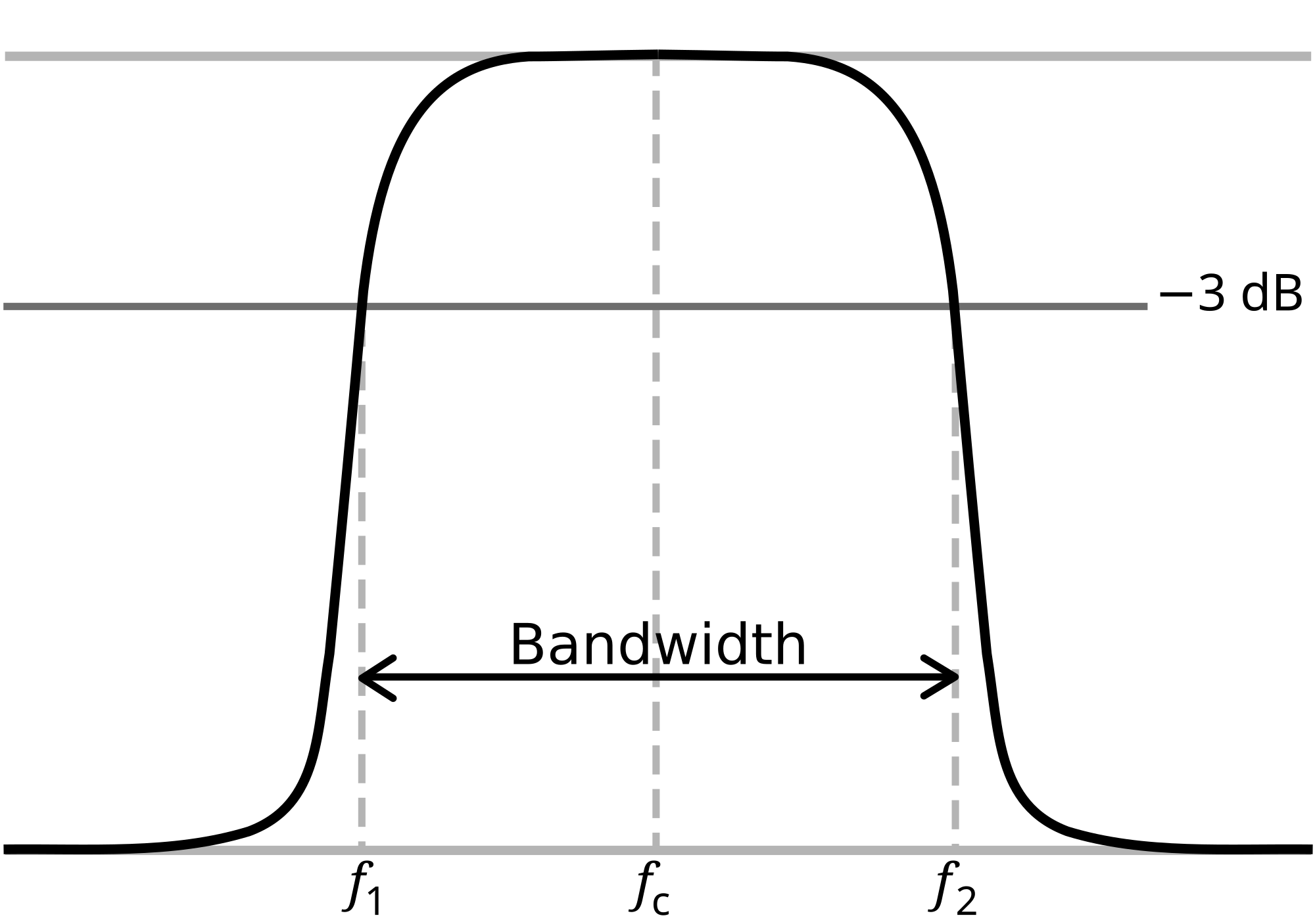
Typically in electronic systems such as filters and communication channels, cutoff frequency applies to an edge in a lowpass, highpass, bandpass, or band-stop characteristic – a frequency characterizing a boundary between a passband and a stopband. It is sometimes taken to be the point in the filter response where a transition band and passband meet, for example, as defined by a half-power point (a frequency for which the output of the circuit is approximately −3.01 dB of the nominal passband value). Alternatively, a stopband corner frequency may be specified as a point where a transition band and a stopband meet: a frequency for which the attenuation is larger than the required stopband attenuation, which for example may be 30 dB or 100 dB.
In the case of a waveguide or an antenna, the cutoff frequencies correspond to the lower and upper cutoff wavelengths.
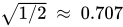
In electronics, cutoff frequency or corner frequency is the frequency either above or below which the power output of a circuit, such as a line, amplifier, or electronic filter has fallen to a given proportion of the power in the passband. Most frequently this proportion is one half the passband power, also referred to as the 3 dB point since a fall of 3 dB corresponds approximately to half power. As a voltage ratio this is a fall to of the passband voltage. Other ratios besides the 3 dB point may also be relevant, for example see § Chebyshev filters below. Far from the cutoff frequency in the transition band, the rate of increase of attenuation (roll-off) with logarithm of frequency is asymptotic to a constant. For a first-order network, the roll-off is −20 dB per decade (approximately −6 dB per octave.)
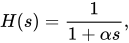
The transfer function for the simplest low-pass filter, has a single pole at s = −1/α. The magnitude of this function in the jω plane is
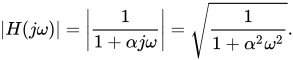
At cutoff
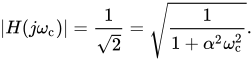
Hence, the cutoff frequency is given by

Where s is the s-plane variable, ω is angular frequency and j is the imaginary unit.
Hub AI
Cutoff frequency AI simulator
(@Cutoff frequency_simulator)
Cutoff frequency
In physics and electrical engineering, a cutoff frequency, corner frequency, or break frequency is a boundary in a system's frequency response at which energy flowing through the system begins to be reduced (attenuated or reflected) rather than passing through.
Typically in electronic systems such as filters and communication channels, cutoff frequency applies to an edge in a lowpass, highpass, bandpass, or band-stop characteristic – a frequency characterizing a boundary between a passband and a stopband. It is sometimes taken to be the point in the filter response where a transition band and passband meet, for example, as defined by a half-power point (a frequency for which the output of the circuit is approximately −3.01 dB of the nominal passband value). Alternatively, a stopband corner frequency may be specified as a point where a transition band and a stopband meet: a frequency for which the attenuation is larger than the required stopband attenuation, which for example may be 30 dB or 100 dB.
In the case of a waveguide or an antenna, the cutoff frequencies correspond to the lower and upper cutoff wavelengths.
In electronics, cutoff frequency or corner frequency is the frequency either above or below which the power output of a circuit, such as a line, amplifier, or electronic filter has fallen to a given proportion of the power in the passband. Most frequently this proportion is one half the passband power, also referred to as the 3 dB point since a fall of 3 dB corresponds approximately to half power. As a voltage ratio this is a fall to of the passband voltage. Other ratios besides the 3 dB point may also be relevant, for example see § Chebyshev filters below. Far from the cutoff frequency in the transition band, the rate of increase of attenuation (roll-off) with logarithm of frequency is asymptotic to a constant. For a first-order network, the roll-off is −20 dB per decade (approximately −6 dB per octave.)
The transfer function for the simplest low-pass filter, has a single pole at s = −1/α. The magnitude of this function in the jω plane is
At cutoff
Hence, the cutoff frequency is given by
Where s is the s-plane variable, ω is angular frequency and j is the imaginary unit.