Hubbry Logo
logo
Cutoff frequency
Community hub

Cutoff frequency

logo
0 subscribers
Read side by side
from Wikipedia
Magnitude transfer function of a bandpass filter with lower 3 dB cutoff frequency f1 and upper 3 dB cutoff frequency f2
Bode plot (a logarithmic frequency response plot) of any first-order low-pass filter with a normalized cutoff frequency at =1 and a unity gain (0 dB) passband.

In physics and electrical engineering, a cutoff frequency, corner frequency, or break frequency is a boundary in a system's frequency response at which energy flowing through the system begins to be reduced (attenuated or reflected) rather than passing through.

Typically in electronic systems such as filters and communication channels, cutoff frequency applies to an edge in a lowpass, highpass, bandpass, or band-stop characteristic – a frequency characterizing a boundary between a passband and a stopband. It is sometimes taken to be the point in the filter response where a transition band and passband meet, for example, as defined by a half-power point (a frequency for which the output of the circuit is approximately −3.01 dB of the nominal passband value). Alternatively, a stopband corner frequency may be specified as a point where a transition band and a stopband meet: a frequency for which the attenuation is larger than the required stopband attenuation, which for example may be 30 dB or 100 dB.

In the case of a waveguide or an antenna, the cutoff frequencies correspond to the lower and upper cutoff wavelengths.

Electronics

[edit]

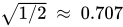
In electronics, cutoff frequency or corner frequency is the frequency either above or below which the power output of a circuit, such as a line, amplifier, or electronic filter has fallen to a given proportion of the power in the passband. Most frequently this proportion is one half the passband power, also referred to as the 3 dB point since a fall of 3 dB corresponds approximately to half power. As a voltage ratio this is a fall to of the passband voltage.[1] Other ratios besides the 3 dB point may also be relevant, for example see § Chebyshev filters below. Far from the cutoff frequency in the transition band, the rate of increase of attenuation (roll-off) with logarithm of frequency is asymptotic to a constant. For a first-order network, the roll-off is −20 dB per decade (approximately −6 dB per octave.)
Single-pole transfer function example

[edit]

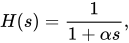
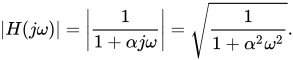
The transfer function for the simplest low-pass filter, has a single pole at s = −1/α. The magnitude of this function in the plane is

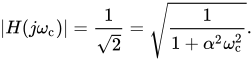
At cutoff

Hence, the cutoff frequency is given by

Where s is the s-plane variable, ω is angular frequency and j is the imaginary unit.

Chebyshev filters

[edit]

Sometimes other ratios are more convenient than the 3 dB point. For instance, in the case of the Chebyshev filter it is usual to define the cutoff frequency as the point after the last peak in the frequency response at which the level has fallen to the design value of the passband ripple. The amount of ripple in this class of filter can be set by the designer to any desired value, hence the ratio used could be any value.[2]

Radio communications

[edit]

In radio communication, skywave communication is a technique in which radio waves are transmitted at an angle into the sky and reflected back to Earth by layers of charged particles in the ionosphere. In this context, the term cutoff frequency refers to the maximum usable frequency, the frequency above which a radio wave fails to reflect off the ionosphere at the incidence angle required for transmission between two specified points by reflection from the layer.

Waveguides

[edit]

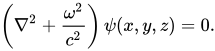
The cutoff frequency of an electromagnetic waveguide is the lowest frequency for which a mode will propagate in it. In fiber optics, it is more common to consider the cutoff wavelength, the maximum wavelength that will propagate in an optical fiber or waveguide. The cutoff frequency is found with the characteristic equation of the Helmholtz equation for electromagnetic waves, which is derived from the electromagnetic wave equation by setting the longitudinal wave number equal to zero and solving for the frequency. Thus, any exciting frequency lower than the cutoff frequency will attenuate, rather than propagate. The following derivation assumes lossless walls. The value of c, the speed of light, should be taken to be the group velocity of light in whatever material fills the waveguide.

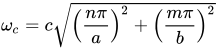
For a rectangular waveguide, the cutoff frequency is where are the mode numbers for the rectangle's sides of length and respectively. For TE modes, (but is not allowed), while for TM modes .
The cutoff frequency of the TM01 mode (next higher from dominant mode TE11) in a waveguide of circular cross-section (the transverse-magnetic mode with no angular dependence and lowest radial dependence) is given by where is the radius of the waveguide, and is the first root of , the Bessel function of the first kind of order 1.
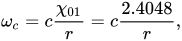
The dominant mode TE11 cutoff frequency is given by[3]
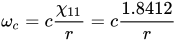
However, the dominant mode cutoff frequency can be reduced by the introduction of baffle inside the circular cross-section waveguide.[4] For a single-mode optical fiber, the cutoff wavelength is the wavelength at which the normalized frequency is approximately equal to 2.405.

Mathematical analysis

[edit]

The starting point is the wave equation (which is derived from the Maxwell equations), which becomes a Helmholtz equation by considering only functions of the form Substituting and evaluating the time derivative gives The function here refers to whichever field (the electric field or the magnetic field) has no vector component in the longitudinal direction - the "transverse" field. It is a property of all the eigenmodes of the electromagnetic waveguide that at least one of the two fields is transverse. The z axis is defined to be along the axis of the waveguide.
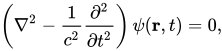

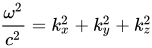
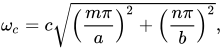
The "longitudinal" derivative in the Laplacian can further be reduced by considering only functions of the form where is the longitudinal wavenumber, resulting in where subscript T indicates a 2-dimensional transverse Laplacian. The final step depends on the geometry of the waveguide. The easiest geometry to solve is the rectangular waveguide. In that case, the remainder of the Laplacian can be evaluated to its characteristic equation by considering solutions of the form Thus for the rectangular guide the Laplacian is evaluated, and we arrive at The transverse wavenumbers can be specified from the standing wave boundary conditions for a rectangular geometry cross-section with dimensions a and b: where n and m are the two integers representing a specific eigenmode. Performing the final substitution, we obtain which is the dispersion relation in the rectangular waveguide. The cutoff frequency is the critical frequency between propagation and attenuation, which corresponds to the frequency at which the longitudinal wavenumber is zero. It is given by The wave equations are also valid below the cutoff frequency, where the longitudinal wave number is imaginary. In this case, the field decays exponentially along the waveguide axis and the wave is thus evanescent.

See also

[edit]

References

[edit]
[edit]
Revisions and contributorsEdit on WikipediaRead on Wikipedia
from Grokipedia
In electronics and signal processing, the cutoff frequency (also known as the corner frequency or -3 dB frequency) is the boundary in a system's frequency response at which the output signal power drops to half its maximum value, corresponding to a voltage attenuation of approximately 70.7% or a -3 dB gain reduction.[1] This point defines the transition between the passband—where signals are transmitted with minimal attenuation—and the stopband, where higher or lower frequencies are significantly suppressed, making it essential for designing frequency-selective circuits.[2] The cutoff frequency is particularly critical in passive and active filters, such as RC, RL, or op-amp-based configurations, where it determines the filter's bandwidth and roll-off characteristics.[1] For a first-order low-pass RC filter, it is calculated as $ f_c = \frac{1}{2\pi RC} $, with $ R $ as resistance and $ C $ as capacitance, ensuring unwanted high-frequency noise is attenuated while preserving the desired signal band.[1] In high-pass filters, the formula adjusts to emphasize low-frequency rejection, and in band-pass filters, two cutoff frequencies ($ f_L $ and $ f_H $) define the operational range.[1] Applications span audio processing, where cutoff frequencies shape speaker response to human hearing limits (typically 20 Hz to 20 kHz),[3] and anti-aliasing filters in analog-to-digital converters, set just below the Nyquist frequency to prevent signal distortion.[4] Beyond filters, cutoff frequency plays a key role in amplifiers and waveguides. In transistor amplifiers, it marks the onset of gain reduction due to internal capacitances, limiting high-frequency performance.[5] In rectangular waveguides, the cutoff frequency is the lowest at which electromagnetic waves propagate without evanescent decay, given by $ f_c = \frac{c}{2a} $ for the dominant TE10_{10} mode, where $ c $ is the speed of light and $ a $ is the waveguide width; below this, signals are fully attenuated.[6] This principle ensures efficient microwave transmission in radar and communication systems, with standard waveguides like WR-90 operating above 6.557 GHz.[7]

Fundamentals

Definition and concepts

The cutoff frequency of a system, such as a filter or transmission medium, is defined as the frequency at which the output power falls to half its maximum value in the passband, corresponding to a -3 dB attenuation relative to the passband gain.[1] This point also equates to the amplitude of the output signal dropping to $ \frac{1}{\sqrt{2}} $ (approximately 0.707) times the passband amplitude, marking the boundary where the system's response transitions from effectively passing signals to significantly attenuating them.[8] The concept originated in early 20th-century filter theory, particularly through the work of engineers like George Ashley Campbell at AT&T, who developed mathematical models for electrical filters to improve long-distance telephony by controlling signal attenuation across frequencies.[9] Campbell's contributions, including the design of constant-k filters around 1915–1922, introduced the idea of defined frequency boundaries to optimize transmission lines for voice signals while suppressing unwanted higher frequencies.[10] In bandpass systems, which allow a range of frequencies to pass while attenuating those outside, there are two distinct cutoff frequencies: the lower cutoff, below which low-frequency signals are increasingly blocked, and the upper cutoff, above which high-frequency signals are attenuated.[11] The bandwidth of such a system is then the difference between these upper and lower cutoffs, defining the operational frequency range. Qualitatively, the cutoff frequency plays a crucial role in determining a system's usable bandwidth, ensuring that signals within the desired range are transmitted with minimal distortion while rejecting out-of-band components that could introduce interference or noise.[12] By setting appropriate cutoffs, engineers can prevent waveform distortion from phase shifts or amplitude variations near the boundaries and effectively manage noise ingress, enhancing overall signal integrity across applications like audio processing and data communication.[13] Examples of systems exhibiting cutoff frequencies include simple RC circuits, where a resistor-capacitor combination acts as a low-pass filter: at frequencies below the cutoff, the capacitor impedes current less, allowing the signal to pass through dominantly via the resistor path, but above it, the capacitor shunts high-frequency components to ground, reducing output.[14]

Mathematical basis

The cutoff frequency in linear time-invariant (LTI) systems, particularly for low-pass filters, is quantitatively defined using the frequency response of the transfer function $ H(j\omega) $. For a low-pass system, the angular cutoff frequency $ \omega_c $ is the value of $ \omega $ at which the magnitude $ |H(j\omega_c)| = |H(0)| / \sqrt{2} $, where $ H(0) $ represents the DC gain or low-frequency asymptote. This definition ensures that the power transfer is reduced to half (since power is proportional to the square of the voltage gain) at the cutoff point.[15] This criterion arises from Bode plot analysis, where the frequency response is plotted in decibels (dB) as $ 20 \log_{10} |H(j\omega)| $. At $ \omega_c $, the attenuation is $ 20 \log_{10} (1 / \sqrt{2}) \approx -3 $ dB relative to the passband gain, marking the -3 dB point as the boundary between the passband and transition band. This 3 dB convention standardizes the measurement across filter designs, reflecting a consistent drop in signal amplitude. In a first-order low-pass system, characterized by a single pole, the cutoff frequency relates directly to the system's time constant $ \tau $, with the frequency in Hertz given by $ f_c = 1 / (2\pi \tau) $. At this frequency, the phase shift introduced by the system is typically -45°, as the contributions from the resistive (real) and reactive (imaginary) components are equal in magnitude. The angular frequency $ \omega $ normalizes the response, related to $ f $ by $ \omega_c = 2\pi f_c $, facilitating dimensionless analysis in normalized frequency plots.[16][17] Edge cases highlight the versatility of the definition: in ideal all-pass filters, which maintain unity magnitude response across all frequencies, the cutoff frequency is effectively infinite, with no attenuation boundary. In contrast, ideal stopband configurations exhibit a cutoff approaching zero in regions of complete rejection, emphasizing the role of $ \omega_c $ in delineating frequency-selective behavior.[18]

Electronics and signal processing

Filter applications

In electronic filters, the cutoff frequency plays a pivotal role in defining the transition between the passband and stopband, determining the sharpness of this transition and thus the filter's selectivity. For low-pass filters, the cutoff frequency marks the upper boundary beyond which higher frequencies are attenuated, while in high-pass filters, it denotes the lower boundary below which lower frequencies are suppressed. Band-pass filters utilize two cutoff frequencies to define a passband range, allowing signals within that interval to pass while attenuating those outside, and band-stop filters employ dual cutoffs to create a rejection band that notches out specific frequencies. This transition sharpness is crucial for applications requiring precise frequency separation, such as audio processing or noise reduction.[19][20][21] A foundational example is the single-pole RC low-pass filter, consisting of a resistor RR in series with a capacitor CC to ground, where the output is taken across the capacitor. The cutoff frequency fcf_c is given by fc=12πRCf_c = \frac{1}{2\pi RC}, at which the magnitude response drops to 3-3 dB relative to the passband gain. The frequency response exhibits a gradual roll-off in the stopband, with the gain decreasing at a rate of 20-20 dB per decade beyond fcf_c, resulting in a smooth curve that approximates an ideal low-pass behavior for simple implementations. This design is widely used in basic signal conditioning due to its simplicity and minimal phase distortion near the cutoff.[22] Butterworth filters provide a more advanced approximation to an ideal response, characterized by a maximally flat magnitude in the passband, with the cutoff frequency defined as the point where the response reaches 3-3 dB. The magnitude of the transfer function for an nnth-order low-pass Butterworth filter is H(jω)=11+(ω/ωc)2n|H(j\omega)| = \frac{1}{\sqrt{1 + (\omega / \omega_c)^{2n}}}, where ωc=2πfc\omega_c = 2\pi f_c is the angular cutoff frequency and nn is the filter order. This formulation ensures no ripples in the passband, making Butterworth filters suitable for applications prioritizing smooth gain, such as in audio equalizers or data acquisition systems.[23][24] In contrast, Chebyshev filters achieve steeper roll-off in the transition band at the expense of passband flatness, featuring equiripple characteristics. Type I Chebyshev filters exhibit ripples in the passband up to the cutoff frequency, providing a sharper transition for a given order compared to Butterworth designs, while Type II (inverse Chebyshev) filters have monotonic passbands but equiripple stopbands, with zeros in the stopband enhancing attenuation. These variants are selected based on whether passband or stopband ripple tolerance is more critical, commonly applied in communications for bandwidth-efficient signal shaping.[25] Filter design involves key trade-offs, particularly with the order nn, which increases transition steepness (roll-off rate of 20n-20n dB/decade) but raises implementation complexity through additional components and potential instability. In second-order filters, the quality factor QQ relates to the cutoff by influencing damping and resonance, where higher QQ sharpens the response near fcf_c but risks peaking or overshoot; typical designs balance QQ around 0.707 for Butterworth-like flatness. These considerations guide selection for performance versus cost in practical circuits.[26][27] Practically, cutoff frequency is measured by applying a sinusoidal input signal swept across frequencies and observing the output amplitude. Using an oscilloscope, the input and output voltages are monitored, identifying fcf_c as the frequency where the output drops to 1/21/\sqrt{2} (or 3-3 dB) of the low-frequency gain; for precision, a spectrum analyzer displays the magnitude spectrum directly, allowing cursor-based pinpointing of the 3-3 dB point in the frequency domain. These methods verify design against theoretical predictions in lab or field testing.

Amplifier and circuit behavior

In operational amplifiers, the cutoff frequency plays a critical role in defining the device's bandwidth limitations, particularly through the gain-bandwidth product (GBW), which is expressed as GBW = A_0 \times f_c, where A_0 is the open-loop DC gain and f_c represents the unity-gain cutoff frequency at which the gain drops to 1 (0 dB).[28] This product remains approximately constant across frequencies, meaning higher closed-loop gains result in lower effective bandwidths, as the cutoff shifts inversely with gain to maintain the GBW invariant.[29] For instance, common op-amps like the 741 exhibit a GBW around 1 MHz, limiting their utility in high-speed applications without external compensation. In transistor-based amplifiers, particularly bipolar junction transistors (BJTs), the cutoff frequency f_T is limited by junction capacitances and base transit time. The Early effect modulates the base width with collector-emitter voltage, primarily affecting the current gain. At high operating currents, f_T reduces due to high injection effects increasing transit time. Additionally, the Miller capacitance, arising from the feedback capacitance between collector and base multiplied by the gain (C_M = C_{cb} (1 + |A_v|)), significantly lowers the input impedance at high frequencies, further reducing the amplifier's cutoff by introducing a dominant pole.[30] These effects collectively limit the high-frequency performance of common-emitter configurations, often requiring careful biasing to mitigate gain roll-off. Frequency compensation techniques in amplifiers, such as pole-zero placement, are employed to stabilize feedback loops by intentionally setting a dominant low-frequency pole that determines the cutoff, ensuring sufficient phase margin (typically 45–60°) to prevent oscillations.[31] In op-amp designs, this often involves adding a compensation capacitor across internal stages to split poles, shifting the unity-gain cutoff to a frequency where the gain is unity while canceling unwanted zeros for flat response.[32] Such methods trade off bandwidth for stability, as the dominant pole reduces the overall cutoff but enhances reliability in closed-loop operation. Slew rate limitations in amplifiers indirectly affect behavior near the cutoff frequency by constraining the maximum rate of output voltage change (typically in V/μs), leading to nonlinear distortion for large-amplitude signals at frequencies approaching f_c, where the required dV/dt exceeds the device's capability.[33] This effect becomes prominent in high-gain configurations, transforming sinusoidal inputs into clipped or triangular waveforms beyond a slew-rate-limited frequency f_{max} = SR / (2\pi V_p), where SR is the slew rate and V_p is the peak voltage.[34] For multistage amplifiers, cascading N identical stages results in cumulative bandwidth narrowing, with the overall cutoff frequency approximated as f_{c,overall} \approx f_{c,stage} \times \sqrt{2^{1/N} - 1}, reflecting the multiplicative impact of individual pole responses on the system's -3 dB bandwidth.[35] This formula highlights how additional stages enhance low-frequency gain but progressively reduce high-frequency extension, necessitating staggered pole placement in practical designs to optimize total bandwidth. Real-world factors like temperature variations and component tolerances can shift the cutoff frequency by 10–20%, as thermal effects alter semiconductor mobilities and parasitic capacitances, while resistor and capacitor tolerances (e.g., ±5–10%) directly impact RC time constants defining poles.[36][37] These shifts underscore the need for temperature-compensated designs and tight-tolerance components in precision amplifiers to maintain consistent performance.

Communications systems

Radio frequency usage

In radio frequency (RF) systems, the cutoff frequency plays a critical role in ensuring selectivity and managing interference in both receivers and transmitters. In receivers, it defines the boundaries of the passband in intermediate frequency (IF) filters, where the response typically drops to -3 dB at the band edges, enabling effective rejection of signals from adjacent channels that could otherwise cause co-channel interference. For instance, in analog FM radio receivers, IF filters with a cutoff around ±100 kHz relative to the 10.7 MHz IF center provide 40-50 dB of adjacent channel rejection at offsets of 200 kHz, balancing audio quality with interference suppression. This design prevents overlap between channels spaced at 200 kHz, as specified in broadcast standards.[38] The superheterodyne architecture, widely used in RF receivers, relies on the cutoff frequency of the preselector filter—typically a bandpass at the RF stage—to enhance image frequency rejection. The image frequency, located at twice the IF offset from the desired signal, is suppressed by aligning the preselector's cutoff to attenuate signals beyond the desired band, often achieving 40-60 dB isolation depending on the IF choice (e.g., 455 kHz for AM). A higher IF relaxes the preselector's sharpness requirements, improving overall image rejection while maintaining coverage of the tuning range.[39] Antenna tuning in RF systems incorporates resonant cutoff principles, particularly in dipole antennas, where the fundamental resonant frequency $ f_c $ corresponds to a physical length of approximately $ \lambda/2 $ at that frequency, yielding a low-impedance match and efficient radiation. For example, a half-wave dipole tuned to 100 MHz has a length of about 1.5 m, with the resonant cutoff marking the point of maximum gain before the response rolls off due to reactance. This resonance ensures minimal reflection and optimal coupling to the transmitter or receiver, directly influencing the effective cutoff for the system's overall bandwidth.[40] Regulatory compliance, such as FCC spectrum allocation rules as of 2025, mandates cutoff frequency adherence to limit out-of-band emissions, preventing interference in allocated bands. For FM broadcast transmitters operating under 47 CFR § 73.317, emissions beyond 600 kHz from the carrier (approximately 1.5 times the 200 kHz channel bandwidth) must be attenuated by at least 43 + 10 log₁₀(mean power in watts) dB below the carrier level, or 80 dB maximum, ensuring spectral efficiency.[41] In digital radio evolution, orthogonal frequency-division multiplexing (OFDM) systems used in standards like DAB or LTE employ cyclic prefixes (CP) to combat multipath fading, where CP length (typically 1/4 to 1/32 of the symbol duration) extends the effective cutoff tolerance by absorbing delay spreads up to 10-20 μs, reducing inter-symbol interference without narrowing the subcarrier bandwidth. Longer CPs improve multipath resilience but reduce spectral efficiency by 10-25%.[42] Measurement of cutoff-related parameters in RF systems follows standards using vector signal analyzers (VSAs), which quantify occupied bandwidth as the span containing 99% of the total power, defined such that the mean powers below the lower and above the upper frequency limits are each equal to 0.5% of the total radiated power, as in FCC § 2.1049 guidelines for equipment authorization. This metric verifies compliance with emission masks. VSAs enable precise assessment of selectivity and spurious emissions in real-time, supporting interference management in dense spectrum environments.[43][44]

Modulation and bandwidth limits

In communication systems, the cutoff frequency of a channel imposes fundamental limits on the choice of modulation schemes by restricting the extent of signal sidebands and the overall bandwidth available for transmission. For amplitude modulation (AM), the channel's cutoff frequency determines the maximum modulating frequency that can be accommodated without distortion, as the sidebands extend to carrier frequency plus or minus the modulating frequency fmf_m, requiring a bandwidth of approximately 2fm2f_m to preserve the full double-sideband signal.[45] Similarly, in frequency modulation (FM), the cutoff frequency constrains the deviation ratio and sideband spread, with Carson's rule providing an approximation for the required bandwidth as B2(Δf+fm)B \approx 2(\Delta f + f_m), where Δf\Delta f is the frequency deviation; exceeding this limit leads to spectral truncation and increased distortion.[46] Baseband signaling, where the signal occupies frequencies from near-zero up to the cutoff, contrasts with passband schemes by directly tying the Nyquist criterion to the channel's bandwidth for avoiding intersymbol interference (ISI). Specifically, for a symbol rate of 1/T1/T, the cutoff frequency fcf_c must satisfy fc=1/(2T)f_c = 1/(2T) to enable ISI-free transmission using ideal sinc pulses or approximations like raised-cosine filters, ensuring that the received pulse at sampling instants has zero tails from adjacent symbols. In passband signaling, this Nyquist limit extends to the equivalent baseband bandwidth, but the channel cutoff further restricts the carrier placement and modulation depth to prevent out-of-band emissions. Advanced digital modulation schemes such as quadrature amplitude modulation (QAM) and phase-shift keying (PSK) face constellation size limitations imposed by the channel cutoff frequency, as higher-order constellations (e.g., 16-QAM or 8-PSK) demand greater spectral efficiency but suffer SNR degradation when signal components extend beyond fcf_c, leading to symbol errors from filtering-induced amplitude and phase distortions.[47] This degradation arises because frequencies above the cutoff are attenuated, reducing the effective signal power relative to noise and compressing the decision regions in the constellation diagram.[48] The Shannon-Hartley theorem formalizes these bandwidth constraints by defining the channel capacity C=Blog2(1+SNR)C = B \log_2(1 + \mathrm{SNR}) in bits per second, where BB is the bandwidth limited by the cutoff frequency, highlighting that capacity scales logarithmically with SNR but linearly with available bandwidth; thus, a lower cutoff reduces CC even at high SNR, bounding the achievable data rates for any modulation scheme.[49] In modern wireless standards as of 2025, 5G and emerging 6G systems exemplify these limits through their use of sub-6 GHz bands (e.g., around 3.5 GHz) versus mmWave bands (e.g., 28 GHz), where higher cutoff frequencies in mmWave enable wider bandwidths for multi-gigabit rates but necessitate advanced beamforming to mitigate path loss and maintain SNR, as narrower beams are required to focus energy at these elevated frequencies.[50][51] Exceeding the channel cutoff frequency exacerbates bit error rates (BER) by introducing severe attenuation and ISI, resulting in an exponential increase in error probability; for instance, in AWGN channels with QAM/PSK, the BER approximates 4log2MQ(3SNRM212)\frac{4}{\log_2 M} Q\left(\sqrt{\frac{3 \mathrm{SNR}}{\frac{M^2-1}{2}}}\right) for M-ary modulation, where the argument decreases beyond fcf_c, causing the Q-function (tail of the Gaussian) to rise exponentially and potentially pushing BER from 10610^{-6} to near 0.5 within a small frequency excess.

Waveguides and transmission lines

Physical mechanisms

In waveguides, the cutoff frequency originates from the boundary conditions imposed by the conducting walls, which dictate the possible field configurations for transverse electric (TE) and transverse magnetic (TM) modes. For TE modes, the tangential component of the electric field must vanish at the walls, leading to standing wave patterns across the guide's cross-section that require a minimum frequency to sustain propagation along the guide's axis; below this cutoff, the fields become evanescent, decaying exponentially without net forward progress. Similarly, TM modes enforce zero tangential magnetic field at the boundaries, resulting in sine-like distributions that also prohibit propagation below the cutoff, as the wavelength becomes too long to fit the geometric constraints without violating these conditions.[52][53] Coaxial cables support a fundamental transverse electromagnetic (TEM) mode that propagates without a cutoff frequency, as its fields resemble those between parallel plates and satisfy boundary conditions at all frequencies, allowing uniform propagation independent of guide dimensions. However, higher-order TE and TM modes can arise above specific cutoff frequencies, such as the dominant TE11 mode, where the inner conductor's presence introduces azimuthal variations that demand a minimum frequency for propagation, potentially causing multimoding and signal distortion if excited.[54] In microstrip lines, which consist of a strip conductor over a dielectric substrate grounded on one side, the dominant quasi-TEM mode approximates TEM behavior but incorporates an effective dielectric constant that accounts for the hybrid air-substrate field distribution, influencing the cutoff for higher-order modes. This effective constant, typically between the substrate's permittivity and unity, modifies the propagation characteristics, leading to a cutoff frequency for the lowest TM mode determined by the line's width, substrate thickness, and dielectric properties, beyond which spurious modes degrade performance.[55][56] Dispersion in waveguides and transmission lines manifests as frequency-dependent propagation, where the group velocity—the speed of energy or signal transport—decreases toward zero as the operating frequency approaches the cutoff from above, compressing wave packets and introducing distortion in broadband signals. At cutoff, the group velocity vanishes entirely, as the mode transitions to evanescent behavior, preventing energy flow and causing temporal broadening of pulses in dispersive media.[57][58] Practical design of waveguides scales dimensions with operating wavelength to ensure operation well above cutoff; for instance, the WR-90 rectangular waveguide, with inner dimensions of 0.900 by 0.400 inches, is standardized for X-band frequencies (8.2–12.4 GHz), where its cutoff for the dominant TE10 mode is 6.557 GHz, allowing efficient propagation while minimizing size.[59] Near the cutoff frequency from above, losses increase significantly because the group velocity approaches zero, causing the fields to interact more strongly with the conducting walls, which enhances ohmic attenuation from conductor resistance and dielectric dissipation, resulting in higher signal amplitude decay along the guide.[60][61]

Derivation and calculations

The cutoff frequency in waveguides arises from solving Maxwell's equations subject to the boundary conditions imposed by the conducting walls, leading to discrete modes of propagation. For a rectangular waveguide with cross-sectional dimensions aa (along xx) and bb (along yy), assuming a>ba > b and filled with a medium of speed cc (e.g., vacuum where cc is the speed of light), the fields satisfy the Helmholtz equation 2E+k2E=0\nabla^2 \mathbf{E} + k^2 \mathbf{E} = 0, where k=ω/c=2πf/ck = \omega / c = 2\pi f / c. Separation of variables yields solutions of the form Ey(x,y,z,t)=E0sin(kxx)sin(kyy)ei(ωtβz)E_y(x,y,z,t) = E_0 \sin(k_x x) \sin(k_y y) e^{i(\omega t - \beta z)} for transverse electric (TE) or transverse magnetic (TM) modes, with kx=mπ/ak_x = m\pi / a and ky=nπ/bk_y = n\pi / b (integers m,nm,n not both zero for TE, both nonzero for TM) to ensure tangential field components vanish at the walls. The dispersion relation then becomes kx2+ky2+β2=k2k_x^2 + k_y^2 + \beta^2 = k^2, or β=k2kc2\beta = \sqrt{k^2 - k_c^2}, where the cutoff wavenumber kc=(mπ/a)2+(nπ/b)2k_c = \sqrt{(m\pi / a)^2 + (n\pi / b)^2}. At cutoff, β=0\beta = 0, so kc=kck_c = k_c implies ωc=ckc\omega_c = c k_c, and the cutoff frequency is fc=c2(ma)2+(nb)2f_c = \frac{c}{2} \sqrt{\left(\frac{m}{a}\right)^2 + \left(\frac{n}{b}\right)^2} for both TE_{mn} and TM_{mn} modes.[6][53] In rectangular waveguides, the dominant mode is TE_{10}, with m=1m=1, n=0n=0, yielding the lowest cutoff frequency fc=c/(2a)f_c = c / (2a), as this mode requires the smallest guide dimension to support half-wavelength variation along the wider dimension.[62] For circular waveguides of radius aa, the boundary conditions involve cylindrical coordinates, leading to Bessel functions Jm(kρρ)J_m(k_\rho \rho) for the radial dependence in TE or TM modes. The cutoff wavenumber kc=pmn/ak_c = p'_{mn} / a for TE_{mn} modes (where pmnp'_{mn} is the nnth root of the derivative Jm(p)=0J_m'(p') = 0) or kc=pmn/ak_c = p_{mn} / a for TM_{mn} modes (roots of Jm(p)=0J_m(p) = 0), with fc=(ckc)/(2π)=(c/(2πa))pmnf_c = (c k_c) / (2\pi) = (c / (2\pi a)) p'_{mn}. The lowest cutoff occurs for TE_{11}, with p111.841p'_{11} \approx 1.841.[63] The propagation constant β\beta relates to the cutoff via β=k2kc2\beta = \sqrt{k^2 - k_c^2}, where k=2πf/ck = 2\pi f / c. Above cutoff (f>fcf > f_c), β\beta is real, enabling propagating waves with phase velocity vp=ω/β>cv_p = \omega / \beta > c. The cutoff wavenumber is kc=2πfc/ck_c = 2\pi f_c / c, linking directly to the free-space wavenumber at cutoff. Below cutoff (f<fcf < f_c), β\beta becomes imaginary, β=iα\beta = i \alpha with α=kc2k2>0\alpha = \sqrt{k_c^2 - k^2} > 0, resulting in evanescent modes where fields decay exponentially as eαze^{-\alpha z} along the guide, preventing net energy propagation.[6] For irregular or non-canonical waveguide cross-sections, analytical solutions are unavailable, so numerical methods are employed to compute cutoff frequencies. Finite element analysis (FEA), as implemented in software like Ansys HFSS, solves the eigenvalue problem for kck_c by discretizing the cross-section into tetrahedral elements and minimizing the variational functional derived from the vector wave equation, yielding mode frequencies accurate to within 0.1% for complex geometries.[64]

References

User Avatar
No comments yet.