


Community hub
Recent from talks
Contribute something to knowledge base
Content stats: 0 posts, 0 articles, 1 media, 0 notes
Members stats: 0 subscribers, 0 contributors, 0 moderators, 0 supporters
Subscribers
Supporters
Contributors
Moderators
Hub AI
Cornus sericea AI simulator
(@Cornus sericea_simulator)
Hub AI
Cornus sericea AI simulator
(@Cornus sericea_simulator)
Cornus sericea
Cornus sericea, the red osier or red-osier dogwood, is a species of flowering plant in the family Cornaceae, native to much of North America. It has sometimes been considered a synonym of the Asian species Cornus alba. Other names include red brush, red willow, redstem dogwood, redtwig dogwood, red-rood, American dogwood, creek dogwood, and western dogwood.
It is a medium to tall deciduous shrub, growing 1.5–4 metres (4.9–13.1 feet) tall and 3–5 m (9.8–16.4 ft) wide, spreading readily by underground stolons to form dense thickets. The branches and twigs are dark red, although wild plants may lack this coloration in shaded areas.
The leaves are opposite, 5–12 centimetres (2.0–4.7 inches) long and 2.5–6 cm (0.98–2.36 in) broad, with an ovate to oblong shape and an entire margin; they are dark green above and glaucous below; fall color is commonly bright red to purple. Like all dogwoods, they have characteristic stringy white piths within the leaf stalks, which can be used for identification.
The flowers are 5–10 millimetres (0.20–0.39 in) wide, flat, umbel-like and dull white, in clusters 3–6 centimetres (1.2–2.4 in) across.
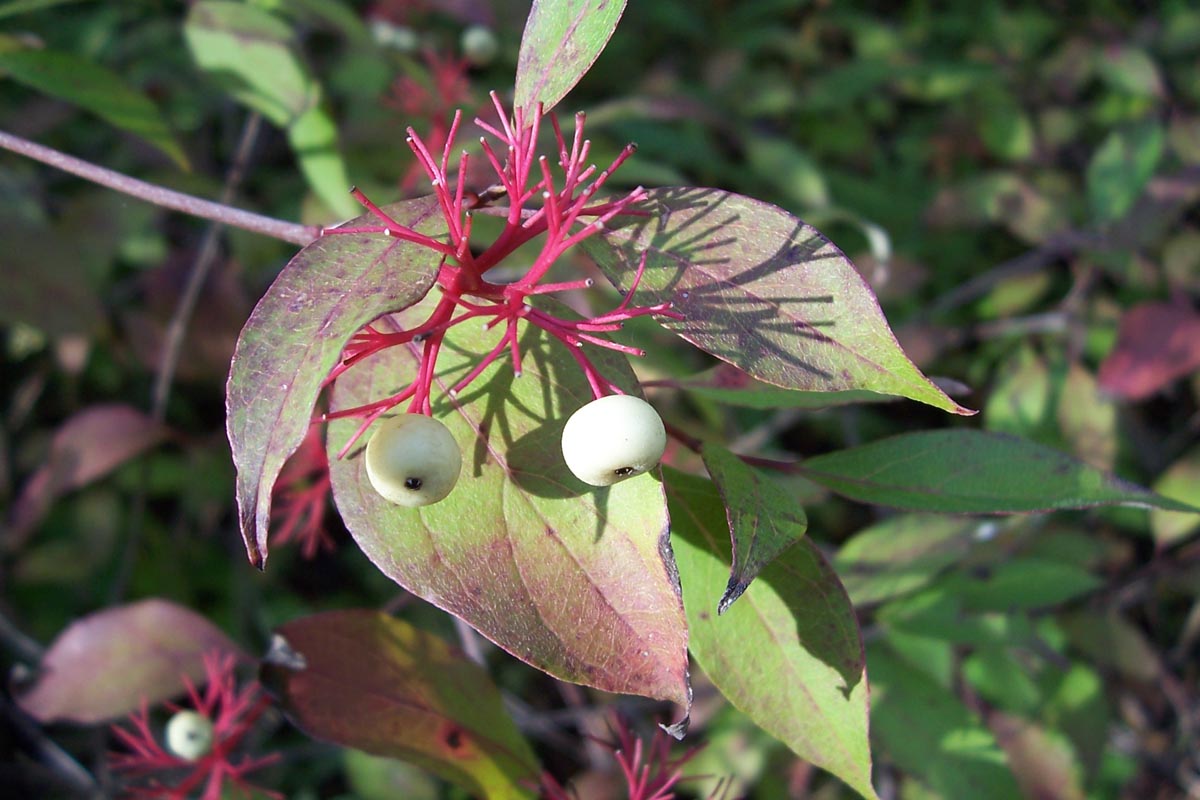
The fruit is a globose white berry 5–9 mm (0.20–0.35 in) in diameter. It is bitter and unpalatable.
It is a variable species, with two subspecies commonly accepted:
The Latin specific epithet sericea means "silky", referring to the texture of the leaves.
It is native throughout boreal and temperate zones in northern and western North America from Alaska east to Newfoundland, south to Durango and Nuevo León in the west, and Illinois and Virginia in the east.
Cornus sericea
Cornus sericea, the red osier or red-osier dogwood, is a species of flowering plant in the family Cornaceae, native to much of North America. It has sometimes been considered a synonym of the Asian species Cornus alba. Other names include red brush, red willow, redstem dogwood, redtwig dogwood, red-rood, American dogwood, creek dogwood, and western dogwood.
It is a medium to tall deciduous shrub, growing 1.5–4 metres (4.9–13.1 feet) tall and 3–5 m (9.8–16.4 ft) wide, spreading readily by underground stolons to form dense thickets. The branches and twigs are dark red, although wild plants may lack this coloration in shaded areas.
The leaves are opposite, 5–12 centimetres (2.0–4.7 inches) long and 2.5–6 cm (0.98–2.36 in) broad, with an ovate to oblong shape and an entire margin; they are dark green above and glaucous below; fall color is commonly bright red to purple. Like all dogwoods, they have characteristic stringy white piths within the leaf stalks, which can be used for identification.
The flowers are 5–10 millimetres (0.20–0.39 in) wide, flat, umbel-like and dull white, in clusters 3–6 centimetres (1.2–2.4 in) across.
The fruit is a globose white berry 5–9 mm (0.20–0.35 in) in diameter. It is bitter and unpalatable.
It is a variable species, with two subspecies commonly accepted:
The Latin specific epithet sericea means "silky", referring to the texture of the leaves.
It is native throughout boreal and temperate zones in northern and western North America from Alaska east to Newfoundland, south to Durango and Nuevo León in the west, and Illinois and Virginia in the east.
Recent media
Recent media