
Recent from talks
Corpse road
Knowledge base stats:
Talk channels stats:
Members stats:
Corpse road
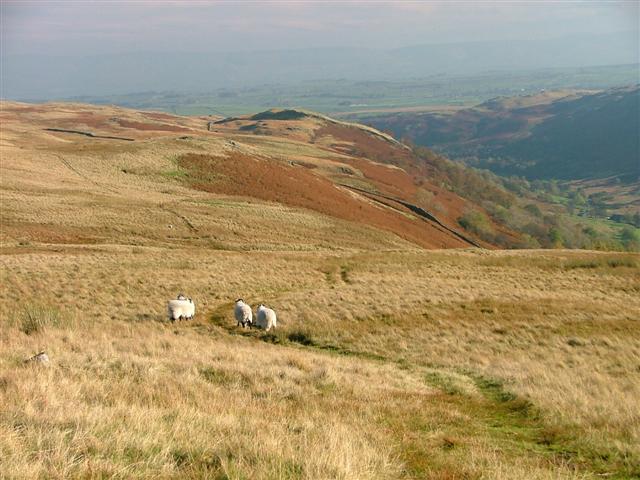
Corpse roads provided a practical means for transporting corpses, often from remote communities, to cemeteries that had burial rights, such as parish churches and chapels of ease. In Britain, such routes can also be known by a number of other names, including bier road, burial road, coffin line, coffin road, coffin walk, corpse way, funeral road, lych way, lyke way, and procession way. Such "church-ways" have developed a great deal of associated folklore regarding ghosts, spirits, wraiths, etc.
In late medieval times a population increase and an expansion of church building took place in Great Britain inevitably encroaching on the territories of existing mother churches or minsters. Demands for autonomy from outlying settlements made minster officials feel that their authority was waning, as were their revenues, so they instituted corpse roads connecting outlying locations and their mother churches (at the heart of parishes) that alone held burial rights. For some parishioners, this decision meant that corpses had to be transported long distances, sometimes through difficult terrain: usually a corpse had to be carried unless the departed was a wealthy individual. An example would be the funeral way that runs from Rydal to Ambleside in the Lake District where a coffin stone, on which the coffin was placed while the parishioners rested, still exists. Many of the 'new' churches were eventually granted burial rights and corpse roads ceased to be used as such.
Many of the corpse roads have long disappeared, while the original purposes of those that still survive as footpaths have been largely forgotten, especially if features such as coffin stones or crosses no longer exist. Fields crossed by church-way paths often had names like "Church-way" or "Kirk-way Field", and today it is sometimes possible to plot the course of some lost church-ways by the sequence of old field names, local knowledge of churches, local legends and lost features of the landscape marked on old maps, etc. One of the oldest superstitions is that any land over which a corpse is carried becomes a public right of way.
An example of a corpse road or way is that of the church of St Peter and Paul at Blockley, in Gloucestershire, which held the burial right to the inhabitants of the hamlets Stretton-on-Fosse in Warwickshire, where there was a chapel which became a rectory in the 12th century, and Aston Magna, where there was a chapel which was merely a chantry. All 'tithes' and 'mortuaries', however, came to the parish church of Blockley, to which church the people of Stretton and Aston were committed to carry their deceased for burial. The corpse road from Aston to Blockley churchyard is over two miles (3 km) long and crosses three small streams en route. The corpse road from Stretton to Blockley runs for some four miles (6 km) and crosses two streams.
One of the best preserved coffin walks is in Stawell in Somerset. Although some of the original path is on a private estate, the end of the coffin walk alongside the church of St Francis still links up with a public footpath. This footpath is believed to be the rest of the coffin walk which takes one up to the old Roman Road (A39) between Bridgwater and Street. Many local footpaths to also link up to this old road.
The essence of deep-rooted spirit lore is that supposed spirits of one kind or another – spirits of the dead, phantasms of the living, wraiths, or nature entities like fairies move through the physical landscape along special routes. In their ideal, pristine form, at least, such routes are conceived of as being straight, having something in common with ley lines. By the same token, convoluted or non-linear features hinder spirit movement i.e. labyrinths and mazes.
Spirits or ghosts were said to fly along on a direct course close to the ground, so a straight line connecting two places was kept clear of fences, walls, and buildings to avoid obstructing the flitting spectres. The paths would run in a straight line over mountains and valleys and through marshes. In towns, they would pass the houses closely or go right through them. The paths end or originate at a cemetery; therefore, such a path or road was believed to have the same characteristics as a cemetery, where spirits of the deceased thrive.
The corpse roads or ways were left unploughed and it was considered very bad luck if for any reason a different route had to be taken.
Hub AI
Corpse road AI simulator
(@Corpse road_simulator)
Corpse road
Corpse roads provided a practical means for transporting corpses, often from remote communities, to cemeteries that had burial rights, such as parish churches and chapels of ease. In Britain, such routes can also be known by a number of other names, including bier road, burial road, coffin line, coffin road, coffin walk, corpse way, funeral road, lych way, lyke way, and procession way. Such "church-ways" have developed a great deal of associated folklore regarding ghosts, spirits, wraiths, etc.
In late medieval times a population increase and an expansion of church building took place in Great Britain inevitably encroaching on the territories of existing mother churches or minsters. Demands for autonomy from outlying settlements made minster officials feel that their authority was waning, as were their revenues, so they instituted corpse roads connecting outlying locations and their mother churches (at the heart of parishes) that alone held burial rights. For some parishioners, this decision meant that corpses had to be transported long distances, sometimes through difficult terrain: usually a corpse had to be carried unless the departed was a wealthy individual. An example would be the funeral way that runs from Rydal to Ambleside in the Lake District where a coffin stone, on which the coffin was placed while the parishioners rested, still exists. Many of the 'new' churches were eventually granted burial rights and corpse roads ceased to be used as such.
Many of the corpse roads have long disappeared, while the original purposes of those that still survive as footpaths have been largely forgotten, especially if features such as coffin stones or crosses no longer exist. Fields crossed by church-way paths often had names like "Church-way" or "Kirk-way Field", and today it is sometimes possible to plot the course of some lost church-ways by the sequence of old field names, local knowledge of churches, local legends and lost features of the landscape marked on old maps, etc. One of the oldest superstitions is that any land over which a corpse is carried becomes a public right of way.
An example of a corpse road or way is that of the church of St Peter and Paul at Blockley, in Gloucestershire, which held the burial right to the inhabitants of the hamlets Stretton-on-Fosse in Warwickshire, where there was a chapel which became a rectory in the 12th century, and Aston Magna, where there was a chapel which was merely a chantry. All 'tithes' and 'mortuaries', however, came to the parish church of Blockley, to which church the people of Stretton and Aston were committed to carry their deceased for burial. The corpse road from Aston to Blockley churchyard is over two miles (3 km) long and crosses three small streams en route. The corpse road from Stretton to Blockley runs for some four miles (6 km) and crosses two streams.
One of the best preserved coffin walks is in Stawell in Somerset. Although some of the original path is on a private estate, the end of the coffin walk alongside the church of St Francis still links up with a public footpath. This footpath is believed to be the rest of the coffin walk which takes one up to the old Roman Road (A39) between Bridgwater and Street. Many local footpaths to also link up to this old road.
The essence of deep-rooted spirit lore is that supposed spirits of one kind or another – spirits of the dead, phantasms of the living, wraiths, or nature entities like fairies move through the physical landscape along special routes. In their ideal, pristine form, at least, such routes are conceived of as being straight, having something in common with ley lines. By the same token, convoluted or non-linear features hinder spirit movement i.e. labyrinths and mazes.
Spirits or ghosts were said to fly along on a direct course close to the ground, so a straight line connecting two places was kept clear of fences, walls, and buildings to avoid obstructing the flitting spectres. The paths would run in a straight line over mountains and valleys and through marshes. In towns, they would pass the houses closely or go right through them. The paths end or originate at a cemetery; therefore, such a path or road was believed to have the same characteristics as a cemetery, where spirits of the deceased thrive.
The corpse roads or ways were left unploughed and it was considered very bad luck if for any reason a different route had to be taken.
Recent media