Hubbry Logo
search
logo
Cosmati
Cosmati
current hub
1909632

Cosmati

logo
Community Hub0 Subscribers
Read side by side
from Wikipedia

The Cosmati were a Roman family, seven members of which, for four generations, were skilful architects, sculptors and workers in decorative geometric mosaic, mostly for church floors.[1]

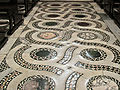
Their name is commemorated in the genre of Cosmatesque work, often just called "Cosmati", a technique of opus sectile ("cut work") formed of elaborate inlays of small triangles and rectangles of colored stones and glass mosaics set into stone matrices or encrusted upon stone surfaces. Bands, panels and shaped reserves of intricate mosaic alternate with contrasting bands, guilloches and simple geometric shapes of plain white marble. Pavements and revetments were executed in Cosmatesque technique, columns were inlaid with fillets and bands, and immovable church furnishings like cathedras and ambones were similarly treated. Initial inspiration for the technique was Byzantine, transmitted through Ravenna and Sicily, while some of the minutely-figured tiling patterns are Islamic in origin, transmitted through Sicily.

In addition, members of the Cosmati engaged in commerce in ancient sculptures, some unearthed in the course of excavating for marbles for reuse. More than one ancient Roman sculpture has survived with the name of one of these craftsmen incised in it.[2]

The following are the main known Cosmati:

  1. Lorenzo (dated works 1190–1210 but probably active earlier)
  2. Jacopo (dated works 1205 and 1210)
  3. Cosimo (1210–1235)
  4. Luca (1221–1240)
  5. Jacopo (1213–1293)
  6. Deodato (1225–1303)
  7. Giovanni (1231 and 1235)
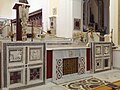
Papal throne and choir-screen in San Lorenzo fuori le Mura, c. 1254

The earliest recorded work was executed for a church at Fabieri in 1190 (Lorenzo) (CE). The principal works of the Cosmati in Rome are:

The chief signed works by Jacopo the younger and his brother Luca are at Anagni and Subiaco.[1]

A large number of other works by members and pupils of the same family, but unsigned, exist in Rome. These are mainly altars and baldacchini, choir-screens, paschal candlesticks, ambones, tombs and the like, all enriched with sculpture and glass mosaic of great brilliance and decorative effect.[1]

Besides the more mechanical sort of work, such as mosaic patterns and architectural decoration, they also produced mosaic pictures and sculpture of very high merit, especially the recumbent effigies, with angels standing at the head and foot, in the tombs of Aracoeli, S. Maria Maggiore and elsewhere. One of their finest works is in S. Cesareo; this is a marble altar richly decorated with mosaic in sculptured panels, and (below) two angels drawing back a curtain (all in marble) so as to expose the open grating of the confessio. The magnificent cloisters of Basilica of Saint Paul Outside the Walls, built about 1285 by Giovanni, the youngest of the Cosmati, are one of the most beautiful works of this school. The baldacchino of the same basilica is a signed work of the Florentine Arnolfo di Cambio, 1285, cum suo socio Petro, probably a pupil of the Cosmati. Other works of Arnolfo, such as the Braye tomb [it] at Orvieto, show an intimate artistic alliance between him and the Cosmati. The equally magnificent cloisters of the Lateran, of about the same date, are very similar in design; both these triumphs of the sculptor-architects and mosaicists work have slender marble columns, twisted or straight, richly inlaid with bands of glass mosaic in delicate and brilliant patterns.[1] In the crypt at Anagni is the largest section of undisturbed Cosmatesque flooring.

Cosmatesque decoration is not entirely confined to Rome, or even to Italy. At Westminster Abbey there are two Cosmatesque pavements, the finest north of the Alps[3] set in Purbeck Marble: one is the Great Pavement before the high altar, the other the paving and decor associated with the shrine of Edward the Confessor in the Sanctuary, both works executed about 1268 for the connoisseur-king Henry III. They are extremely unusual in England: more characteristic luxury flooring in England consisted of lead-glazed ceramic tiles painted in patterns. This mosaic is depicted in Hans Holbein's The Ambassadors.

The general style of works of the Cosmati school is more closely related to Romanesque art, even though some of the buildings they worked in are Gothic, as in their main lines are their larger structures, especially in the elaborate altar-canopies, with their pierced geometrical tracery. In detail, however, they differ widely from the purer Gothic of northern countries. The richness of effect which the English or French architect obtained by elaborate and carefully worked mouldings was produced in Italy by the beauty of polished marbles and jewel-like mosaics; the details being mostly rather coarse and often carelessly executed.[1]

Ecclesiastical patronage in Rome dried up with the removal of the Papacy to Avignon in 1305, and by the time the curial court had returned and the ensuing schism had been settled a hundred years later, the craft tradition had lapsed. The differential resistance of the stones used in Cosmati work, marbles, porphyry and other coloured stones has resulted in uneven wear on pavements, which have been periodically repaired, whether finely or coarsely, since the late Middle Ages, with the result that modern assessments of the quality of individual works may be compromised by overlooking later repairs.

[edit]

References

[edit]

Literature

[edit]
  • "Cosmati Mosaic" in the Catholic Encyclopedia (1908).
  • Dorothy Glass (1984).?
  • Linda Grant and Richard Mortimer (2002). Westminster Abbey: The Cosmati Pavements. Courtauld Institute Research Papers, No. 3. Online review
  • Paloma Pajarez-Ayuela (2001). Cosmatesque Ornament: Flat Polychrome Geometric Patterns in Architecture. London and New York: WW Norton. Online review
Revisions and contributorsEdit on WikipediaRead on Wikipedia
from Grokipedia
The Cosmati, or Cosmatesque, refers to the intricate geometric decorative style developed by several Roman families of marble workers and mosaicists active in the 12th and 13th centuries, spanning multiple generations, best known for creating inlays using colored marbles, glass, and ancient stone fragments.[1][2][3] This technique, often termed opus sectile or "cut work," involved assembling precisely cut pieces into complex patterns of circles, squares, stars, and interlocking shapes, primarily adorning church floors, altars, cloisters, and architectural elements.[2] Originating from workshops in medieval Rome, the Cosmati passed down specialized knowledge of mosaic craftsmanship, blending Byzantine influences with repurposed materials from ancient Roman ruins, such as porphyry and serpentine marbles, to create enduring liturgical and ornamental features.[1] Their work flourished during a period of ecclesiastical rebuilding and artistic revival in Rome, where they received commissions from the papacy and major basilicas, contributing to the city's medieval artistic heritage.[2] Key characteristics of Cosmatesque work include vibrant color contrasts achieved with red, green, yellow, and blue glass tesserae alongside white marble frames, often incorporating subtle Christian symbolism like crosses and wheels within the geometric designs.[1] The style emphasized precision and harmony, recycling spolia—salvaged ancient columns and fragments—to evoke continuity between antiquity and the Christian era.[2] Notable examples of Cosmati craftsmanship survive in Roman churches such as the Basilica of San Clemente (with its labyrinthine floor mosaics), Santa Maria Maggiore (featuring a central red porphyry disc), and the cloister of San Paolo fuori le Mura, as well as the cathedra in the Lateran Basilica.[2] Their influence extended beyond Italy, inspiring similar pavements like the 13th-century mosaic at Canterbury Cathedral and the Cosmati floor at Westminster Abbey, laid in 1268 by Roman craftsmen led by Odoricus.[4][5] Today, Cosmatesque work remains a testament to medieval Roman artistry, preserved in over 20 major sites and studied for its technical innovation and symbolic depth.[1]

Overview

Definition

Cosmati, also known as Cosmatesque, is a style of geometric decorative inlay stonework that emerged in medieval Italy, characterized as a form of opus sectile in which precisely cut pieces of colored marble and stone are fitted and inlaid into a white marble base to create intricate, harmonious patterns.[2] This technique, known as "cut work," differs from traditional mosaics by employing larger, shaped pieces rather than uniform tesserae, allowing for bold contrasts and fluid designs.[5] The term derives from the Cosmati, a renowned family of Roman artisans who specialized in this craft over four generations from the 12th to the 14th centuries, producing works that exemplify precision and aesthetic refinement.[6] Prominent members such as Laurentius (Lorenzo), Jacobus (Jacopo), and Odericus (Odoricus)[5] led workshops that honed and propagated the style, often reusing ancient Roman spolia to infuse their creations with historical depth.[6][2] Primarily utilized in ecclesiastical architecture, Cosmati work decorates church floors, altars, ambons, and balustrades, featuring motifs like guilloche borders, roundels, and interlocking geometric shapes that convey eternity and balance.[2] These designs symbolized cosmic order and divine geometry, drawing on medieval cosmology to represent the universe's structured harmony.[5]

Characteristics

Cosmati work is distinguished by its intricate geometric motifs, including circles, stars, crosses, and braided guilloche patterns, which collectively evoke notions of infinity and the cosmic order. These elements often form modular compositions that blend repetition and variation, creating a sense of eternal movement and harmony reflective of theological ideals. For instance, the quincunx motif—a central roundel encircled by four others—symbolizes Christian cosmology, representing the tetramorph of the evangelists and the structure of the universe.[7] A key aesthetic feature is the striking contrast between a luminous white Carrara marble background and vibrant inlays of colored stones, such as red porphyry and green serpentine, which heighten visual depth and draw the eye toward symbolic layers. Porphyry, with its imperial purple-red hue, traditionally signified sacrificial blood and divine passion in medieval Christian art, while serpentine's verdant tone contributed to the overall palette evoking renewal and earthly vitality. This material interplay not only enhances the decorative appeal but also underscores theological themes of creation and redemption.[5][8] Symbolically, Cosmati patterns frequently represent the cosmos, as seen in designs interpreting the universe's vastness and its eschatological end, inviting contemplation of divine infinity. Labyrinthine arrangements within the geometry symbolize the pilgrimage of the soul, guiding viewers through a metaphorical journey toward spiritual enlightenment. Numerological elements, such as repetitions tied to the number 12, allude to the apostles and completeness in Christian doctrine, integrating sacred numerology into the visual fabric.[5][7] The scale and intricacy of Cosmati designs allow for expansive coverage in architectural settings while preserving meticulous precision in individual components, with precisely cut pieces of varying sizes to ensure seamless integration. This modular approach enables artists to adapt patterns to large surfaces without sacrificing fine detail, resulting in pavements that function both as functional floors and profound meditative aids. The style, developed by the Cosmati family of Roman decorators, exemplifies this balance of grandeur and delicacy.[7]

History

Origins in Medieval Rome

The Cosmatesque style, commonly referred to as Cosmati work, emerged in Rome during the mid-12th century, approximately 1140–1150, coinciding with the city's cultural and artistic revival as a papal center following the resolution of the Investiture Controversy in 1122. This conflict's end bolstered the authority of the papacy, enabling renewed church building and decoration projects that stimulated specialized craftsmanship in marble inlays. The style's roots trace to 11th-century Monte Cassino, where Byzantine-influenced marble workers laid early geometric pavements under Abbot Desiderius (r. 1058–1087), bridging eastern techniques to Roman workshops. These influences were localized for Romanesque and early Gothic contexts, emphasizing geometric motifs that evoked both antiquity and contemporary liturgical symbolism.[9][10] Pioneered by family-run workshops, including those of the Vassalletto and Cosmati, the practice drew inspiration from ancient Roman opus sectile— a technique of cutting and assembling colored marbles into patterns— and Byzantine mosaics, which introduced vibrant, tessellated designs suited to ecclesiastical spaces. The Cosmati workshop, in particular, originated as a hereditary guild-like tradition under Laurentius Cosmati (active from 1162, d. ca. 1210), whose family members transmitted skills across generations, collaborating with related groups like the Vassalletto to standardize the craft.[9][10] Papal patronage under Innocent III (r. 1198–1216) played a pivotal role in elevating the style, with commissions for church restorations that integrated these innovative elements. One of the early documented applications appears in the pavement of Santa Maria in Trastevere, executed in the 13th century, where the workshops' geometric arrangements enhanced the basilica's nave and presbytery. This support not only elevated the Cosmati and Vassalletto artisans but also embedded the style within Rome's burgeoning papal artistic program.[10][9]

Development and Patronage

The Cosmati workshops experienced significant expansion in the 13th century, particularly under the patronage of Popes Innocent III (1198–1216) and Honorius III (1216–1227), who commissioned extensive opus sectile decorations across numerous Roman basilicas, including St. Peter's Basilica and the Archbasilica of St. John Lateran.[11] These commissions, exceeding 20 in total within Rome's major churches, reflected the popes' efforts to revitalize ecclesiastical architecture amid the city's resurgence as a papal center.[12] The workshops' growth was supported by institutional backing from the papacy, enabling the production of intricate geometric inlays that adorned floors, ambones, and ciboria. Key figures in this development included Jacopo Cosmati, active from the early 13th century (with signed works in 1205 and 1210), and his sons Cosma, Luca, and Deodatus, who expanded the family's operations to handle larger-scale projects such as ambulatory pavements and altar canopies.[3] Their innovations involved refining assembly techniques for more complex patterns, allowing for efficient replication across multiple sites while maintaining the style's signature balance of colored marbles and porphyry.[11] This familial collaboration marked a shift toward industrialized workshop practices, with signed works like those in Santa Maria in Aracoeli demonstrating their technical advancements. The initial export of Cosmati expertise began with craftsmen traveling to southern Italy, notably to Anagni in the 1220s, where they adapted Roman geometric motifs to blend with local architectural traditions in cathedrals and crypts.[13] These ventures, often under cardinal or papal oversight, introduced Cosmatesque elements to regional patronage networks beyond Rome. Economically, the widespread adoption by papal and cardinal patrons was facilitated by the strategic use of salvaged materials—spolia from ancient Roman ruins—which provided abundant, low-cost supplies of colored stones and reduced the need for new quarrying.[14] This practice not only lowered production expenses but also imbued the works with a sense of historical continuity, appealing to elite commissioners seeking to evoke imperial grandeur in medieval contexts.[2]

Decline and Later Use

The production of Cosmati work began to wane from around 1300, primarily due to the relocation of the papal court to Avignon in 1309, which severely curtailed the ecclesiastical patronage that had sustained the Roman workshops.[15] This shift left Rome economically and artistically diminished, with fewer major commissions for opus sectile inlays as resources and skilled artisans dispersed. The Black Death of 1348 exacerbated this interruption, devastating populations and disrupting craft traditions across Italy by killing many workers and halting construction projects.[16] Artistic preferences also evolved, favoring more narrative frescoes and painted ceramic tiles over geometric stone mosaics, as exemplified by the rising influence of painters like Giotto in early 14th-century church decorations.[17] The final significant efforts by the Cosmati family occurred around 1300, with Odoricus Cosmati contributing to prestigious projects like the sanctuary pavement at Westminster Abbey, laid in 1268.[18] By the early 14th century, though the family's major output waned, minor Cosmatesque pieces persisted sporadically in Roman churches into the 15th century, often as repairs or small-scale adaptations by successor workshops, with Deodatus active until at least 1332.[19] Revivals emerged in the 19th and 20th centuries amid restorations of medieval basilicas, where neo-Cosmati techniques imitated original inlays using salvaged marbles for liturgical elements like altars and screens. These modern imitations extended to custom furniture in churches, blending authenticity with contemporary needs. Preservation of Cosmati pavements faces ongoing threats from centuries of foot traffic, which erodes delicate inlays and dislodges tesserae, necessitating periodic cleaning and consolidation as seen in recent interventions at sites like Westminster Abbey. Additionally, looting during the Napoleonic era (1796–1815) targeted Italian ecclesiastical treasures, though many pavements survived in situ due to their fixed nature.[20]

Materials and Techniques

Materials Sourced

Cosmati works primarily utilized a palette of durable, vividly colored stones selected for their aesthetic contrast and symbolic ties to antiquity. The base material was typically white Carrara marble, quarried from the Apuan Alps in northern Italy, prized for its fine grain, purity, and ability to provide a clean backdrop for intricate inlays.[18] Red porphyry, known as imperial red or rosso antico, originated from the ancient quarries of Mons Porphyrites in Egypt's Eastern Desert; this hard, feldspar-rich igneous rock, with its distinctive purple-red hue and white inclusions, was valued for its rarity, polishability, and resistance to wear, making it ideal for bold geometric accents.[21] Green serpentine, sourced from Ligurian deposits near Genoa in northwest Italy, featured a mottled, waxy texture and vibrant emerald tones due to its metamorphic composition rich in magnesium and iron; its subtle veining added depth to patterns. Yellow Sienese marble, extracted from quarries around Siena in Tuscany, offered a warm ochre shade from its limestone base with iron impurities, providing luminous highlights. Black Nero antico, a fine-grained black limestone from Simitthus (modern Chemtou) in Tunisia, contributed sharp, matte contrasts essential for defining edges and shadows in designs.[22][23] A significant portion of these materials—often the majority—were salvaged through spoliation practices, repurposing fragments from ancient Roman ruins to emphasize continuity with classical heritage and promote sustainable upcycling in an era of limited new quarrying. Stones were recycled from sites like the Roman Forum, Colosseum, and imperial palaces, where porphyry columns, serpentine basins, and marble panels were dismantled and recut, transforming debris into vibrant new compositions. This approach not only conserved resources but also imbued Cosmati pavements with historical resonance, as the reused marbles carried traces of their pagan origins into Christian sacred spaces.[18][10] Supplementary materials enhanced the visual complexity, particularly in areas requiring finer details or metallic sheen. Opaque colored glass tesserae in shades of red, blue, and turquoise were incorporated as small accents, offering translucency and brilliance that stone alone could not achieve; these were often produced locally from silica and metallic oxides. Occasional elements included gilded glass tiles, backed with gold leaf for a shimmering effect, to evoke opulence in liturgical furnishings.[5] Sourcing logistics centered on Rome as a hub for both quarrying and recycling, with local Italian stones like Carrara marble and Ligurian serpentine transported via overland routes from northern regions. Imported varieties, such as Egyptian porphyry and Tunisian marbles, arrived through established Mediterranean trade ports like Ostia and Civitavecchia, leveraging ancient Roman networks that persisted into the medieval period; once in Rome, materials were stored in workshops near the city's ruins for processing and distribution to ecclesiastical patrons.[21][23]

Inlay and Assembly Methods

The creation of Cosmati work begins with the preparation of the base surface, where thin marble slabs, typically 1-2 cm thick, are laid onto mortar beds to provide a stable foundation for the inlaid design.[5] Designs are meticulously drawn using compasses to ensure geometric symmetry and precision in the intricate patterns characteristic of opus sectile technique.[2] Stones are then cut into precise shapes, often sawn with iron blades embedded with abrasives such as sand or emery to achieve clean edges suitable for interlocking.[24] Iron chisels are employed to refine the pieces, allowing for the formation of polygons like triangles, squares, and discs without gaps, creating a seamless inlay that defines the opus sectile method.[25] During assembly, the cut pieces are hammered into shallow grooves carved in the base slab, ensuring tight fits that rely on friction and gravity rather than adhesives for stability.[26] The surface is subsequently polished using pumice to enhance luster and uniformity, with modular panels constructed to facilitate disassembly and transport to installation sites.[24] The precision required in these processes was preserved through family-based apprenticeships among Roman marmorari guilds, such as the Cosmati lineage, where skills in tool handling and pattern execution were passed down across generations to maintain the art's high standards.[2]

Architectural Applications

Floor Pavements

Cosmati floor pavements were primarily designed for durability underfoot, incorporating robust geometric patterns such as guilloche borders and quincunx motifs to withstand constant treading while guiding ecclesiastical processions along wide, delineated paths.[7] The patterns drew from opus sectile inlay techniques, where precisely cut marble pieces were assembled to create interlocking forms that resisted wear.[27] In terms of scale, these pavements varied from small sanctuary areas to larger nave sections, allowing for grand visual impact during liturgical events; for instance, the sanctuary pavement at Westminster Abbey measures approximately 7 by 7 meters.[5] Modular construction enabled adaptation to curved ambulatories and irregular spaces, such as those in cloisters, by repeating geometric units like circles, squares, and triangles in a tessellated manner.[7] In examples like Westminster Abbey, mortar beds used hydraulic lime mixed with crushed terracotta to enhance durability in damp environments.[27] Theologically, Cosmati floors served as "cosmic carpets," evoking the universe's order and the believer's path to salvation through symbolic motifs like the River of Life and Resurrection imagery embedded in the geometric designs.[7] These elements transformed the act of walking upon them into a metaphor for spiritual progression, aligning with medieval Christian cosmology where the pavement represented the macrocosm and its eschatological fulfillment.[5]

Altars, Tombs, and Other Features

In Cosmati work, altars and ciboria were often adorned with inlaid marble panels featuring geometric motifs and twisted columns in the Solomonic style, creating a visual hierarchy that elevated the sacred space. For instance, the ciborium at Santa Cecilia in Trastevere, executed by Arnolfo di Cambio in 1293, incorporates white marble with trefoil arches and Cosmatesque geometric insets, supported by slender shafts that enhance the canopy's luminous effect through contrasting colored marbles like porphyry and serpentine. Similarly, fragments of a ciborium attributed to Deodatus Cosmati survive in the cloister of St. John Lateran, showcasing ribbon mosaics and classical-inspired designs that reflect light upward to symbolize divine illumination. Tombs and thrones utilized Cosmati techniques for sarcophagi framed in geometric patterns and episcopal seats with intricate inlays, adapting the opus sectile method to vertical surfaces for a sense of grandeur and permanence. The papal cathedra in the cloister of St. John Lateran, dating to the 1280s, exemplifies this with its Cosmatesque decoration of geometric borders and marble contrasts, originally part of the basilica's apse furnishings before relocation.[28] Notable tombs include that of Cardinal Gonsalvus in Santa Maria Maggiore, crafted by Johannes Magister Cosmati in 1299, featuring a Cosmati Madonna with the Virgin and infant Christ alongside figures of the Bishop of Albi, St. Matthias, and St. Jerome, all set within a frame of star and lozenge motifs. Another example is the 1286 tomb of Cardinal Ancher in Santa Prassede, with an effigy in robes surrounded by mosaic panels that emphasize height through vertical radiating lines.[28] Other features such as paschal candlesticks, ambo pulpits, choir screens, and schola cantorum employed Cosmati inlays on a smaller, often portable scale, with designs prioritizing verticality and light reflection to guide worshippers' gazes. Paschal candlesticks, like those at San Lorenzo fuori le Mura standing on twin lions, feature spiral-fluted shafts with checkerboard and star patterns in tinted glass tesserae and marble, reaching heights up to 7.5 meters to dramatically illuminate Easter rites; similar examples appear in San Clemente with ribbon mosaics enhancing their twist.[29] Ambo pulpits, such as the gospel ambo in San Lorenzo and the epistle ambo by Laurencius in Santa Maria in Cosmedin, incorporate eagle supports and geometric frames that radiate outward, using portable marble slabs for liturgical flexibility. Choir screens, seen in San Clemente and Santa Maria in Cosmedin, divide nave and sanctuary with perforated geometric panels and twisted colonnettes, their inlays of gold and colored glass creating a shimmering barrier that draws light through to the altar. These adaptations, often signed by family members like Laurencius or Jacobus, utilized repurposed antique marbles for contrast, ensuring durability and symbolic depth in non-ambulatory contexts.[2]

Notable Works

Major Sites in Italy

Prominent examples of Cosmati work survive in Old St. Peter's Basilica, where the floor pavements featured intricate geometric designs using recycled ancient marbles, including porphyry roundels, dating to the 12th and 13th centuries.[2] In the Basilica of Santa Maria Maggiore in Rome, the 13th-century ambulatory pavement exemplifies Cosmati mastery through its radiant star patterns formed by interlocking discs and bands of porphyry, green serpentine, and white marble, evoking celestial motifs that complement the basilica's Marian devotion.[30] The tomb of Cardinal Gonzalo Rodriguez Hinojosa, crafted in the 13th century by Giovanni Cosmati, stands as a highlight with its arched canopy adorned in geometric mosaics and inscribed effigy, blending sculptural elegance with opus sectile techniques to honor the cardinal's legacy.[31] The Cathedral of Anagni, south of Rome, houses a remarkable Cosmati crypt floor dating to 1231, designed as a microcosm of the universe with fractal-like geometric patterns that mirror cosmic order and infinity, laid in contrasting marbles to symbolize divine harmony beneath the frescoed vaults.[32] In the presbytery above, twisted columns inlaid with Cosmati motifs further unify the space, their helical forms drawing on ancient Roman precedents while integrating vibrant stone tesserae for a sense of upward spiritual ascent.[33] Other notable Italian sites include the labyrinthine floor mosaics in the Basilica of San Clemente and the cathedra in the Lateran Basilica, both showcasing the precision of Cosmati geometric inlays.[2]

Examples Outside Italy

The spread of Cosmati techniques beyond Italy occurred primarily through the migration of Roman craftsmen, facilitated by papal networks that connected the Roman Curia with northern European monarchs and ecclesiastical patrons. During the 13th century, these connections enabled the export of skilled artisans to England, where King Henry III, seeking to emulate Roman imperial grandeur amid political recovery from civil unrest, commissioned works that adapted the opus sectile style to local materials.[34][35] One of the most prominent examples is the sanctuary pavement at Westminster Abbey, laid in 1268 on the orders of Henry III as part of his Gothic rebuilding of the abbey. Executed by a team of Roman workmen led by the artisan Odoricus (also known as Odericus), the pavement measures approximately 7.6 meters square and features intricate geometric patterns inlaid with purple porphyry from Egypt, green serpentine, yellow limestone, onyx, and colored glass pieces, set against a base of local Purbeck marble—a dark limestone that replaced the white marble typical in Italian works. At its center lies a cosmological wheel, or quincunx design, symbolizing the macrocosm of the universe and the microcosm of humanity, with surrounding inscriptions in brass letters alluding to the world's duration of 19,683 years and the four elements. This adaptation to northern European marbles not only reduced costs but also integrated the Cosmati aesthetic with local resources, marking a key instance of stylistic transmission.[5][34] Fragments of possible Cosmati work survive at Canterbury Cathedral, dating to the early 13th century and associated with the reconstruction of the Trinity Chapel pavement around the 1230s. These include inlays of purple and green porphyry, white Carrara marble (now discolored), black Tournai marble, and other imported stones, reassembled after a fire in 1174 damaged the original Romanesque mosaic. Petrological analysis confirms the use of Italian-sourced materials, leading scholars to attribute the alterations to traveling Cosmati mosaicists hired by the cathedral chapter, possibly in preparation for Henry III's 1236 marriage celebrations. The attribution remains debated, with some questioning whether the fragments represent direct Roman intervention or local emulation, but the presence of signature Cosmati geometric motifs supports the involvement of Italian experts.[4] In France, direct examples of Cosmati work are limited, largely due to the interruption of Roman production in the 14th century following the transfer of the papal seat to Avignon, which disrupted the flow of craftsmen and materials northward. Influences appear indirectly in 14th-century features such as the choir screens at the Basilica of Saint-Denis, where geometric inlay techniques echo Cosmati patterns, potentially transmitted through monastic networks like the Cistercian orders that facilitated artistic exchanges across Europe. Adaptations in northern Europe often substituted scarce imported marbles with regional varieties, preserving the geometric precision while aligning with local availability.[3]

Legacy

Influence on European Art

The geometric precision and intricate inlay techniques of Cosmati work exerted a notable influence on medieval European art, particularly in the development of Gothic decorative elements. The style's emphasis on interlocking patterns inspired aspects of Gothic tracery, where linear motifs and repetitive geometries echoed the sectile compositions seen in Roman pavements. This stylistic spread was facilitated by contacts during the Crusades, which introduced Islamic geometric tile designs from the Levant and Sicily to southern Italy, blending with local Roman traditions to enrich Cosmati aesthetics before their dissemination northward. In England, the adoption of Cosmati techniques is evident in the Decorated style floors of Westminster Abbey, where Roman craftsmen like Odericus and Petrus Romanus created mosaics that integrated with Gothic architectural forms, influencing the English Court Style through hybrid tracery and inlay designs.[7][36][34] Liturgically, Cosmati pavements shaped ecclesiastical flooring across monastic and cathedral contexts, symbolizing cosmic order and divine hierarchy through their patterned motifs. These floors, often placed before altars, reinforced ritual symbolism, as seen in the coronation pavement at Westminster Abbey, where Cosmati elements underscored royal and sacred authority during ceremonies like Edward I's 1274 coronation.[34][37] During the Renaissance, Cosmati's legacy contributed to renewed interest in classical proportion and perspective in Florentine architecture, with figures like Filippo Brunelleschi and Leon Battista Alberti drawing on Roman inlay traditions for spatial harmony. This revival highlighted Cosmati's role in bridging medieval and humanist aesthetics, emphasizing mathematical precision in decorative arts.[38] Cross-cultural exchanges underpinned Cosmati's evolution. Parallels with Byzantine opus Alexandrinum are evident in the shared use of contrasting marbles for guilloche patterns, a technique refined in Constantinople and adapted by Cosmati artisans to suit papal commissions, fostering a synthesis of Eastern and Western geometric traditions.[39][34]

Modern Revivals and Preservation

In the 19th century, the Victorian Gothic Revival in England sparked renewed interest in medieval decorative techniques, including Cosmati work. At Westminster Abbey, restorations of the 13th-century Cosmati Pavement involved the analysis and replication of original medieval mortars, such as lime-based mixtures with aggregates like crushed brick and marble fragments, to maintain authenticity during repairs conducted in the mid-1800s under architects like George Gilbert Scott.[40] Twentieth-century scholarship advanced the understanding and conservation of Cosmati works through systematic documentation. Richard Krautheimer's multivolume Corpus Basilicarum Christianarum Romae, with its first installment published in 1937, cataloged the architectural features of early Christian basilicas in Rome, including detailed descriptions of Cosmati pavements and inlays, providing a foundational reference for subsequent restoration projects. This effort complemented broader initiatives, such as the UNESCO inscription in 1980 of the Historic Centre of Rome as a World Heritage Site, which includes key basilicas like Saint John Lateran and Saint Paul's Outside the Walls—both renowned for their Cosmati floors—and mandates ongoing preservation measures. Contemporary preservation of Cosmati works confronts significant challenges from mass tourism and urban pollution in Rome, where millions of annual visitors contribute to abrasion of marble surfaces and acidic deposition accelerates degradation of porphyry and serpentine inlays.[41] To address these issues, conservation strategies increasingly incorporate non-invasive technologies, such as high-resolution 3D scanning, to create digital replicas for study and virtual replicas that reduce physical foot traffic on originals. Recent efforts include conservation projects at Westminster Abbey, where the Cosmati pavement underwent restoration and was featured in lectures on salvage and preservation as of 2024.[42]

References

User Avatar
No comments yet.