


Community hub
Recent from talks
Contribute something
Nothing was collected or created yet.
Inlay
View on Wikipedia

Inlay covers a range of techniques in sculpture and the decorative arts for inserting pieces of contrasting, often colored materials into depressions in a base object to form ornament or pictures that normally are flush with the matrix.[1] A great range of materials have been used both for the base or matrix and for the inlays inserted into it. Inlay is commonly used in the production of decorative furniture, where pieces of colored wood, precious metals or even diamonds are inserted into the surface of the carcass using various matrices including clear coats and varnishes. Lutherie inlays are frequently used as decoration and marking on musical instruments, particularly the smaller strings.
Perhaps the most famous example of furniture inlay is that of André-Charles Boulle (1642–1732) which is known as Boulle work and evolved in part from inlay produced in Italy during the late 15th century at the studiolo for Federico da Montefeltro in his Ducal Palace at Urbino, in which trompe-l'œil shelving seems to carry books, papers, curios and mathematical instruments, in eye-deceiving perspective. The similar private study made for him at Gubbio is now in the Metropolitan Museum of Art.
Inlay in wood
[edit]

In a wood matrix, inlays commonly use wood veneers, but other materials like shells, mother-of-pearl, horn or ivory may also be used. Pietre dure, or coloured stones inlaid in white or black marbles, and inlays of precious metals in a base metal matrix, are other forms of inlay. Master craftspeople who make custom knives continue a tradition of ancient techniques of inlaying precious metals; additionally, many new techniques which use contemporary tools have also been developed and utilized as well by artisans.
Intarsia inlay in wood furniture differs from marquetry, a similar technique that largely replaced it in high-style European furniture during the 17th century,[2] in that marquetry is an assembly of veneers applied over the entire surface of an object, whereas inlay consists of small pieces inserted on the bed of cut spaces in the base material, of which most remains visible.
Inlay on metals
[edit]_with_geometric_decoration.jpg)

The history of inlay is very old but it is still evolving alongside new technologies and new materials being discovered today. The technique of metal in metal inlay was sophisticated and accomplished in ancient China as shown in examples of vessels decorated with precious metals, including this ding vessel (pictured) with gold and silver inlay from the Warring States period (403-221 BC).
The French cabinet maker André-Charles Boulle (1642-1732) specialized in furniture using inlays or metal and either wood or tortoiseshell together, the latter acting as the background. This type of inlay is known as "Boulle work".
After learning the skill of smithing from the Navaho in 1872, the Zuni silversmiths cut small chips from crystals and gemstones, pearl shell and coral, to make inlay designs in a base of silver.
In 1990, Vivienne Westwood was inspired by Boulle work, the inlay of precious metals into or onto wood to create a collection with inlay in the manner of Boulle.[citation needed]

In 2016, a subsidiary company of Jean-Raymond Boulle discovered and has filed a patent[8] for a new type of diamond inlay in keeping with Boulle work, subsequently produced by AkzoNobel for application on cars,[9][10] planes[11][12] and yachts.[13]
Inlay in stone
[edit]
The natives of Kerma (c. 2500 BCE – c. 1500 BCE) developed techniques for architectural inlays and glazed quartzite.[14][15] Pietra dura is the usual term in Europe for detailed inlays in contrasting colours of stones, including many semi-precious types; parchin kari is an Indian term. Pietra dura developed from the Roman opus sectile, which was typically used on a larger scale, especially in floors. Cosmatesque work on walls and floors, and smaller objects, was a medieval intermediate stage, continuing ancient opus alexandrinum.
Inlaid artifacts have come down to us from the Ancient Mayan civilization, among them, jade, mother of pearl and onyx inlaid into stone during the era that arts reached a peak during the seven centuries from 200 to 900 AD.
Angie Reano Owen, a Kewa Pueblo artist from New Mexico revived prehistoric Hohokam and Anasazi traditional designs in the 1970s with a new technique to inlay stone and shell mosaic jewelry. Her work has been collected by the Museum of Fine Arts Boston, the National Museum of the American Indian and the American Museum of Natural History.[16]
Inlay on fabrics
[edit]Vivienne Westwood created her Portrait Collection based on the furniture of André-Charles Boulle.[17]
Inlay in painting
[edit]Kaloust Guedel Introduced the inlay technique into contemporary painting as a philosophical concept.[18][19]
In knitting, roositud is an inlay technique found in Estonian knitting.[20]
Gallery
[edit]-
 Pre-Dynastic Egyptian bone figure with eyes inlaid in lapis lazuli; inlaid eyes are found in sculptures from many periods
 -
 Decaying wood inlay on a chest in a Greek monastery.
 -
 Ding bronze vessel with gold and silver inlay (damascening) from the Warring States period (403–221 BC) of ancient China (c. 300 BC)
 -
 Egyptian bone plaque of a putto, with wax inlay, 4th century
 -

-
 Parchin kara (pietra dura) in stone on the Taj Mahal
 -

-
 Marquetry casket, Ottoman Empire (Istanbul or North Africa), 17th–18th century, wood, tortoise shell, bone, ivory inlay.
 -

-

-

-

-
 Commode André-Charles Boulle, son of Jean Boulle (c. 1710–20). Boulle work brass, tortoiseshell inlay.
 -

-
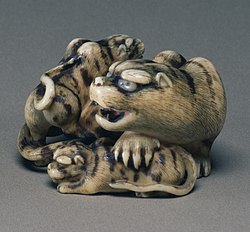 Japanese netsuke in ivory with ink; the eyes are inlaid in shell. 19th century
 -
 Egyptian basin with silver inlay (Walters Art Museum)
 -
 Japanese lacquerware Photograph Album Cover with ivory inlay, 1865
 -
 Japanese: late 19th century, wood with ivory, tortoiseshell, mother-of-pearl inlays; manjū type
 -
 Gyerim-ro dagger and sheath, probably originating from the Black Sea region and discovered in a tomb from Silla Kingdom (c. 57 BCE – 935 CE), South Korea. Gyeongju National Museum, Gyeongju.
 -
 Mother of pearls inlaid furniture set in An Giang Museum, Vietnam.
 -
 An element of a pheasant house inlaid with bark in the Sofiyivka Park


,_17th-18th_century,_wood,_tortoise_shell,_bone,_ivory_inlay_-_Royal_Ontario_Museum_-_DSC04772.JPG)


.jpg)


See also
[edit]Notes
[edit]- ^ Oxford Companion to the Decorative Arts, 1975, s.v. "Inlay", "Wood-working (Special Techniques)".
- ^ John Fleming and Hugh Honour, The Penguin Dictionary of Decorative Arts (1977) s.v. "Inlay".
- ^ "Monaco: So bling it's blinding! Can your eyes handle the 2 MILLION DIAMONDS lining this Bentley?". EBL News. Archived from the original on Mar 9, 2019. Retrieved 20 April 2017.
- ^ "Jean Boulle Luxury Group announces a world first at the 14th Edition of Top Marques Monaco" (PDF). Jean Boulle Luxury. March 21, 2017. Retrieved Dec 12, 2017.
- ^ "Supercars and flying vehicles on show at Top Marques Monaco". Yahoo News Singapore. 24 April 2017.
- ^ "Boulle Luxury". Top Marques, Monaco. Archived from the original on Jun 30, 2017. Retrieved 19 March 2017.
- ^ "Jean Boulle Luxury Group's Proprietary Natural Gem Diamond Finish Technology Exhibited #Boulleluxury". Investors Africa. Archived from the original on Dec 12, 2017. Retrieved 23 March 2017.
- ^ "Oceanco's project Lumen shines with revolutionary Sun King® coating made from diamonds". Oceanco. Archived from the original on Dec 12, 2017.
The proprietary Sun King® coating uses a patent pending process developed by Jean Boulle Luxury, a group that has a long heritage in all facets of the diamond industry. Boulle is working exclusively with partners AkzoNobel to tailor the diamond coating for automobiles, airplanes and yachts.
- ^ "Spectacular World Premieres at Top Marques Monaco Luxury Car Show". News 18. 25 April 2017.
- ^ Nargess, Banks (Mar 20, 2017). "Meet The World's First Diamond Car, The Rolls-Royce Ghost Elegance". Forbes.
- ^ "Jean Boulle Luxury Launches the World's First Aircraft Finished with the Sun King™ Natural Gem Diamond Coating at EBACE 2017". Business Wire. 22 May 2017.
- ^ "Jean Boulle: Diamond Luxury at Greater Heights". Aviation Week Network. November 11, 2017.
- ^ Verdon, Michael (7 November 2017). "Bedazzled Oceanco Lumen". Robb Report. Archived from the original on Nov 8, 2017.
- ^ W SS, 'Glazed Faience Tiles found at Kerma in the Sudan,' Museum of the Fine Arts, Vol.LX:322, Boston 1962, p. 136
- ^ Peter Lacovara, 'Nubian Faience', in ed. Florence D Friendman, Gifts of the Nile – Ancient Egyptian Faience, London: Thames & Hudson, 1998, 46–49)
- ^ "Angie Reano Owen – Artists – Indian Arts Research Center". emuseum.sarsf.org. Retrieved 2025-01-21.
- ^ "Vivienne Westwood 1990 A/W Collection : Portrait". 08245498d. Blogger. 23 March 2009. Retrieved 23 March 2009.
- ^ "How A Los Angeles Artist Transforms An Ancient Chinese Technique Into Contemporary Painting, September 08, 2022".
- ^ "Old Inlay Technique in Contemporary Art!, September 27, 2022". 12 October 2022.
- ^ Cubley, Kathleen (2024-03-15). "How to Work Roositud Inlay for Knitting". Interweave. Retrieved 2025-02-15.
External links
[edit]


| International | |
|---|---|
| Other | |

Inlay
View on GrokipediaFundamentals
Definition and Principles
Inlay is a decorative technique in the visual arts that involves embedding pieces of one material into a recess precisely carved into a base material, resulting in a flush surface that forms patterns, designs, or scenes.[10] This method creates a seamless integration where the inlaid elements sit level with the surrounding surface, enhancing the object's aesthetic through contrast in color, texture, or sheen.[11] Common applications appear across woodworking, metalwork, and stonework, where the goal is to produce intricate, durable ornamentation without altering the base material's overall profile.[10] The core principles of inlay revolve around precision cutting to ensure the inserted pieces fit exactly into the prepared cavities, often using hand tools like bow saws or chisels for accuracy.[10] Material contrast is essential for visual impact, with the inlay chosen to differ markedly from the base in hue or finish to highlight the design. Adhesion typically employs glues or adhesives to secure the pieces, followed by polishing or finishing to blend seams invisibly and achieve a smooth, unified appearance.[10] In some cases, heat may assist in setting materials like metals or resins, though mechanical fitting contributes to longevity.[12] Inlay differs from related techniques such as marquetry, which applies thin veneers directly onto a surface without recessing, and overlay, which superimposes materials atop the base rather than embedding them into a cavity.[13] Representative material combinations include wood bases with ivory or shell inlays for subtle luminosity, and metal surfaces with gemstones for opulent effects.[10] Designs often feature basic geometric patterns like interlocking stars or borders, alongside pictorial motifs such as arabesques and florals that evoke natural forms through flowing lines and motifs.[10]Historical Development
The practice of inlay, involving the insertion of materials such as ivory, metal, or stone into a base to create decorative patterns, traces its earliest known origins to ancient civilizations where it enhanced furniture and artifacts. In ancient Egypt, particularly during the Kerma culture (c. 2500–1500 BCE) in Nubia, ivory inlays were used to adorn wooden furniture such as boxes and headrests, as evidenced by archaeological finds from Nubian sites.[14] Similarly, in China during the Warring States period (475–221 BCE), bronze vessels and artifacts featured inlays of silver and gold strands, marking the emergence of sophisticated metal inlay techniques known as "jin yin cuo" (gold-silver inlay), which demonstrated advanced metallurgical skills.[15] During the classical and medieval periods, inlay techniques flourished across diverse cultures, adapting to local materials and symbolic needs. In the Mayan civilization of Mesoamerica (c. 200–900 CE), jade and shell inlays were prominently used in ceremonial masks and ornaments, where greenstone faces were embedded with shell for eyes and teeth to evoke divine attributes, as seen in elite burial goods from sites like Tikal.[16][17] In Islamic and Mughal India from the 16th to 19th centuries, the technique of pietra dura—semi-precious stones inlaid into marble—reached architectural heights, notably in the Taj Mahal under Emperor Shah Jahan, where floral motifs in jade, lapis lazuli, and carnelian adorned walls and tombs, blending Persian influences with local craftsmanship.[18] The European Renaissance elevated inlay in furniture design, with French ébéniste André-Charles Boulle (1642–1732) pioneering "Boulle work" in the late 17th century, layering tortoiseshell with brass and pewter cutouts to create intricate marquetry on cabinets and desks for Louis XIV's court, influencing opulent Baroque aesthetics across Europe.[19] In the 19th and 20th centuries, inlay expanded into indigenous American jewelry, as Zuni Pueblo silversmiths in New Mexico adopted silver and turquoise inlays starting in the 1870s, learning from Navajo traders and incorporating shell and coral for symbolic fetishes and rings that reflected spiritual traditions.[20][21] Art Nouveau (c. 1890–1910) further revived inlay in Europe and America, with designers like Louis Comfort Tiffany using enamel, silver, and gemstone inlays in jewelry and furniture to evoke organic forms, drawing from Japanese and Celtic motifs for fluid, nature-inspired patterns.[22] Key events shaped inlay's global evolution, including its dissemination via ancient trade routes like the Silk Road, where materials such as turquoise and lapis lazuli—and associated inlay methods—traveled from Central Asia to China and the Mediterranean, as documented in artifacts from the Shōsō-in repository in Japan (8th century CE) that blend Persian, Indian, and East Asian techniques.[23] The Industrial Revolution in the 19th century contributed to a decline in traditional inlay by favoring mass-produced goods over handcraft, diminishing artisanal quality in Europe and America.[24] However, the Arts and Crafts movement in the late 19th century, led by figures like William Morris, spurred a revival by championing handmade furniture techniques, including inlay in wood and metal, as a protest against mechanization, restoring value to skilled labor and influencing modern design ethics.[25]Techniques and Tools
General Process
The general process of creating an inlay involves embedding contrasting materials into a base to form decorative patterns, a technique applicable across various crafts such as woodworking, jewelry, and stonework. This method requires meticulous preparation to achieve a seamless, flush integration of the inlay with the substrate, ensuring durability and aesthetic appeal. The process is labor-intensive, often demanding high precision to prevent visible seams or structural weaknesses.[10][26] The process typically begins with design sketching and material selection, where artisans outline the motif on the base material and choose complementary inlays based on color, texture, and contrast for visual impact. Next, a recess is carved into the base using methods like chiseling or routing to match the design's contours exactly, creating a cavity that accommodates the inlay without excess space. The inlay pieces are then cut to precise dimensions, often from thin slices of material (typically 1-4 mm thick), ensuring they fit snugly into the recess through iterative trimming. Adhesion follows, where the pieces are secured using adhesives such as glues, epoxies, or heat-setting compounds, often clamped to allow drying and prevent shifting. Finally, the surface is leveled and polished—through sanding, scraping, or buffing—to create a smooth, flush finish that blends the inlay seamlessly with the base.[27][10][28][29] Common challenges include achieving tight fits to avoid gaps that could trap moisture or detract from the design, as well as accounting for material expansion or contraction due to environmental factors like humidity. Safety concerns arise during cutting, particularly with sharp tools or hard materials, necessitating protective measures. Additionally, the process can be time-consuming, with drying times ranging from hours to days per step.[27][28][26] Quality is determined by precision measurements, such as using calipers to verify dimensions down to fractions of a millimeter, and conducting dry fits—testing assembly without adhesive—to identify and correct mismatches before final bonding. These practices minimize errors and enhance longevity, with successful inlays exhibiting no visible joints and uniform sheen after polishing.[27][10][29] The scale of inlay work varies widely, from micro-scale applications in jewelry where cavities are mere millimeters deep, to large architectural panels spanning meters, requiring proportional adjustments in technique while maintaining core principles of fit and finish.[26][10]Specialized Tools and Modern Innovations
Inlay work relies on a range of specialized hand tools to achieve precise cuts, fittings, and assemblies. Hand chisels, such as custom short chisels with fine side bevels, are essential for tapping scribe lines and removing waste from mortises, ensuring clean edges for seamless integration of inlay materials.[30] Coping saws and fret saws, including fine-tooth Japanese saws, facilitate intricate cuts and trimming of inlay pieces from bundles or veneers, allowing for accurate mitered joints and complex shapes.[30] Routers, often hand-held or bench-mounted, carve recesses to exact depths for embedding inlays, while measuring tools like dividers and gauges maintain uniformity in alignment and thickness during preparation.[31] Adhesives play a critical role in securing pieces; traditional hide glue provides a reversible bond for antique restorations, whereas modern options like cyanoacrylate offer quick-setting strength for gap-filling in detailed work, and epoxy ensures durability in multi-layer assemblies.[30][31] Contemporary advancements have transformed inlay production through computer numerical control (CNC) routers and laser cutters, enabling automated precision beyond manual capabilities. CNC routers use vector design software, such as Adobe Illustrator, to translate intricate patterns into toolpaths for cutting pockets and shapes, supporting materials from wood to metal with minimal gaps.[32] Laser cutters, particularly CO2 models, excel in marquetry and inlay by vaporizing material along precise paths, with kerf widths of 0.1-0.2 mm requiring software adjustments for compensation to ensure parts fit without overlap or looseness.[33] Digital design platforms like LightBurn optimize laser operations by distinguishing vector cuts for outlines from raster engraving for textures, streamlining workflows for veneers and thin substrates.[34] These technologies offer significant advantages in efficiency and versatility for inlay applications. CNC routers provide speed and repeatability, allowing consistent replication of complex geometries across production runs, which reduces labor time compared to hand-cutting.[32] Laser cutters enhance this with even greater precision for fine details, producing smooth edges that minimize post-processing and enable designs like simulated wood grain patterns unattainable manually.[35] For instance, in marquetry simulations, lasers facilitate rapid prototyping of multi-material assemblies, cutting intricate motifs in under three minutes for simple layouts.[34] Emerging trends since the 2010s integrate 3D printing with traditional inlay for prototyping and hybrid fabrication. 3D printers create custom inlay prototypes and templates, such as wood-filled PLA components for testing fits in artistic boxes or tool organizers, allowing artisans to iterate designs before committing to final materials.[36] Hybrid approaches, like those in MIT's Fused Crafts project, combine 3D-printed structures with hand-woven or carved elements to bridge digital precision and tactile craftsmanship, fostering personalized inlay work in furniture and decor.[37]Inlay by Material
Wood Inlay
Wood inlay involves embedding contrasting materials into a wooden base to create decorative patterns, where the base is typically a dense hardwood like oak or mahogany to provide stability for the insertion process.[27] Oak, known for its strength and grain patterns, serves as a common base in traditional furniture, while mahogany offers a finer grain suitable for intricate designs.[38] Inserts often include thin veneers of exotic woods such as ebony or rosewood for color contrast, as well as non-wood materials like mother-of-pearl or abalone shell, which add iridescence and are cut to fit precisely into recesses.[39] These materials are selected for their ability to complement the base wood's natural tones while resisting degradation over time. Techniques for wood inlay begin with routing shallow pockets into the base wood using a router bit, typically 1/8-inch or smaller, to create precise cavities that match the shape of the insert.[40] Scroll saw cutting is employed for detailed, curved designs in the insert materials, allowing for stack-cutting multiple pieces simultaneously to ensure alignment.[41] Woodworkers must account for the base's grain direction to avoid splitting during routing, as well as humidity variations that can cause differential expansion—up to 1% shrinkage across the grain in low-humidity environments—which may loosen inserts if not anticipated.[42] Once fitted and glued, the surface is leveled with sanding, then finished with penetrating oils like tung oil to enhance grain visibility or lacquer for a durable, glossy seal that protects against moisture ingress. For copper inlay in wood, a common beginner method involves carving grooves into the wood and hammering copper wire into them for secure embedding.[43] Safety precautions are essential, including wearing eye protection and gloves to prevent injury from flying copper shards during hammering.[44] Practitioners should practice on scrap wood to develop skills and avoid material waste. Attempting to pour molten copper at home is extremely dangerous due to temperatures exceeding 1,000°C, which can cause severe burns, fires, and explosions if moisture is present in the wood.[45] Copper tarnishes over time, so applying a clear coat, such as brass lacquer followed by acrylic lacquer, is recommended for a shiny, long-term finish.[46] In furniture applications, wood inlay adorns 18th-century French cabinets, such as Rococo-style writing tables featuring kingwood bases with inlays of exotic woods and mother-of-pearl in floral motifs, exemplifying the era's opulent ébénisterie.[47] For musical instruments, abalone shell inlays on guitar fretboards, as seen in models like the Fender Stratocaster, provide subtle markers that highlight the rosewood or maple surface while adding visual flair under stage lighting.[48] A unique aspect of wood inlay is banding, where thin strips of contrasting wood or shell, often 1/16-inch thick, are applied along edges to frame panels or drawers, creating a bordered effect that accentuates curves without overwhelming the design.[49] Unlike parquetry, which uses geometric wood patterns primarily for flooring to form repeating motifs like herringbone, wood inlay focuses on pictorial or freeform compositions embedded into furniture or instruments for narrative decoration.[50] Conservation of wood inlay faces challenges from aging and shrinkage, as fluctuating humidity induces cross-grain contraction in base woods like oak, leading to cracks up to 0.5 cm wide that can dislodge inserts in historic pieces.[42] Stabilizing such artifacts often requires controlled microclimates to limit relative humidity swings to under 7%, preventing further warping while preserving the integrity of glued joints.[51]Metal Inlay
Metal inlay involves embedding contrasting metal alloys or compounds into a base metal surface to create decorative patterns, often requiring careful consideration of material compatibilities to ensure adhesion and durability. Common base metals include iron, steel, and silver, while inserts typically consist of softer metals like gold or silver, or specialized alloys such as niello, a black sulfide mixture of silver, copper, lead, and sulfur.[52][53] In damascening, for example, thin gold or silver wire is inlaid into a steel base, providing a lustrous contrast against the darker metal.[52] Techniques for metal inlay emphasize mechanical and thermal methods to secure inserts without compromising the base structure. Recesses are often created through chasing or repoussé, where tools hammer designs into the metal to form channels, followed by pressing or hammering the insert material into place; soldering or fusing may be used for alloys like niello, where the paste is applied to engraved surfaces and heated at low temperatures to bond it integrally.[52][53] Final polishing achieves a high sheen, enhancing the visual depth of the inlay. Unique metallurgical aspects include oxidation prevention through patination—such as treating steel with tannic acid solutions to form a protective black layer—and controlled heat treatments to minimize warping during fusing.[52][54] Applications of metal inlay span jewelry, armor, and decorative objects, with notable examples in 19th-century Zuni silver jewelry featuring turquoise inlays set into silver bases using bezel techniques and stamping for intricate mosaic patterns. In historical contexts, damascening adorned ancient Persian swords and armor, where gold wire enhanced both aesthetics and status on iron blades.[55][52] Culturally, Japanese shakudō exemplifies metal inlay with its copper-gold alloy base (typically 90-96% copper and 4-10% gold, sometimes with trace silver), patinated to a deep black-blue for inlaying gold or silver motifs in sword fittings and jewelry, a practice refined since the 15th century to achieve color stability through specific alloy compositions and patination solutions.[54]Stone Inlay
Stone inlay involves embedding pieces of harder or semi-precious stones into a base material of softer stone, such as marble or limestone, to create durable decorative patterns valued for their permanence and resistance to environmental degradation.[56] Common base materials include white Makrana marble and limestone, which provide a stable, workable substrate that contrasts with the vibrant inserts.[57] Insert materials typically consist of semi-precious stones like lapis lazuli for deep blue hues, jasper for red tones, agate for banded patterns, malachite for green, and onyx for black accents, selected for their natural colorfastness that prevents fading over centuries.[56][57] Techniques for stone inlay emphasize precision to accommodate the materials' hardness and non-malleability. In modern practices, drilling employs diamond-tipped bits to create recesses in the base stone, followed by abrading the insert pieces with diamond laps or grinders to achieve a precise fit, often to tolerances of fractions of a millimeter.[56] Adhesion uses epoxy resins for strong, durable bonds in contemporary work, while historical methods relied on mortar or organic pastes like mixtures of beeswax, honey, and marble dust; the assembly is then subjected to extensive polishing with abrasives to reveal a seamless, glossy surface.[56][57] Applications of stone inlay span architectural and sculptural contexts, showcasing its integration into large-scale durable works. In 17th-century Mughal architecture, pietra dura panels adorn the Taj Mahal, where semi-precious stones are inlaid into marble walls and tombs to form intricate floral motifs, employing up to 60 pieces per design element for three-dimensional effects.[57] Ancient Egyptian sculptures, including sarcophagi, incorporated stone inlays such as travertine and obsidian pieces set into limestone or granite bases to depict eyes and symbolic elements, enhancing the protective and eternal symbolism of these burial structures.[58] A distinctive feature of stone inlay is its superior colorfastness and resistance to weathering, as the inert nature of stones like lapis lazuli and jasper maintains vibrancy without chemical degradation, unlike organic or metallic alternatives.[56] The commesso technique, originating in 16th-century Florence, exemplifies this through puzzle-like mosaics of hard stones cut with wire bows and fitted without visible joints, producing lifelike "paintings" in stone for panels and tabletops.[59] Challenges in stone inlay arise primarily from the brittleness of materials, which can lead to cracks during cutting or abrading if tension is unevenly applied, often necessitating restarts and comprising up to 60% of production time in precision work.[56] This fragility demands skilled handling to avoid chipping semi-precious inserts, particularly in historical contexts where tools lacked modern diamond reinforcements.[57]Textile and Fabric Inlay
Textile and fabric inlay adapts the decorative insertion principle to pliable, fibrous materials, involving the embedding of contrasting elements into a base fabric to create patterns or motifs that enhance texture and visual interest. Unlike rigid materials, textile inlays prioritize flexibility, allowing the inserted elements to move with the substrate while maintaining structural integrity through stitching or bonding. This technique has been employed across cultures for centuries, evolving from handcrafted methods to incorporate modern precision tools.[60] Common base fabrics include silk, wool, and leather, chosen for their durability and ability to hold stitches without excessive fraying. Inserts often consist of metallic threads for shimmer, beads for dimensional accents, or leather patches for contrast and strength. These materials are selected to complement the base's properties, such as using non-stretch inserts on elastic bases to add stability.[61][62] Key techniques encompass appliqué-style methods, where slits or shapes are cut into the base fabric and contrasting pieces are stitched into place, often with edge finishing to prevent unraveling. Felting integration involves needle-felting wool fibers or pre-felted pieces directly into the base for a seamless, textured embed, while weaving inlay uses supplementary wefts—such as metallic threads—laid into the ground weave without full traversal, locked by subsequent picks. For synthetic fabrics, heat-bonding employs fusible adhesives like iron-on webs to secure inserts, enabling quick assembly and reduced stitching. Reverse appliqué variants cut through top layers to reveal underlying fabrics, creating layered effects akin to inlay.[61][63] Applications span fashion, where inlay adds rebellious flair, as seen in 1990s punk designs featuring stitched leather patches and metallic accents on denim or cotton bases; upholstery, such as embroidered cushions with woven inlay motifs for added luxury; and historical tapestries, like Mamluk-era Egyptian pieces (1250–1517) using inlaid wool for heraldic banners. In Iranian Qajar textiles, felted wool inlays decorated tent panels, demonstrating cultural adaptation.[60][64] Unique to textiles, inlay must accommodate stretch in knit bases through elastic stitching or integrated yarns, ensuring patterns distort evenly during wear. Washability poses challenges, as repeated laundering can loosen stitches or fade metallic inserts, necessitating protective coatings or machine-washable synthetics.[65][66] Modern innovations include laser-cut fabric inserts, which enable precise shapes for inlay appliqué, reducing manual cutting errors and allowing intricate designs on synthetics or leathers for high-fashion pieces.[67]Painting and Pigment Inlay
Painting and pigment inlay techniques involve embedding colored pigments, paints, or wax-based media into a prepared surface to create decorative patterns or designs, often combining elements of painting with inlaid effects for depth and vibrancy. These methods differ from traditional solid-material inlays by using fluid or semi-fluid media that integrate directly with the base, allowing for intricate, layered compositions. Common bases include canvas, wood panels, or prepared furniture surfaces, which provide a stable foundation for adhesion.[68][69] Key materials encompass natural or synthetic pigments mixed with binders such as wax for encaustic applications, gold leaf for metallic accents, and colored waxes for textured embeds. In modern contexts, pre-printed paint sheets like those from Iron Orchid Designs serve as inserts; these consist of artist-grade pigments adhered to carrier paper, designed to release and embed into wet paint surfaces without synthetic films or adhesives. Bases must be matte and dry to ensure compatibility, preventing rejection during embedding.[68][69] Encaustic inlay, a prominent technique, entails heating wax mixed with pigments to a molten state, applying it in layers over a base, and using tools or stencils to incise marks before filling them with contrasting colors; subsequent scraping reveals embedded designs beneath translucent layers. Stencil-based pigment embedding involves placing a stencil on the surface, applying pigment ink or thinned paints into the openings, and sealing to fix the colors without bleeding. For furniture applications, paint inlay transfers use a damp sponge to press pigment sheets onto freshly painted wood, followed by burnishing and sealing with a patina or wax topcoat to integrate the design seamlessly.[68][70] These techniques appear in fine art, such as ancient Egyptian artifacts where synthetic Egyptian blue pigment was used to color faience or paint wood surfaces, mimicking the appearance of lapis lazuli. In contemporary DIY practices during the 2020s, pigment inlays have gained popularity for furniture upcycling, transforming plain pieces into ornate items with embedded motifs. Miniature painting employs similar methods, filling recesses in sculpted models with thinned acrylic pigments to highlight details like engravings on armor or weapons.[71][69][72] Unique to pigment inlay is its capacity for layering, which builds optical depth through successive embeds, and translucency effects from wax or thin paint films that allow light to penetrate and reflect internally, creating luminous qualities absent in opaque media. Unlike fresco, where pigments bind chemically to wet plaster on walls, pigment inlay embeds media into pre-prepared surfaces for portable or object-based art.[68][73][70] Challenges include preventing color bleeding, where pigments migrate due to excess moisture or incompatible binders, addressed by thinning paints appropriately and applying sealants promptly. Ensuring compatibility between pigments and the base material is crucial, as mismatches can lead to cracking or delamination during drying or heating processes.[74][69]References
- https://commons.wikimedia.org/wiki/Category:Guitar_inlay