


Community hub
Recent from talks
Contribute something to knowledge base
Content stats: 0 posts, 0 articles, 1 media, 0 notes
Members stats: 0 subscribers, 0 contributors, 0 moderators, 0 supporters
Subscribers
Supporters
Contributors
Moderators
Hub AI
Coupling constant AI simulator
(@Coupling constant_simulator)
Hub AI
Coupling constant AI simulator
(@Coupling constant_simulator)
Coupling constant
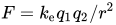
In physics, a coupling constant or gauge coupling parameter (or, more simply, a coupling), is a number that determines the strength of the force exerted in an interaction. Originally, the coupling constant related the force acting between two static bodies to the "charges" of the bodies (i.e. the electric charge for electrostatic and the mass for Newtonian gravity) divided by the distance squared, , between the bodies; thus: in for Newtonian gravity and in for electrostatic. This description remains valid in modern physics for linear theories with static bodies and massless force carriers..





A modern and more general definition uses the Lagrangian (or equivalently the Hamiltonian ) of a system. Usually, (or ) of a system describing an interaction can be separated into a kinetic part and an interaction part : (or ). In field theory, always contains 3 fields terms or more, expressing for example that an initial electron (field 1) interacts with a photon (field 2) producing the final state of the electron (field 3). In contrast, the kinetic part always contains only two fields, expressing the free propagation of an initial particle (field 1) into a later state (field 2). The coupling constant determines the magnitude of the part with respect to the part (or between two sectors of the interaction part if several fields that couple differently are present). For example, the electric charge of a particle is a coupling constant that characterizes an interaction with two charge-carrying fields and one photon field (hence the common Feynman diagram with two arrows and one wavy line). Since photons mediate the electromagnetic force, this coupling determines how strongly electrons feel such a force, and has its value fixed by experiment. By looking at the QED Lagrangian, one sees that indeed, the coupling sets the proportionality between the kinetic term and the interaction term .




A coupling plays an important role in dynamics. For example, one often sets up hierarchies of approximation based on the importance of various coupling constants. In the motion of a large lump of magnetized iron, the magnetic forces may be more important than the gravitational forces because of the relative magnitudes of the coupling constants. However, in classical mechanics, one usually makes these decisions directly by comparing forces. Another important example of the central role played by coupling constants is that they are the expansion parameters for first-principle calculations based on perturbation theory, which is the main method of calculation in many branches of physics.
Couplings arise naturally in a quantum field theory. A special role is played in relativistic quantum theories by couplings that are dimensionless; i.e., are pure numbers. An example of such a dimensionless constant is the fine-structure constant,
where e is the charge of an electron, ε0 is the permittivity of free space, ħ is the reduced Planck constant and c is the speed of light. This constant is proportional to the square of the coupling strength of the charge of an electron to the electromagnetic field.
In a non-abelian gauge theory, the gauge coupling parameter, , appears in the Lagrangian as

(where G is the gauge field tensor) in some conventions. In another widely used convention, G is rescaled so that the coefficient of the kinetic term is 1/4 and appears in the covariant derivative. This should be understood to be similar to a dimensionless version of the elementary charge defined as
In a quantum field theory with a coupling g, if g is much less than 1, the theory is said to be weakly coupled. In this case, it is well described by an expansion in powers of g, called perturbation theory. If the coupling constant is of order one or larger, the theory is said to be strongly coupled. An example of the latter is the hadronic theory of strong interactions (which is why it is called strong in the first place). In such a case, non-perturbative methods need to be used to investigate the theory.
Coupling constant
In physics, a coupling constant or gauge coupling parameter (or, more simply, a coupling), is a number that determines the strength of the force exerted in an interaction. Originally, the coupling constant related the force acting between two static bodies to the "charges" of the bodies (i.e. the electric charge for electrostatic and the mass for Newtonian gravity) divided by the distance squared, , between the bodies; thus: in for Newtonian gravity and in for electrostatic. This description remains valid in modern physics for linear theories with static bodies and massless force carriers..
A modern and more general definition uses the Lagrangian (or equivalently the Hamiltonian ) of a system. Usually, (or ) of a system describing an interaction can be separated into a kinetic part and an interaction part : (or ). In field theory, always contains 3 fields terms or more, expressing for example that an initial electron (field 1) interacts with a photon (field 2) producing the final state of the electron (field 3). In contrast, the kinetic part always contains only two fields, expressing the free propagation of an initial particle (field 1) into a later state (field 2). The coupling constant determines the magnitude of the part with respect to the part (or between two sectors of the interaction part if several fields that couple differently are present). For example, the electric charge of a particle is a coupling constant that characterizes an interaction with two charge-carrying fields and one photon field (hence the common Feynman diagram with two arrows and one wavy line). Since photons mediate the electromagnetic force, this coupling determines how strongly electrons feel such a force, and has its value fixed by experiment. By looking at the QED Lagrangian, one sees that indeed, the coupling sets the proportionality between the kinetic term and the interaction term .
A coupling plays an important role in dynamics. For example, one often sets up hierarchies of approximation based on the importance of various coupling constants. In the motion of a large lump of magnetized iron, the magnetic forces may be more important than the gravitational forces because of the relative magnitudes of the coupling constants. However, in classical mechanics, one usually makes these decisions directly by comparing forces. Another important example of the central role played by coupling constants is that they are the expansion parameters for first-principle calculations based on perturbation theory, which is the main method of calculation in many branches of physics.
Couplings arise naturally in a quantum field theory. A special role is played in relativistic quantum theories by couplings that are dimensionless; i.e., are pure numbers. An example of such a dimensionless constant is the fine-structure constant,
where e is the charge of an electron, ε0 is the permittivity of free space, ħ is the reduced Planck constant and c is the speed of light. This constant is proportional to the square of the coupling strength of the charge of an electron to the electromagnetic field.
In a non-abelian gauge theory, the gauge coupling parameter, , appears in the Lagrangian as
(where G is the gauge field tensor) in some conventions. In another widely used convention, G is rescaled so that the coefficient of the kinetic term is 1/4 and appears in the covariant derivative. This should be understood to be similar to a dimensionless version of the elementary charge defined as
In a quantum field theory with a coupling g, if g is much less than 1, the theory is said to be weakly coupled. In this case, it is well described by an expansion in powers of g, called perturbation theory. If the coupling constant is of order one or larger, the theory is said to be strongly coupled. An example of the latter is the hadronic theory of strong interactions (which is why it is called strong in the first place). In such a case, non-perturbative methods need to be used to investigate the theory.
Recent media
Recent media