Hubbry Logo
search
logo
2161427

Coupling constant

logo
Community Hub0 Subscribers
Read side by side
from Wikipedia

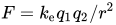
In physics, a coupling constant or gauge coupling parameter (or, more simply, a coupling), is a number that determines the strength of the force exerted in an interaction. Originally, the coupling constant related the force acting between two static bodies to the "charges" of the bodies (i.e. the electric charge for electrostatic and the mass for Newtonian gravity) divided by the distance squared, , between the bodies; thus: in for Newtonian gravity and in for electrostatic. This description remains valid in modern physics for linear theories with static bodies and massless force carriers..[1]

A modern and more general definition uses the Lagrangian (or equivalently the Hamiltonian ) of a system. Usually, (or ) of a system describing an interaction can be separated into a kinetic part and an interaction part : (or ). In field theory, always contains 3 fields terms or more, expressing for example that an initial electron (field 1) interacts with a photon (field 2) producing the final state of the electron (field 3). In contrast, the kinetic part always contains only two fields, expressing the free propagation of an initial particle (field 1) into a later state (field 2). The coupling constant determines the magnitude of the part with respect to the part (or between two sectors of the interaction part if several fields that couple differently are present). For example, the electric charge of a particle is a coupling constant that characterizes an interaction with two charge-carrying fields and one photon field (hence the common Feynman diagram with two arrows and one wavy line). Since photons mediate the electromagnetic force, this coupling determines how strongly electrons feel such a force, and has its value fixed by experiment. By looking at the QED Lagrangian, one sees that indeed, the coupling sets the proportionality between the kinetic term and the interaction term .

A coupling plays an important role in dynamics. For example, one often sets up hierarchies of approximation based on the importance of various coupling constants. In the motion of a large lump of magnetized iron, the magnetic forces may be more important than the gravitational forces because of the relative magnitudes of the coupling constants. However, in classical mechanics, one usually makes these decisions directly by comparing forces. Another important example of the central role played by coupling constants is that they are the expansion parameters for first-principle calculations based on perturbation theory, which is the main method of calculation in many branches of physics.

Fine-structure constant

[edit]

Couplings arise naturally in a quantum field theory. A special role is played in relativistic quantum theories by couplings that are dimensionless; i.e., are pure numbers. An example of such a dimensionless constant is the fine-structure constant,
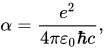
where e is the charge of an electron, ε0 is the permittivity of free space, ħ is the reduced Planck constant and c is the speed of light. This constant is proportional to the square of the coupling strength of the charge of an electron to the electromagnetic field.

Gauge coupling

[edit]

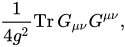
In a non-abelian gauge theory, the gauge coupling parameter, , appears in the Lagrangian as

(where G is the gauge field tensor) in some conventions. In another widely used convention, G is rescaled so that the coefficient of the kinetic term is 1/4 and appears in the covariant derivative. This should be understood to be similar to a dimensionless version of the elementary charge defined as

Weak and strong coupling

[edit]

In a quantum field theory with a coupling g, if g is much less than 1, the theory is said to be weakly coupled. In this case, it is well described by an expansion in powers of g, called perturbation theory. If the coupling constant is of order one or larger, the theory is said to be strongly coupled. An example of the latter is the hadronic theory of strong interactions (which is why it is called strong in the first place). In such a case, non-perturbative methods need to be used to investigate the theory.

In quantum field theory, the dimension of the coupling plays an important role in the renormalizability property of the theory,[2] and therefore on the applicability of perturbation theory. If the coupling is dimensionless in the natural units system (i.e. , ), like in QED, QCD, and the weak interaction, the theory is renormalizable and all the terms of the expansion series are finite (after renormalization). If the coupling is dimensionful, as e.g. in gravity (), the Fermi theory () or the chiral perturbation theory of the strong force (), then the theory is usually not renormalizable. Perturbation expansions in the coupling might still be feasible, albeit within limitations,[3][4] as most of the higher order terms of the series will be infinite.

Running coupling

[edit]
Fig. 1 Virtual particles renormalize the coupling

One may probe a quantum field theory at short times or distances by changing the wavelength or momentum, k, of the probe used. With a high frequency (i.e., short time) probe, one sees virtual particles taking part in every process. This apparent violation of the conservation of energy may be understood heuristically by examining the uncertainty relation

which virtually allows such violations at short times. The foregoing remark only applies to some formulations of quantum field theory, in particular, canonical quantization in the interaction picture.

In other formulations, the same event is described by "virtual" particles going off the mass shell. Such processes renormalize the coupling and make it dependent on the energy scale, μ, at which one probes the coupling. The dependence of a coupling g(μ) on the energy-scale is known as "running of the coupling". The theory of the running of couplings is given by the renormalization group, though it should be kept in mind that the renormalization group is a more general concept describing any sort of scale variation in a physical system (see the full article for details).

Phenomenology of the running of a coupling

[edit]

The renormalization group provides a formal way to derive the running of a coupling, yet the phenomenology underlying that running can be understood intuitively.[5] As explained in the introduction, the coupling constant sets the magnitude of a force which behaves with distance as . The -dependence was first explained by Faraday as the decrease of the force flux: at a point B distant by from the body A generating a force, this one is proportional to the field flux going through an elementary surface S perpendicular to the line AB. As the flux spreads uniformly through space, it decreases according to the solid angle sustaining the surface S. In the modern view of quantum field theory, the comes from the expression in position space of the propagator of the force carriers. For relatively weakly-interacting bodies, as is generally the case in electromagnetism or gravity or the nuclear interactions at short distances, the exchange of a single force carrier is a good first approximation of the interaction between the bodies, and classically the interaction will obey a -law (note that if the force carrier is massive, there is an additional dependence). When the interactions are more intense (e.g. the charges or masses are larger, or is smaller) or happens over briefer time spans (smaller ), more force carriers are involved or particle pairs are created, see Fig. 1, resulting in the break-down of the behavior. The classical equivalent is that the field flux does not propagate freely in space any more but e.g. undergoes screening from the charges of the extra virtual particles, or interactions between these virtual particles. It is convenient to separate the first-order law from this extra -dependence. This latter is then accounted for by being included in the coupling, which then becomes -dependent, (or equivalently μ-dependent). Since the additional particles involved beyond the single force carrier approximation are always virtual, i.e. transient quantum field fluctuations, one understands why the running of a coupling is a genuine quantum and relativistic phenomenon, namely an effect of the high-order Feynman diagrams on the strength of the force.

Since a running coupling effectively accounts for microscopic quantum effects, it is often called an effective coupling, in contrast to the bare coupling (constant) present in the Lagrangian or Hamiltonian.

Beta functions

[edit]

In quantum field theory, a beta function, β(g), encodes the running of a coupling parameter, g. It is defined by the relation
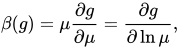
where μ is the energy scale of the given physical process. If the beta functions of a quantum field theory vanish, then the theory is scale-invariant.

The coupling parameters of a quantum field theory can flow even if the corresponding classical field theory is scale-invariant. In this case, the non-zero beta function tells us that the classical scale-invariance is anomalous.

QED and the Landau pole

[edit]

If a beta function is positive, the corresponding coupling increases with increasing energy. An example is quantum electrodynamics (QED), where one finds by using perturbation theory that the beta function is positive. In particular, at low energies, α ≈ 1/137, whereas at the scale of the Z boson, about 90 GeV, one measures α ≈ 1/127.

Moreover, the perturbative beta function tells us that the coupling continues to increase, and QED becomes strongly coupled at high energy. In fact the coupling apparently becomes infinite at some finite energy. This phenomenon was first noted by Lev Landau, and is called the Landau pole. However, one cannot expect the perturbative beta function to give accurate results at strong coupling, and so it is likely that the Landau pole is an artifact of applying perturbation theory in a situation where it is no longer valid. The true scaling behaviour of at large energies is not known.

QCD and asymptotic freedom

[edit]
Comparison of the strong coupling constant measurements by different experiments as of 2023 with ATLAS the latest and most precise value[6][7]

In non-abelian gauge theories, the beta function can be negative, as first found by Frank Wilczek, David Politzer and David Gross. An example of this is the beta function for quantum chromodynamics (QCD), and as a result the QCD coupling decreases at high energies.[5]

Furthermore, the coupling decreases logarithmically, a phenomenon known as asymptotic freedom (the discovery of which was awarded with the Nobel Prize in Physics in 2004). The coupling decreases approximately as

where is the energy of the process involved and β0 is a constant first computed by Wilczek, Gross and Politzer.

Conversely, the coupling increases with decreasing energy. This means that the coupling becomes large at low energies, and one can no longer rely on perturbation theory. Hence, the actual value of the coupling constant is only defined at a given energy scale. In QCD, the Z boson mass scale is typically chosen, providing a value of the strong coupling constant of αs(MZ2 ) = 0.1179 ± 0.0010.[8] In 2023 Atlas measured αs(MZ2) = 0.1183 ± 0.0009 the most precise so far.[6][7] The most precise measurements stem from lattice QCD calculations, studies of tau-lepton decay, as well as by the reinterpretation of the transverse momentum spectrum of the Z boson.[9]

QCD scale

[edit]

In quantum chromodynamics (QCD), the quantity Λ is called the QCD scale. The value is [5] for three "active" quark flavors, viz when the energy–momentum involved in the process allows production of only the up, down and strange quarks, but not the heavier quarks. This corresponds to energies below 1.275 GeV. At higher energy, Λ is smaller, e.g. MeV[10] above the bottom quark mass of about 5 GeV. The meaning of the minimal subtraction (MS) scheme scale ΛMS is given in the article on dimensional transmutation. The proton-to-electron mass ratio is primarily determined by the QCD scale.


String theory

[edit]

A remarkably different situation exists in string theory since it includes a dilaton. An analysis of the string spectrum shows that this field must be present, either in the bosonic string or the NS–NS sector of the superstring. Using vertex operators, it can be seen that exciting this field is equivalent to adding a term to the action where a scalar field couples to the Ricci scalar. This field is therefore an entire function worth of coupling constants. These coupling constants are not pre-determined, adjustable, or universal parameters; they depend on space and time in a way that is determined dynamically. Sources that describe the string coupling as if it were fixed are usually referring to the vacuum expectation value. This is free to have any value in the bosonic theory where there is no superpotential.

See also

[edit]

References

[edit]
[edit]
Revisions and contributorsEdit on WikipediaRead on Wikipedia
from Grokipedia
In quantum field theory, the coupling constant is a fundamental parameter, typically dimensionless, that quantifies the strength of interactions between fields or elementary particles in the Lagrangian density, determining the relative probability of interaction processes such as scattering or decay.[1] It appears as a multiplicative factor in interaction vertices within Feynman diagrams, scaling the amplitudes for perturbative calculations and enabling predictions of physical observables like cross-sections.[1] Within the Standard Model of particle physics, distinct coupling constants characterize the three non-gravitational fundamental forces: the strong force (governed by the QCD coupling α_s ≈ 0.1179 at the Z boson mass scale),[2] the electromagnetic force (via the fine-structure constant α ≈ 1/137.035999206 as of 2022),[3] and the weak force (with α_w ≈ 1/30 at similar scales).[4] These constants are not fixed but exhibit energy-scale dependence, known as "running," due to quantum loop corrections captured by the renormalization group beta function, which leads to phenomena like asymptotic freedom in QCD where α_s decreases at high energies.[1] Efforts to unify the forces often explore their convergence at high energies, though gravity's extremely weak coupling (α_g ≈ 10^{-39} for protons) remains outside the Standard Model framework.[5] Beyond particle physics, the term "coupling constant" also applies in contexts like nuclear magnetic resonance (NMR) spectroscopy, where it refers to the scalar J-coupling (in hertz) between nuclear spins through chemical bonds, providing structural insights into molecules; for instance, vicinal ³J(H,H) values typically range from 0–18 Hz depending on dihedral angles.[6] In condensed matter physics, coupling constants describe interactions in models like the Hubbard model for electron correlations.[7]

Basic Concepts

Definition

In quantum field theory, a coupling constant is a parameter that determines the strength of the interaction between elementary particles or fields, appearing as a multiplicative factor in the interaction terms of the theory's Lagrangian density.[8] These constants characterize the relative intensity of fundamental forces, such as those mediated by gauge bosons, and are essential for perturbative calculations where weak couplings allow expansions in powers of the constant itself.[8] Mathematically, interaction terms in the Lagrangian are typically of the form $ g \times $ (product of fields), where $ g $ is the coupling constant. For instance, in Yukawa theory, which models the interaction between a scalar field $ \phi $ and a Dirac fermion field $ \psi $, the relevant term is $ g \bar{\psi} \phi \psi $, with $ g $ quantifying the interaction strength.[9] This structure generalizes to other interactions, such as gauge couplings in quantum electrodynamics or chromodynamics. Coupling constants can be either dimensionful or dimensionless, depending on the operator's scaling dimension and the spacetime dimensionality of the theory. In four-dimensional quantum field theories, dimensionless couplings correspond to marginal (renormalizable) operators, while dimensionful ones arise in super-renormalizable or non-renormalizable cases; however, renormalization techniques absorb ultraviolet divergences and define effective dimensionless couplings that remain perturbative up to high energies in asymptotically free or renormalizable models.[10] The notion of a coupling constant originated historically in early quantum electrodynamics, where Arnold Sommerfeld introduced it in 1916 to parameterize the fine splitting of hydrogen spectral lines through the fine-structure constant, marking the first quantification of electromagnetic interaction strength beyond classical theory.[11]

Physical Interpretation

In quantum field theory, the coupling constant $ g $ quantifies the intrinsic strength of interactions between fundamental fields, serving as a dimensionless parameter in the Lagrangian that governs the probability amplitude for vertices where particles exchange force carriers. Each interaction vertex contributes a factor of $ g $ to the Feynman diagram amplitude, enabling the computation of transition probabilities as the square of these amplitudes. When $ g $ is small, the theory admits a perturbative expansion, where observables like scattering amplitudes are calculated as convergent power series in $ g $ (or often $ g^2 $, corresponding to probabilities), providing reliable predictions for weak interactions.[12] The value of $ g $ distinguishes between weak and strong coupling regimes, dictating the applicability of analytical methods in physical theories. In the weak coupling regime ($ g \ll 1 ),perturbativetechniquesdominate,asseeninhighenergy[quantumchromodynamics](/page/Quantumchromodynamics)(QCD)wherethestrongcouplingbecomessufficientlysmalltoallowsystematicexpansions.Incontrast,thestrongcouplingregime(), perturbative techniques dominate, as seen in high-energy [quantum chromodynamics](/page/Quantum_chromodynamics) (QCD) where the strong coupling becomes sufficiently small to allow systematic expansions. In contrast, the strong coupling regime ( g \gtrsim 1 $) necessitates non-perturbative approaches, such as lattice simulations, to capture phenomena like confinement in low-energy QCD. The fine-structure constant $ \alpha \approx 1/137 $ exemplifies a prototypical weak coupling in electromagnetism.[13][14] Coupling constants directly influence measurable quantities, such as scattering cross-sections in particle collisions. For two-to-two body processes in the high-energy limit, the total cross-section scales as $ \sigma \propto g^4 / s $, where $ s $ is the Mandelstam variable representing the center-of-mass energy squared; this arises from the tree-level amplitude being proportional to $ g^2 ,withtheprobabilityenteringquadratically.Theseconstantsalsoencodetherelativestrengthsamongfundamentalforces:thestrongforce(, with the probability entering quadratically. These constants also encode the relative strengths among fundamental forces: the strong force ( \alpha_s \approx 0.118 $ at the electroweak scale) is far more intense than electromagnetism ($ \alpha \approx 0.0073 ),whilegravityseffectivecouplingremainsnegligible(), while gravity's effective coupling remains negligible ( \sim 10^{-38} $ for typical particle masses).[15][14]

Electromagnetic Coupling

Fine-Structure Constant

The fine-structure constant, denoted α\alpha, is the dimensionless coupling constant characterizing the strength of the electromagnetic interaction in quantum electrodynamics (QED). It quantifies the probability of photon exchange between charged elementary particles, serving as a fundamental parameter in the theory.[3] Introduced by Arnold Sommerfeld in 1916, α\alpha was proposed to explain the fine structure—the small splitting of spectral lines in atomic spectra, such as those of hydrogen—beyond the predictions of the Bohr model, incorporating relativistic effects on electron orbits.[16] Sommerfeld's extension of the Bohr quantization rules revealed that this splitting arises from the interplay of orbital motion and electron spin, with α\alpha determining its scale.[16] The constant is defined in SI units as
α=e24πϵ0c, \alpha = \frac{e^2}{4\pi \epsilon_0 \hbar c},
where ee is the elementary electric charge, ϵ0\epsilon_0 the vacuum permittivity, \hbar the reduced Planck constant, and cc the speed of light in vacuum. This formulation ensures α\alpha is purely numerical, independent of units. At low energies (zero momentum transfer), its value is α1/137.03599918\alpha \approx 1/137.03599918.[14][3] In QED, α\alpha plays a central role in perturbative calculations, parameterizing the expansion parameter for quantum corrections to classical electromagnetism. It governs the magnitude of vertex corrections, which modify the electron-photon coupling at the interaction vertex, and vacuum polarization effects, where virtual particle-antiparticle pairs screen the bare charge and alter the effective interaction strength.[3] These contributions are essential for high-precision predictions, such as the anomalous magnetic moment of the electron. In QED, α\alpha runs mildly with the energy scale due to vacuum polarization, increasing from its low-energy value toward higher energies.[3]

Measurement and Value

The fine-structure constant α\alpha has been measured historically through atomic spectroscopy, particularly the fine structure splitting in the hydrogen atom spectrum, which Arnold Sommerfeld introduced in 1916 to quantify the relativistic corrections to the Bohr model.[11] Early determinations relied on precise wavelength measurements of these spectral lines, yielding initial values around 1/α1371/\alpha \approx 137.[17] Another key historical approach involved the anomalous magnetic moment of the electron, g2g-2, where quantum electrodynamics (QED) relates the deviation from g=2g=2 directly to α\alpha through perturbative expansions; experiments at Harvard in the 2000s achieved uncertainties below 0.3 parts per billion using Penning traps to measure the electron's cyclotron and spin precession frequencies.[18] Post-2019 SI redefinition, with ee, \hbar (from exact hh), and cc fixed as exact constants, modern determinations of α\alpha primarily derive from independent measurements such as the electron anomalous magnetic moment (g-2), comparing experimental values to QED theory, and corroborated by the quantum Hall effect. These enable indirect evaluation via the relation α=e2/(4πϵ0c)\alpha = e^2 / (4\pi\epsilon_0 \hbar c), with relative uncertainties around 1.5×10101.5 \times 10^{-10}. Since the 2019 redefinition, ee is fixed at exactly 1.602176634×10191.602176634 \times 10^{-19} C, building on historical measurements like Robert Millikan's 1909 oil-drop experiment, which demonstrated charge quantization by balancing gravitational and electrostatic forces on charged oil droplets. A 2017 atom interferometry experiment with laser-cooled cesium atoms measured α\alpha by determining the recoil frequency (related to h/mCsh/m_{\ce{Cs}}) in a matter-wave interferometer, yielding α1=137.035999046(27)\alpha^{-1} = 137.035999046(27) with a relative uncertainty of 2.0×10102.0 \times 10^{-10}, contributing to CODATA adjustments.[19] These metrological techniques, including the quantum Hall effect for resistance standards (RK=h/e2R_K = h/e^2) and Josephson junctions for voltage standards (V=n(hf/2e)V = n (h f / 2e)), enable the indirect determination of α\alpha by linking macroscopic electrical measurements to fundamental quantum effects, with uncertainties dominated by the precision of capacitance comparisons.[20] The 2022 CODATA recommended value is α1=137.035999177(21)\alpha^{-1} = 137.035999177(21), corresponding to a relative uncertainty of 1.5×10101.5 \times 10^{-10}, reflecting adjustments from 133 input data points including the above methods (as of May 2024).[21] Precision improvements have been bolstered by particle accelerators, such as the Large Electron-Positron (LEP) collider at CERN, where Bhabha scattering cross-sections at energies up to 209 GeV provided QED tests consistent with the low-energy α\alpha value, confirming radiative corrections to within 0.1% and aiding the extraction of electroweak parameters like the weak mixing angle.[22]

Nuclear Couplings

Strong Coupling Constant

The strong coupling constant, denoted as αs\alpha_s, is the fundamental parameter governing the strength of interactions in quantum chromodynamics (QCD), the theory describing the strong nuclear force between quarks and gluons. It is defined as αs=gs2/(4π)\alpha_s = g_s^2 / (4\pi), where gsg_s is the gauge coupling associated with the SU(3)c_c color symmetry group that mediates quark-gluon interactions.[2] In the QCD Lagrangian, αs\alpha_s enters through the gauge coupling gsg_s in the covariant derivative Dμ=μigsAμaTaD_\mu = \partial_\mu - i g_s A_\mu^a T^a, where AμaA_\mu^a are the gluon fields and TaT^a are the SU(3)c_c generators, and in the field strength tensor term tr(GμνGμν)\operatorname{tr}(G_{\mu\nu} G^{\mu\nu}), with Gμνa=μAνaνAμagsfabcAμbAνcG_{\mu\nu}^a = \partial_\mu A_\nu^a - \partial_\nu A_\mu^a - g_s f^{abc} A_\mu^b A_\nu^c. This structure encapsulates the non-Abelian nature of the strong force, leading to self-interactions among gluons that are absent in quantum electrodynamics.[2] The value of αs\alpha_s is scale-dependent due to quantum corrections, but its conventional reference value at the Z-boson mass scale is αs(MZ)0.1179±0.0009\alpha_s(M_Z) \approx 0.1179 \pm 0.0009. At low energies, relevant to nuclear scales, αs\alpha_s becomes large (on the order of 1 or greater), driving the phenomenon of confinement, where quarks are perpetually bound into color-neutral hadrons such as protons and mesons, preventing the observation of free quarks.[2] At high energies, αs\alpha_s decreases, embodying asymptotic freedom and allowing perturbative QCD calculations for processes like deep inelastic scattering.[2]

Weak Coupling Constants

In the electroweak theory, the weak nuclear force is mediated by the SU(2)_L gauge group with coupling constant gg, while the U(1)_Y hypercharge group has coupling constant gg'. These are related to the electromagnetic coupling ee through the Weinberg angle θW\theta_W, defined such that sin2θW0.231\sin^2 \theta_W \approx 0.231 (in the MS\overline{\text{MS}} scheme at the [Z](/page/Z)[Z](/page/Z) boson mass scale MZM_Z), with the relations e=gsinθW=gcosθWe = g \sin \theta_W = g' \cos \theta_W.[4] The relevant terms in the electroweak Lagrangian describing the weak interactions are gWμJμg W_\mu J^\mu for the charged-current interactions involving the W±W^\pm bosons and left-handed fermions, and (g/2)BμY(g'/2) B_\mu Y for the neutral-current hypercharge interactions involving the BB boson and the hypercharge current YY.[4] After electroweak symmetry breaking, these mix to form the photon, W±W^\pm, and ZZ bosons, with the weak couplings governing the strengths of the resulting interactions. At the ZZ boson mass scale (MZ91.19M_Z \approx 91.19 GeV), the values are g0.652g \approx 0.652 and g0.358g' \approx 0.358, derived from the running electromagnetic fine-structure constant α(MZ)1/127.93\alpha(M_Z) \approx 1/127.93 and sin2θW\sin^2 \theta_W.[4] These correspond to the weak fine-structure constants αW=g2/4π1/30\alpha_W = g^2 / 4\pi \approx 1/30 and α=g2/4π1/100\alpha' = {g'}^2 / 4\pi \approx 1/100, which are weaker than the electromagnetic coupling but stronger than the Fermi constant in low-energy effective theory.[4] The weak couplings primarily govern flavor-changing charged-current processes such as beta decay (β\beta decay of neutrons into protons, electrons, and antineutrinos) and neutral-current processes like neutrino-nucleon scattering, where the cross sections scale with g2g^2 or g2{g'}^2.[4] Unlike the parity-conserving strong and electromagnetic forces, the weak interaction violates parity, manifesting in phenomena like the asymmetric electron emission in cobalt-60 beta decay, which distinguishes it through maximal VAV-A (vector minus axial-vector) structure in the charged currents. This unification of weak and electromagnetic forces occurs at the electroweak scale around 100 GeV.[4]

Running Behavior

Phenomenology of Running

In quantum field theories such as QED and QCD, coupling constants display a scale dependence referred to as running, arising from quantum corrections involving virtual particle loops that renormalize the effective interaction strength at different momentum transfer scales $ Q $. These loops modify the propagator of the mediating bosonvacuum polarization in QED from fermion-antifermion pairs, and analogous gluon and quark contributions in QCD—leading to an energy-dependent effective coupling.[23][2] In QED, this results in the fine-structure constant $ \alpha $ increasing logarithmically with $ Q $, while in QCD, the strong coupling $ \alpha_s $ decreases at high $ Q $ due to the non-Abelian nature of the theory.[24] Phenomenological signatures of this running are observed in high-energy scattering processes. In QED, the increase of $ \alpha $ at higher energies contributes to the scale dependence of the R ratio, defined as $ R = \sigma(e^+ e^- \to \mathrm{hadrons}) / \sigma(e^+ e^- \to \mu^+ \mu^-) $, where perturbative corrections incorporating the running coupling explain the ratio's behavior beyond simple parton-model expectations.[2] For QCD, the diminution of $ \alpha_s $ manifests in collider jet production, where higher-energy events exhibit reduced multiplicity of soft gluon emissions and more collimated jets, consistent with a weaker effective coupling at large $ Q $.[24] Key experimental tests have verified these effects through precision measurements at electron-positron colliders. At LEP, analyses of event shapes like thrust and the rates of three-jet final states in $ e^+ e^- $ annihilations near the Z-boson mass scale ($ M_Z \approx 91 $ GeV) yield values of $ \alpha_s(M_Z) \approx 0.118 $, demonstrating consistency with the predicted running from lower-energy determinations such as tau decays.[2] These observables, calculated to next-to-next-to-leading order in perturbation theory, provide stringent constraints on the scale evolution of $ \alpha_s $, with systematic uncertainties dominated by nonperturbative effects rather than statistics.[2] The running of couplings has broad implications for particle physics phenomenology, as it alters predicted cross-sections for processes like deep inelastic scattering and decay widths of heavy particles, requiring renormalization-group resummation for reliable calculations at varying energy scales.[24] This scale dependence also underpins efforts toward gauge unification, where the logarithmic evolution allows electroweak, strong, and electromagnetic couplings to potentially meet at a high unification scale, informed by precise low-energy measurements.[2]

Beta Functions

In quantum field theory, the beta function describes the renormalization group flow of a coupling constant with respect to the energy scale. It is defined as β(g)=μdgdμ\beta(g) = \mu \frac{dg}{d\mu}, where gg is the coupling constant and μ\mu is the renormalization scale. This function encodes how the coupling evolves under changes in the scale at which the theory is probed, arising from the requirement of scale invariance in the renormalized theory. In perturbative quantum field theories, particularly gauge theories, the beta function admits a power series expansion in the coupling: β(g)=bg316π2+O(g5)\beta(g) = -\frac{b g^3}{16\pi^2} + O(g^5), where the leading one-loop term dominates at weak coupling, and higher-order contributions include two-loop and beyond effects. The negative sign convention ensures that for asymptotically free theories, the coupling decreases at high energies. For non-Abelian gauge theories, the one-loop coefficient bb is given by b=113CA43TFnfb = \frac{11}{3} C_A - \frac{4}{3} T_F n_f, where CAC_A is the quadratic Casimir operator in the adjoint representation, TFT_F is the normalization factor for the fermion representation (typically TF=1/2T_F = 1/2 for the fundamental representation of SU(NN)), and nfn_f is the number of Dirac fermion flavors in that representation. For SU(3) color, CA=3C_A = 3, yielding b=1123nfb = 11 - \frac{2}{3} n_f. The positive value of bb in such theories (for nf<16.5n_f < 16.5) implies asymptotic freedom when the beta function is negative. The renormalization group equation (RGE) for the fine-structure constant α=g2/(4π)\alpha = g^2 / (4\pi) at one loop follows from the beta function: dαdlnμ=b2πα2\frac{d\alpha}{d \ln \mu} = -\frac{b}{2\pi} \alpha^2. This differential equation governs the scale dependence of α\alpha and can be integrated to obtain the running coupling explicitly. In theories with multiple couplings, such as the Standard Model or grand unified theories (GUTs), the beta functions generalize to a system of coupled renormalization group equations for the vector of couplings g=(g1,g2,)\mathbf{g} = (g_1, g_2, \dots). At one loop, for the Standard Model's three gauge couplings (g1g_1 for U(1)Y_Y, g2g_2 for SU(2)L_L, g3g_3 for SU(3)c_c), the equations take the form β(gi)=bigi316π2\beta(g_i) = -\frac{b_i g_i^3}{16\pi^2} with group-specific coefficients bib_i, though higher-loop terms introduce mixing between the couplings. In GUTs, unification imposes relations among these betas above the unification scale.

QED Running and Landau Pole

In quantum electrodynamics (QED), the beta function governing the running of the fine-structure constant α\alpha at one-loop order is given by
β(α)=23α2πfQf2nf, \beta(\alpha) = \frac{2}{3} \frac{\alpha^2}{\pi} \sum_f Q_f^2 n_f,
where the sum is over Dirac fermions with electric charges QfQ_f (in units of the elementary charge) and nfn_f counting the number of such fields; the positive sign of the leading term implies that α\alpha increases with the energy scale μ\mu. This behavior arises primarily from vacuum polarization effects due to fermion loops in the photon propagator, with the electron contribution dominating at low energies. The one-loop running of α\alpha can be approximated by integrating the renormalization group equation, yielding
α(μ)=α(0)1α(0)3πln(μ2me2), \alpha(\mu) = \frac{\alpha(0)}{1 - \frac{\alpha(0)}{3\pi} \ln\left(\frac{\mu^2}{m_e^2}\right)},
valid for μme\mu \gg m_e where α(0)\alpha(0) is the low-energy value and mem_e the electron mass; higher-loop corrections and additional fermion thresholds modify this slightly but preserve the qualitative trend. This formula highlights the monotonic increase of α(μ)\alpha(\mu) with μ\mu, contrasting with the decrease observed in quantum chromodynamics due to asymptotic freedom. Precision electroweak measurements at the ZZ boson mass scale MZ91M_Z \approx 91 GeV confirm this running, with α(MZ)1/128\alpha(M_Z) \approx 1/128 derived from LEP data on processes sensitive to the effective coupling.[4] The continued growth of α(μ)\alpha(\mu) leads to a Landau pole, a singularity in the perturbative expansion where the denominator vanishes at an ultrahigh scale μLmeexp(3π2α(0))10280\mu_L \sim m_e \exp\left( \frac{3\pi}{2 \alpha(0)} \right) \approx 10^{280} GeV.[25] This indicates a breakdown of QED as an effective theory at such extreme energies, far exceeding the electroweak scale, where non-perturbative effects or a more fundamental ultraviolet completion (e.g., incorporating grand unification) would be required.[25] The Landau pole underscores the infrared-free nature of QED, rendering it inconsistent as a standalone theory up to the Planck scale without additional physics.

QCD Asymptotic Freedom

Asymptotic freedom is a fundamental property of quantum chromodynamics (QCD), the theory describing the strong nuclear force, where the strong coupling constant αs\alpha_s decreases as the energy scale μ\mu increases, allowing quarks and gluons to behave as nearly free particles at very short distances.[26] This behavior arises from the negative sign of the QCD beta function β(αs)\beta(\alpha_s), which governs the running of the coupling with energy. Specifically, the leading-order beta function is β(αs)=β0αs22π\beta(\alpha_s) = -\frac{\beta_0 \alpha_s^2}{2\pi}, where the positive coefficient β0=1123nf>0\beta_0 = 11 - \frac{2}{3} n_f > 0 for the number of quark flavors nf16n_f \leq 16, ensuring αs\alpha_s diminishes logarithmically at high μ\mu.[27] The discovery of this property stemmed from calculations by David Gross and Frank Wilczek in 1973, who demonstrated that in non-Abelian gauge theories like QCD, the ultraviolet behavior leads to free-field-like asymptotics due to gluon self-interactions.[27] In their proof outline, the one-loop beta function contribution from quarks (fermion loops) acts as screening, similar to QED, tending to increase the effective coupling at short distances; however, the self-interaction of colored gluons produces an antiscreening effect that dominates, resulting in a net decrease in αs\alpha_s.[27] Independently, David Politzer arrived at the same conclusion by computing the renormalization group equation for the strong coupling, confirming the negative beta function for realistic flavor numbers. This asymptotic freedom has profound implications for perturbative QCD, enabling reliable calculations at high energies where αs\alpha_s is small, such as in deep inelastic scattering experiments that probe quark structure inside protons.[26] For instance, the scaling violations observed in deep inelastic scattering data align with QCD predictions of logarithmic corrections from the running coupling.[28] At low energies, the increasing αs\alpha_s connects to quark confinement, where the force strengthens to bind quarks within hadrons. The seminal contributions of Gross, Wilczek, and Politzer were recognized with the 2004 Nobel Prize in Physics for discovering asymptotic freedom in the theory of the strong interaction.[29]

QCD Scale Parameter

The QCD scale parameter, denoted ΛQCD\Lambda_{\rm QCD}, represents the intrinsic energy scale of quantum chromodynamics (QCD) that governs the non-perturbative regime of strong interactions. It is defined as the renormalization scale μ\mu at which the strong coupling constant αs(μ)\alpha_s(\mu) reaches approximately 1, signaling the breakdown of perturbation theory and the dominance of confinement effects. This parameter emerges as the integration constant when solving the renormalization group equation (RGE) for the running of αs\alpha_s, which in the leading-order approximation takes the form
αs(μ)=4πbln(μ2/ΛQCD2), \alpha_s(\mu) = \frac{4\pi}{b \ln(\mu^2 / \Lambda_{\rm QCD}^2)},
where b=11(2/3)nfb = 11 - (2/3) n_f and nfn_f is the number of active quark flavors.[2] The value of ΛQCD\Lambda_{\rm QCD} is scheme-dependent and varies with nfn_f; for nf=3n_f = 3 (considering the up, down, and strange quarks), it is approximately 330 MeV in the MS\overline{\rm MS} scheme, reflecting the energy scale relevant for low-energy hadron physics. Higher-order corrections and lattice computations refine this to around 332 \pm 20 MeV in recent determinations, but the range underscores the parameter's sensitivity to renormalization details.[30][2][31] Extraction of ΛQCD\Lambda_{\rm QCD} relies on comparing theoretical predictions with experimental or simulated observables sensitive to the strong scale. In lattice QCD, it is obtained from non-perturbative computations of quantities like the string tension σ\sigma in the quark-antiquark potential, where σ440\sqrt{\sigma} \approx 440 MeV provides a direct link to confinement dynamics. Hadron masses, such as those of the ρ\rho meson or proton, also yield estimates by relating their values to the QCD binding energy scale through sum rules or effective models. At high energies, jet event rates and shapes in proton-proton collisions at the LHC allow determination of the running αs\alpha_s, from which ΛQCD\Lambda_{\rm QCD} is inferred via the RGE.[2][32][2] ΛQCD\Lambda_{\rm QCD} sets the fundamental confinement scale in QCD, dictating the distance (1/ΛQCD\sim 1/\Lambda_{\rm QCD}) beyond which quarks cannot be observed as free particles. It plays a crucial role in generating hadron masses through gluon dynamics; for example, the proton mass of about 938 MeV arises predominantly from this scale, as the constituent light quark masses are negligible (<10< 10 MeV), with nearly all the mass emerging from the non-perturbative strong interaction energy.[33]

Gauge Unification

Gauge Couplings in the Standard Model

The Standard Model of particle physics is based on the non-Abelian gauge group $ SU(3)_C \times SU(2)_L \times U(1)_Y $, where $ SU(3)_C $ describes the strong interactions, $ SU(2)_L $ the weak isospin, and $ U(1)_Y $ the hypercharge.[34] The corresponding gauge couplings are denoted $ g_3 $, $ g_2 $, and $ g_1 $, respectively, with the fine-structure constants defined as $ \alpha_i = g_i^2 / (4\pi) $ for $ i = 1, 2, 3 $.[34] For consistency in grand unified theories, the $ U(1)_Y $ coupling is normalized such that $ g_1 = \sqrt{5/3}, g' $, where $ g' $ is the conventional hypercharge coupling; this rescaling ensures the generators have uniform trace normalization across the groups.[35] In the Standard Model, these gauge couplings exhibit energy-scale dependence governed by renormalization group equations, with distinct running behaviors arising from the one-loop beta function coefficients $ b_1 = 41/10 $, $ b_2 = -19/6 $, and $ b_3 = -7 $.[34] The strong coupling $ \alpha_3 $ decreases most rapidly with increasing energy due to its large negative coefficient, reflecting asymptotic freedom in quantum chromodynamics, while $ \alpha_1 $ increases slowly owing to its positive coefficient dominated by fermion contributions.[36] The weak coupling $ \alpha_2 $ runs more moderately, decreasing but at a slower rate than $ \alpha_3 $. These differing slopes highlight the non-universal nature of the interactions within the Standard Model framework. At the electroweak scale around $ M_W \approx 80 $ GeV, the $ SU(2)L \times U(1)Y $ symmetry breaks via the Higgs mechanism, unifying the weak and electromagnetic forces.[23] Here, the weak coupling relates to the electromagnetic fine-structure constant $ \alpha\mathrm{em} $ and the weak mixing angle $ \theta_W $ by $ \alpha_2 = \alpha\mathrm{em} / \sin^2 \theta_W $, while the normalized hypercharge coupling satisfies $ \alpha_1 = \alpha_\mathrm{em} / \cos^2 \theta_W $, with $ \sin^2 \theta_W \approx 0.231 $.[23] These relations emerge from the mixing of the neutral gauge bosons into the photon and Z boson, determining the strengths of the residual interactions post-symmetry breaking. Threshold effects from integrating out heavy particles modify the running of the couplings across mass scales. For instance, the top quark, with mass $ m_t \approx 173 $ GeV, contributes to the beta functions only above its threshold; below $ m_t $, its decoupling reduces the effective number of active flavors, altering the slope of $ \alpha_3 $ and, to a lesser extent, the electroweak couplings.[34] Such effects are crucial for precision comparisons between theory and experiment, as they introduce logarithmic corrections proportional to $ \log(m_t / \mu) $.[34] When extrapolated to very high energies, the Standard Model couplings approach closer values but do not fully unify without extensions.[34]

Grand Unified Theories

In grand unified theories (GUTs), the three gauge couplings of the Standard Model are hypothesized to converge to a single unified coupling constant, denoted αGUT\alpha_\mathrm{GUT}, at a high-energy unification scale MGUT2×1016M_\mathrm{GUT} \approx 2 \times 10^{16} GeV. This idea was first proposed in the SU(5) model by Georgi and Glashow, where the Standard Model gauge group SU(3)C_\mathrm{C} × SU(2)L_\mathrm{L} × U(1)Y_\mathrm{Y} embeds into the simple Lie group SU(5), unifying the strong, weak, and electromagnetic interactions under one gauge structure. Similarly, the SO(10) model extends this unification by accommodating all Standard Model fermions, including a right-handed neutrino, within a single 16-dimensional spinor representation, naturally incorporating lepton number as the fourth color.[34] The prediction of unification arises from the renormalization group evolution of the couplings, visualized in a plot of αi1\alpha_i^{-1} versus lnμ\ln \mu, where the inverse couplings for the electromagnetic, weak, and strong interactions run linearly with the logarithm of the energy scale μ\mu. In the minimal Standard Model, the lines fail to intersect precisely, but incorporating minimal supersymmetry (SUSY) alters the beta functions, leading to a near intersection around 101510^{15}101610^{16} GeV, supporting the GUT scale. This success of SUSY GUTs, particularly minimal SUSY SU(5), relies on the additional supersymmetric particles contributing to the running, with αGUT1/25\alpha_\mathrm{GUT} \approx 1/25 at unification.[34]91245-1) Despite these strengths, GUTs face significant challenges. Proton decay, a hallmark prediction mediated by gauge bosons like the X and Y in SU(5), is tightly constrained by experiments; Super-Kamiokande reports a lower limit on the partial lifetime for pe+π0p \to e^+ \pi^0 of τ>2.4×1034\tau > 2.4 \times 10^{34} years, pushing the colored Higgs triplet mass above 101610^{16} GeV in SUSY models and straining unification without additional mechanisms. The doublet-triplet splitting problem further complicates SUSY GUTs, requiring the Higgs doublets to remain light at the electroweak scale while their triplet partners acquire GUT-scale masses, often resolved through fine-tuning or mechanisms like the missing partner or sliding singlet.[34] Variants of the basic models address these issues while preserving unification. Flipped SU(5) × U(1) modifies the embedding to avoid rapid proton decay and naturally incorporates the seesaw mechanism for neutrino masses, where heavy right-handed neutrinos at scales around 101410^{14} GeV suppress light neutrino masses via mνv2/Mm_\nu \approx v^2 / M. The Pati-Salam model, based on SU(4)C_\mathrm{C} × SU(2)L_\mathrm{L} × SU(2)R_\mathrm{R}, unifies quarks and leptons differently, explaining charge quantization and serving as an intermediate step toward SO(10), with gauge couplings running to unification at similar high scales. These extensions highlight the flexibility of GUT frameworks in accommodating experimental constraints.91176-7)90141-4)[34]

String Theory Context

String Coupling Constant

In perturbative string theory, the string coupling constant $ g_s $ governs the strength of interactions among strings and is defined as $ g_s = e^{\langle \phi \rangle} $, where $ \langle \phi \rangle $ is the vacuum expectation value of the dilaton field $ \phi $.[37] This dimensionless parameter emerges from the low-energy effective action of the theory and determines the regime of validity for perturbative calculations. While the fundamental string tension $ T = \frac{1}{2\pi \alpha'} $, with $ \alpha' $ the Regge slope parameter, remains independent of $ g_s $, the theory incorporates extended objects like D-branes whose tensions scale inversely with $ g_s $; for instance, the tension of a Dp-brane is $ T_p = \frac{1}{g_s (2\pi)^p l_s^{p+1}} $, where $ l_s = \sqrt{\alpha'} $ is the string length.[37] This scaling ensures that D-brane charges contribute significantly in the weak-coupling limit, facilitating the embedding of gauge theories within string frameworks. The role of $ g_s $ becomes particularly evident in the computation of scattering amplitudes, which encode the S-matrix elements of the theory. These amplitudes are constructed via path integrals over worldsheets of different topologies, with $ g_s $ weighting contributions according to the Euler characteristic. For a closed-string amplitude on a Riemann surface of genus $ h $ (corresponding to $ h $ handles or loops), the overall factor is proportional to $ g_s^{2h-2} .[](https://www.damtp.cam.ac.uk/user/tong/string/string6.pdf)Attreelevel(.[](https://www.damtp.cam.ac.uk/user/tong/string/string6.pdf) At tree level ( h=0 $, spherical topology), this yields a factor of $ g_s^{-2} $, which enhances the contribution at weak coupling and reflects the classical limit, while higher-genus corrections introduce positive powers of $ g_s^2 $, systematically accounting for quantum fluctuations. This structure mirrors the loop expansion in quantum field theory but is adapted to the extended nature of strings, ensuring modular invariance and unitarity when $ g_s $ is small. For the perturbative expansion to converge and avoid non-perturbative effects dominating, $ g_s \ll 1 $ is essential, placing the theory in a weakly coupled regime. In string models aimed at phenomenological applications, such as those incorporating the Standard Model gauge sector, $ g_s $ is typically constrained to values between $ 10^{-3} $ and $ 10^{-1} $, allowing control over corrections while matching observed coupling strengths.[38] A key distinction arises between closed and open strings: the closed-string coupling is $ g_s $, whereas the open-string coupling $ g_o $ satisfies $ g_o^2 = g_s $ (or $ g_o = \sqrt{g_s} $), derived from the boundary conditions and interaction vertices in the worldsheet theory.[37] This relation directly influences gauge dynamics on D-branes, where stacks of open strings give rise to Yang-Mills theories with $ g_{YM}^2 \propto g_s $, linking the string coupling to observable particle physics parameters.

Dilaton Dependence

In string theory, the dilaton is a scalar field ϕ\phi whose vacuum expectation value determines the string coupling constant via gs=eϕg_s = e^{\langle \phi \rangle}.[39] This relation arises because the dilaton governs the strength of string interactions, with perturbative expansions valid for small gsg_s. The dilaton acquires a potential through perturbative contributions from fluxes or non-perturbative effects such as gaugino condensation in the hidden sector of heterotic string theories, which generates an exponential term stabilizing ϕ\phi at weak coupling. The tree-level effective action in the string frame, derived from the beta-function equations of the worldsheet theory, takes the form
S=12κ2d10xge2ϕ(R+4(ϕ)2112H32)+, S = \frac{1}{2\kappa^2} \int d^{10}x \sqrt{-g} \, e^{-2\phi} \left( R + 4 (\partial \phi)^2 - \frac{1}{12} |H_3|^2 \right) + \cdots,
where RR is the Ricci scalar, H3H_3 is the field strength of the Neveu-Schwarz B-field, and the ellipsis denotes higher-order α\alpha' corrections.[39] This action highlights the dilaton's role in rescaling the Einstein-Hilbert term and kinetic energies, reflecting its influence on the overall coupling strength at low energies. In compactifications, the dilaton participates in moduli stabilization within flux vacua, where three-form fluxes generate a superpotential that fixes both the complex structure moduli and the axio-dilaton τ=C0+ieϕ\tau = C_0 + i e^{-\phi}.[40] The seminal framework by Giddings, Kachru, and Polchinski demonstrates how RR and NS-NS fluxes in type IIB string theory on Calabi-Yau orientifolds stabilize these fields, producing warped throats and addressing the hierarchy problem; uplifting mechanisms, such as anti-D3-brane contributions, further allow for de Sitter solutions with positive cosmological constant.[40] At strong coupling where gs>1g_s > 1, the theory transitions via S-duality, mapping the strongly coupled regime to a weakly coupled dual description that reveals non-perturbative structure. For instance, in type IIB superstring theory, S-duality under SL(2,Z\mathbb{Z}) exchanges gsg_s with 1/gs1/g_s, ensuring self-duality and perturbative control at strong coupling through dual variables like D-branes. This duality extends to connections with M-theory, where strong-coupling limits of type IIB compactifications relate to eleven-dimensional geometries via dualities such as T-duality on the type IIA side.[41]

References

User Avatar
No comments yet.