


Community hub
Recent from talks
Contribute something to knowledge base
Content stats: 0 posts, 0 articles, 1 media, 0 notes
Members stats: 0 subscribers, 0 contributors, 0 moderators, 0 supporters
Subscribers
Supporters
Contributors
Moderators
Hub AI
Covered goods wagon AI simulator
(@Covered goods wagon_simulator)
Hub AI
Covered goods wagon AI simulator
(@Covered goods wagon_simulator)
Covered goods wagon
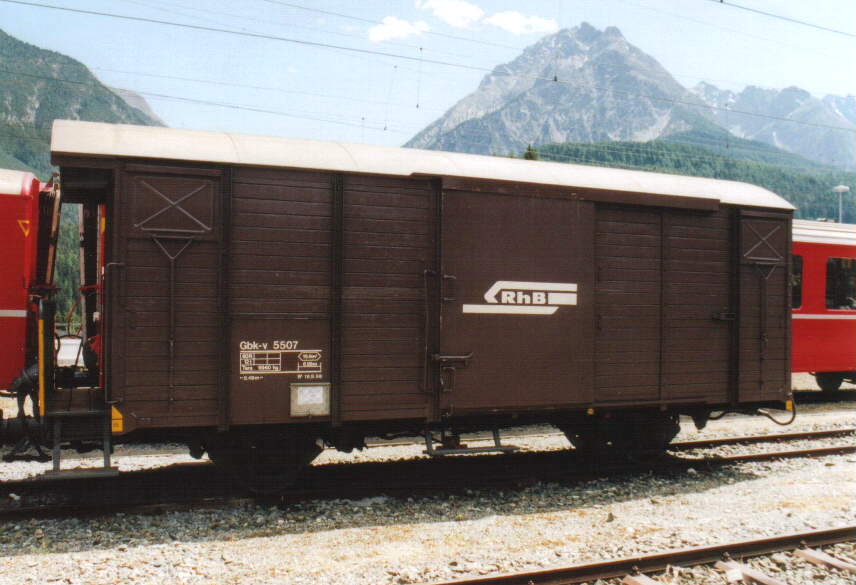
In the United Kingdom, a covered goods wagon or covered goods van is a railway goods wagon which is designed for the transportation of moisture-susceptible goods and therefore fully enclosed by sides and a fixed roof. They are often referred to simply as covered wagons, and this is the term used by the International Union of Railways (UIC). Since the introduction of the international classification for goods wagons by the UIC in the 1960s a distinction has been drawn between ordinary and special covered wagons. Other types of wagon, such as refrigerated vans and goods wagons with opening roofs, are closely related to covered wagons from a design point of view. Similar freight cars in North America are called boxcars.
Covered goods wagons for transporting part-load or parcel goods are almost as old as the railway itself. Because part-load goods were the most common freight in the early days of the railway, the covered van was then the most important type of goods wagon and, for example, comprised about 40% of the German railways goods fleet until the 1960s. Since then however the open wagon and flat wagon have become more common. By contrast the covered goods wagon still forms the majority of two-axled wagons in countries like Germany, because the comparatively light freight does not routinely require the use of bogie wagons.
The formerly widespread ordinary covered wagon with side doors was almost fully displaced in the third quarter of the 20th century by special covered wagons with sliding walls which can be rapidly loaded and unloaded with palletised goods using fork-lift trucks.
During the 1950s the International Union of Railways developed a standard design for covered goods wagons. This has 8 ventilation hatches and is therefore suitable for the transportation of cattle. Since then, European railways have procured covered wagons which at least match the main dimensions of this standard, but otherwise have minor variations. For example, there are wagons with different axle bases or a different number of ventilation hatches. The body is of a mainly wood and steel compound construction. Refrigerated vans were also developed, based on the long, twin-axled types (Gbs and Hbfs).
The following table contains details of the UIC ordinary covered wagon according to Behrends because this is the single available source with systematic specifications. Other sources may differ in some respects from this; in particular the door height has not been clarified beyond doubt. It is also unclear to what extent the present-day, twin-axled, sliding wall wagons were standardised.
The UIC's ordinary covered wagon class has rigid, fixed walls with sliding doors on each side. The upper third of the side walls has closable openings of various types. These may be designed as ventilation openings, loading hatches or combined ventilation and loading hatches. Today, Class G wagons have been largely superseded by other classes.
The transportation of part-load goods that are susceptible to the weather in boxes, sacks and barrels is the main function of G class wagons. One disadvantage they have is that the single side door does not facilitate rapid loading and unloading of large unit loads. The demand for G wagons fell with the increasing use of intermodal freight transport. Today the majority of part-load goods are moved in ISO containers, for which special flat wagons are available. Where there is a requirement for the direct loading of part-load goods, wagons with sliding sides are preferred (see below), because they enable a faster transfer of pallets.
G wagons were also frequently filled with bulk materials that were vulnerable to the weather. Special wall attachments were developed, especially for the transportation of grain, with which the side doors could be closed. Today there are self-discharging wagons with opening roofs available for this type of freight that are quicker to load and unload.
Covered goods wagon
In the United Kingdom, a covered goods wagon or covered goods van is a railway goods wagon which is designed for the transportation of moisture-susceptible goods and therefore fully enclosed by sides and a fixed roof. They are often referred to simply as covered wagons, and this is the term used by the International Union of Railways (UIC). Since the introduction of the international classification for goods wagons by the UIC in the 1960s a distinction has been drawn between ordinary and special covered wagons. Other types of wagon, such as refrigerated vans and goods wagons with opening roofs, are closely related to covered wagons from a design point of view. Similar freight cars in North America are called boxcars.
Covered goods wagons for transporting part-load or parcel goods are almost as old as the railway itself. Because part-load goods were the most common freight in the early days of the railway, the covered van was then the most important type of goods wagon and, for example, comprised about 40% of the German railways goods fleet until the 1960s. Since then however the open wagon and flat wagon have become more common. By contrast the covered goods wagon still forms the majority of two-axled wagons in countries like Germany, because the comparatively light freight does not routinely require the use of bogie wagons.
The formerly widespread ordinary covered wagon with side doors was almost fully displaced in the third quarter of the 20th century by special covered wagons with sliding walls which can be rapidly loaded and unloaded with palletised goods using fork-lift trucks.
During the 1950s the International Union of Railways developed a standard design for covered goods wagons. This has 8 ventilation hatches and is therefore suitable for the transportation of cattle. Since then, European railways have procured covered wagons which at least match the main dimensions of this standard, but otherwise have minor variations. For example, there are wagons with different axle bases or a different number of ventilation hatches. The body is of a mainly wood and steel compound construction. Refrigerated vans were also developed, based on the long, twin-axled types (Gbs and Hbfs).
The following table contains details of the UIC ordinary covered wagon according to Behrends because this is the single available source with systematic specifications. Other sources may differ in some respects from this; in particular the door height has not been clarified beyond doubt. It is also unclear to what extent the present-day, twin-axled, sliding wall wagons were standardised.
The UIC's ordinary covered wagon class has rigid, fixed walls with sliding doors on each side. The upper third of the side walls has closable openings of various types. These may be designed as ventilation openings, loading hatches or combined ventilation and loading hatches. Today, Class G wagons have been largely superseded by other classes.
The transportation of part-load goods that are susceptible to the weather in boxes, sacks and barrels is the main function of G class wagons. One disadvantage they have is that the single side door does not facilitate rapid loading and unloading of large unit loads. The demand for G wagons fell with the increasing use of intermodal freight transport. Today the majority of part-load goods are moved in ISO containers, for which special flat wagons are available. Where there is a requirement for the direct loading of part-load goods, wagons with sliding sides are preferred (see below), because they enable a faster transfer of pallets.
G wagons were also frequently filled with bulk materials that were vulnerable to the weather. Special wall attachments were developed, especially for the transportation of grain, with which the side doors could be closed. Today there are self-discharging wagons with opening roofs available for this type of freight that are quicker to load and unload.
Recent media
Recent media