Hubbry Logo
search
logo
251117

Cow corner

logo
Community Hub0 Subscribers
Read side by side
from Wikipedia
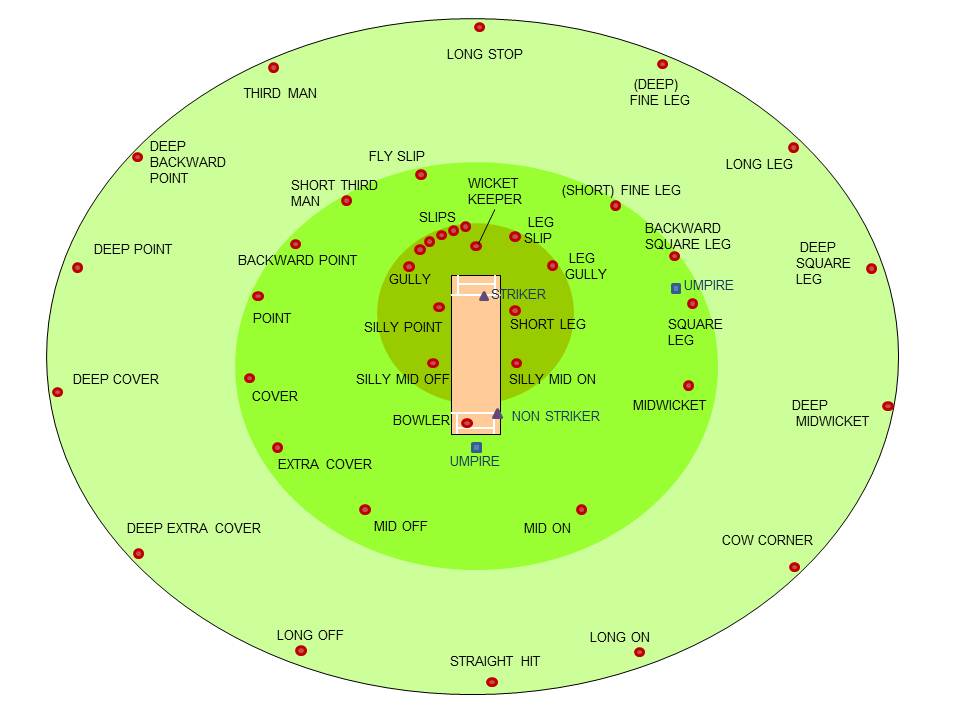
Fielding positions for a right-handed batsman. Cow corner is to the bottom right.

Cow corner is a region of the field in cricket.[1]

The location of cow corner depends on a batsman's handedness, but it is always a part of the field in the deep on the batsman's leg side, typically stretching between deep-midwicket and long on. The diagram shows the location of cow corner for a right-handed batsman.

Cow corner is thought to be named after an area on the ground at Dulwich College where cattle would often graze.[2] This has led to the naming of Cow shots, which are wild and risky shots that tend to end up at cow corner, and are considered to be mostly played by players with little knowledge of, or ability to apply, the more difficult techniques of the game. Such players were supposed to be particularly prominent in the type of cricket played in rural or agricultural areas, where players did not have exposure to more sophisticated methods of playing. Such shots are also called agricultural.

This region of the field has been somewhat more frequented in more recent forms of the game, including T20 matches, as batsmen have had to find ways to hit the ball to the boundary even for yorker-length deliveries. Shots such as the "slog sweep" popularised by Steve Waugh and baseball style crossbat 'swipes' are often utilised to hit the ball in the Deep Midwicket and Cow Corner areas of the field.[3]

See also

[edit]

References

[edit]
Revisions and contributorsEdit on WikipediaRead on Wikipedia
from Grokipedia
Cow corner is a fielding position in cricket, situated on the leg side between deep midwicket and wide long-on for a right-handed batsman, or between deep square leg and deep midwicket for a left-hander.[1] This area, often targeted by batsmen for lofted shots, historically represented an unguarded region of the field where powerful hits were infrequent.[2] The term "cow corner" is believed to have originated at Dulwich College in London, England, where cows and sheep grazed in that corner of the cricket ground, making it a relatively safe and seldom-used part of the playing area.[3][1] This etymology reflects the pastoral settings of early village and school cricket matches, where adjacent fields for livestock bordered the pitches.[2] In modern cricket, particularly in limited-overs formats like Twenty20, cow corner has gained prominence as a strategic hitting zone for aggressive batsmen employing the "cow shot"—an unorthodox, cross-line slog that propels the ball toward this boundary region to score sixes.[1][4] The position's importance surged with the rise of T20 cricket in the early 2000s, transforming it from an obscure spot into a key defensive placement for fielding teams aiming to curb big hits.[4]

Definition and Positioning

Core Definition

In cricket, cow corner refers to an informal region on the field, particularly on the leg side for a right-handed batsman, where lofted shots are typically directed between the positions of deep midwicket and long-on.[5][1] This area is often targeted for aggressive batting strokes, such as slogs or powerful drives, due to its position near the boundary, which frequently results in boundaries or sixes given the distance from the batsman.[1] Unlike standard fielding positions like midwicket or long-on, which have precise placements and names recognized in official rules, cow corner is a colloquial term describing a broader, unconventional zone rather than a fixed spot for a fielder.[5] It is commonly associated with less formal or lower-level matches where fielding restrictions are looser, making it a "dead" or under-patrolled area prone to high-scoring shots.[5] This positioning exploits the geometry of the cricket field, emphasizing its role in boundary-hitting strategies within the sport's overall layout.[6]

Location on the Cricket Field

In cricket, cow corner refers to a region in the deep outfield on the boundary, situated on the leg side for a right-handed batsman between deep midwicket and long-on.[5] This area lies deep in the leg-side outfield, where the ball can be hit for boundaries or sixes when lofted shots are played across the line of the delivery. The position is particularly relevant in diagrams of the field, capturing the arc where aggressive leg-side shots land beyond the infield. Visually, in conventional fielding diagrams depicting a right-handed batsman at the receiving end with the bowler approaching from above, cow corner corresponds to the bottom-right quadrant. It spans from a point forward of deep square leg, curving backward toward midwicket, encompassing the deeper portions of the boundary rope in that sector. For a left-handed batsman, cow corner is mirrored to their leg side, equivalent to the area between deep extra cover and long-off relative to a standard right-handed setup.[5] The precise boundaries of this position can vary by venue, as international cricket grounds must have boundaries measuring between 65 yards (59.43 meters) and 90 yards (82.29 meters) from the center of the pitch, with Test match fields often larger and oval-shaped compared to the typically more uniform, circular perimeters in limited-overs formats.[7]

Etymology and History

Origin of the Term

The term "cow corner" in cricket is believed to derive from the pastoral settings of 19th-century England, where matches were often played on rural fields shared with grazing livestock.[1] In these settings, the leg-side boundary area—roughly between deep mid-wicket and long-on—was infrequently targeted by batsmen, who favored more conventional ground shots, rendering it a safe haven for cows away from the action and potential hazards like errant balls or well-trodden paths. This unassuming zone, free from the dung and disruptions common in busier parts of the field, symbolized the sport's rustic beginnings before professionalized pitches became standard.[8] A prominent theory links the phrase specifically to Dulwich College in London, where historical accounts suggest cows grazed undisturbed in a corner of the college grounds used for cricket during the 19th century.[3][1] As shots rarely reached this spot, it earned the moniker "cow corner," highlighting how the field's layout accommodated both sport and agriculture in an era when boundaries were not always fenced. The term's adoption reflects cricket's evolution from village greens to organized play, with "cow" evoking the unrefined, agrarian essence of the game.[4] The exact date of origin is unknown, and while anecdotal references to directing shots toward grazing areas exist, precise first uses are not documented.[8] Overall, "cow corner" embodies the sport's cultural ties to England's countryside, where the field's "unpolished" edges were as much a part of the game as the wickets themselves.[1]

Evolution in Cricket Usage

The term "cow corner" originated as a literal reference to rural cricket fields in 19th-century England, where the area between deep mid-wicket and long-on was often unused for play and thus frequented by grazing livestock. This etymology is commonly attributed to grounds like those at Dulwich College, where cows would gather in the field's corner due to the low frequency of shots directed there during traditional matches.[3][5] As cricket professionalized in the mid-20th century, transitioning from village greens to urban stadiums and adopting covered pitches from the 1960s onward, the term evolved into a metaphorical descriptor for an unconventional boundary position in professional games.[9][10] This shift reflected broader changes in the sport, including more consistent playing conditions that encouraged varied shot-making, reducing the area's association with literal rural elements. The term gained significant prominence with the rise of Twenty20 (T20) cricket in the early 2000s, where aggressive batting strategies began exploiting the region more deliberately to score boundaries and sixes.[4] Its usage became ubiquitous in the 2000s through television commentary and international broadcasts, embedding it in the global cricket lexicon as a standard reference for high-risk scoring zones. By the 2010s, "cow corner" had become common in coaching resources, with adaptations in slang across English-speaking nations like Australia, where it denotes a key defensive placement in shorter formats.[11]

Strategic Role in Gameplay

Batting Perspective

From the batsman's viewpoint, cow corner represents a prime target for aggressive scoring, particularly in limited-overs formats where rapid boundary accumulation is essential. Batsmen typically select lofted drives or pulls to exploit this deep leg-side zone, aiming to clear infield fielders and reach the boundary. These shots are especially effective during powerplays, when field restrictions limit close-in protection, allowing batters to capitalize on fuller deliveries or those pitched up outside off stump.[12] A key technique for directing the ball toward cow corner involves precise wrist rotation to generate leg-side elevation and control trajectory, enabling the shot to arc over midwicket without excessive risk to balance. This wrist work is integral to modern 360-degree batting, as exemplified by AB de Villiers, whose compact grip and quick hand speed allowed him to execute slog sweeps and pulls into cow corner off spinners with remarkable consistency. However, mistiming these shots can lead to catches in the deep, as the elevated flight path exposes the ball to boundary riders if the connection is not clean.[13] In T20 cricket, targeting cow corner with shots like pulls and slog sweeps demonstrates high statistical relevance, with pull shots achieving a strike rate of 197.54 and slog sweeps reaching 239.24 based on analysis of over half a million deliveries across nine years. These figures underscore the area's profitability for boundaries, particularly against pace on shorter boundaries.[14]

Fielding and Bowling Perspective

In fielding strategies, the cow corner region demands dedicated protection due to its vulnerability to lofted leg-side shots, typically requiring a deep midwicket or long-on fielder positioned on the boundary to intercept boundaries and potential sixes. This placement is essential in both traditional and limited-overs formats, where the fielder must anticipate high catches or dive to save runs from mishits. In village or lower-level cricket, the position is often occupied by a more visible and agile player.[15][5] In T20 cricket, the evolution of aggressive batting has led to specialized roles like the "cow corner sweeper," where boundary patrollers with strong aerial awareness cover the sector between deep midwicket and wide long-on to counter power-hitting. These fielders balance proximity to the boundary for quick saves with readiness for tumbling catches, often adjusting depth based on the batsman's stroke tendencies—closer in off-side areas but farther in cow corner to maximize coverage. Captains prioritize athletic players for this duty, through proactive positioning.[16][17] Bowlers adopt targeted variations to restrict access to cow corner, with pacers favoring yorkers at the stumps' base to deny elevation for lofted drives or wide deliveries outside leg stump to limit swinging room. These tactics cramp the batsman, forcing defensive play or edges rather than clean strikes toward the area, as seen in death-over scenarios where precision yorkers disrupt slogging intent. Spinners counter by deploying the wrong'un or googly, which turns the ball from off to leg for a right-hander, dragging shots away from the zone and inducing lbw or bowled dismissals if the batsman premeditates a leg-side attack.[18][19] The cow corner proves especially risky in death overs of T20 matches, accounting for a notable share of boundaries and prompting tactical shifts like reinforcing leg-side cover or adjusting slips to maintain balance. While batsmen view it as a prime hitting target, these defensive measures emphasize reactive containment over outright denial.[20]

Notable Examples and Cultural References

Famous Matches and Shots

One of the most iconic instances involving cow corner occurred during the 2007 ICC Men's T20 World Cup match between India and England at Kingsmead, Durban, where Yuvraj Singh smashed six consecutive sixes off Stuart Broad in the 19th over. Among these, the first six was lofted to cow corner, contributing to Yuvraj's explosive 58 not out off 16 balls that propelled India to 218/4 and a 18-run victory, marking a turning point in the tournament as India advanced to the Super Eights.[21] This performance not only set a record for the fastest T20I fifty (in 12 balls) but also highlighted cow corner as a vulnerable area for fielding sides under pressure in limited-overs cricket. In the Indian Premier League, Chris Gayle frequently exploited cow corner during his dominant 2010s campaigns, notably in a 2013 Group match for Royal Challengers Bangalore against Kolkata Knight Riders at Chinnaswamy Stadium. Gayle, in his unbeaten 102 off 49 balls, swung Sunil Narine for two massive sixes near cow corner, helping RCB post 183/5 and secure a 13-run win while underscoring his power-hitting prowess in T20 franchise cricket.[22] Gayle's overall IPL record includes 357 sixes across 142 matches, with several hauls like his IPL-record 17 sixes in a 175* against Pune Warriors India in 2013 relying on leg-side blasts to areas including cow corner to inflate scores in high-stakes encounters. In the 2023 ICC Men's Cricket World Cup, statistical peaks for leg-side sixes were evident, with India leading through Rohit Sharma's tournament-high 31 maximums, many directed towards cow corner to accelerate chases and totals in India's unbeaten run.[23] South Africa set a record with 99 team sixes, surpassing Australia's previous mark, often via leg-side hauls including slog sweeps to cow corner that defined their high-scoring semi-final loss to Australia.[24] By 2025, batsmen like Rohit Sharma had amassed over 300 IPL sixes, with notable examples such as his six over cow corner against Sunrisers Hyderabad in IPL 2025 emphasizing the zone's role in elevating strike rates during power-hitting phases of T20 games.[25][26] In the 2024 ICC Men's T20 World Cup opener between USA and Canada at Grand Prairie Stadium, Aaron Jones struck multiple sixes over cow corner during his unbeaten 94 off 40 balls (including 10 sixes), powering USA to a seven-wicket victory in their debut World Cup match and showcasing the area's strategic value in aggressive T20 batting for emerging teams.[27]

Usage in Commentary and Media

In cricket broadcasts, particularly during limited-overs formats, commentators frequently reference "cow corner" to describe shots dispatched to the unguarded leg-side boundary region between deep midwicket and long-on.[28] In the Indian Premier League (IPL), such phrases are routine; in the 2025 season's final between Royal Challengers Bengaluru and Punjab Kings, commentary detailed Josh Inglis "pull[ing] it flat towards cow corner for a boundary," reflecting its prevalence in describing power-hitting.[29] The term has permeated cricket journalism and literature, often evoking the sport's informal, pastoral roots. In a 2025 Guardian analysis of cricket's unique lexicon, "cow corner" exemplifies how the game's vocabulary blends historical whimsy with modern tactical insight, appearing in discussions of boundary-clearing shots like "mows towards cow corner."[30] A notable example is the 2024 photobook Cow Corner: Cricket World Cup 2024 by Vikram Valluri, which uses the phrase as its title to explore cricket's cultural impact in India during the 2023 World Cup, documenting fan fervor and the sport's transcendence of social divides through visual essays on matches and street celebrations.[31] Beyond broadcasts and print, "cow corner" extends into fan culture and coaching resources as colloquial shorthand for unorthodox leg-side aggression. It features prominently in instructional content, such as the 2021 YouTube video "How to Play Cow Corner Shot" by AT Sports, which breaks down the technique of shuffling across to target short-of-length deliveries for maximum boundary potential.[32] Podcasts like Cow Corner from Nepal further embed the term in global discourse, with episodes interviewing former players like Sushil Chaugai on regional cricket tactics, positioning it as a staple of informal analysis.[33] In North America, the term inspires cricket infrastructure, as seen with Redmond Cow Corner, a Washington-based facility offering nets and coaching that explicitly nods to the field's infamous zone to promote T20-style training. This usage has even surfaced in broader media, such as a 2024 New York Times Athletic explainer on U.S. cricket adoption, where "cow corner" illustrates the sport's quirky terminology for newcomers during the T20 World Cup.[2]

References

User Avatar
No comments yet.