
Recent from talks
Crewe Works
Knowledge base stats:
Talk channels stats:
Members stats:
Crewe Works
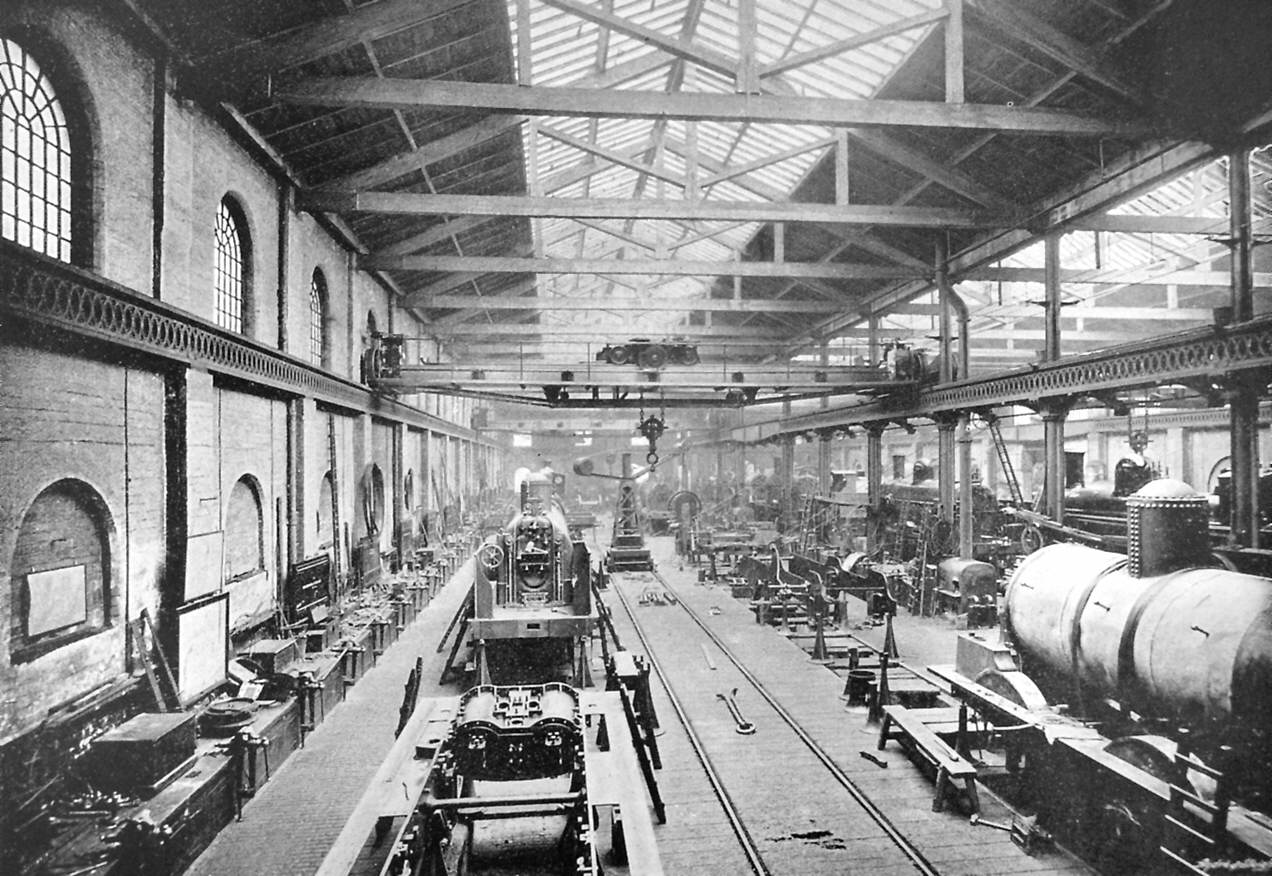
Crewe Works is a British railway engineering facility located in the town of Crewe, Cheshire. The works, which was originally opened by the Grand Junction Railway in March 1843, employed around 7,000 to 8,000 workers at its peak. In the 1980s much of the engineering works were closed. Most of the site has been redeveloped, but the remaining parts are owned and operated by Alstom.
During the late 19th century, the London and North Western Railway used Crewe Works to produce many famous locomotives such as the Webb 2-4-0 Jumbo class and the compounds, the Whale Experiment and Precursor classes, and the Bowen-Cooke Claughtons. In particular, Whale's 1912 superheated G1 Class 0-8-0 developed from a locomotive introduced by Webb in 1892, lasted, in many cases until 1964, near the end of steam in 1968.
After grouping, the works were taken over by London, Midland and Scottish Railway which was the successor to the LNWR. It was during this period that the works reached its zenith in size and output. Creating notable steam engines such as Sir William Stanier's locomotives as well as the 'Jubilee' and Class 5 4-6-0s, the 'Princess Royal' and the 'Princess Coronation' 4-6-2s.
The works continued to produce engines under British Railways such as the Britannia 4-6-2s and the Franco-Crosti boilered Class 9 freight locomotives. In the 1980s, a large part of the works was sold for redevelopment. Due to the scale of the works, it had its own internal narrow gauge tramway, the Crewe Works Railway, which was used from 1862 until 1932.
The directors of the Grand Junction Railway determined to construct a works on a 3 acres (12,000 m2) site at Crewe in 1840 with the first locomotive, No. 32Tamerlane completed in October 1843. By 1846, the demand for space was such that wagon building was moved, first to Edge Hill and Manchester, then to a new works at Earlestown. By 1848, the works employed over 1,000 producing one locomotive a week.
In 1845, the Liverpool and Manchester Railway was merged with the Grand Junction. These, in turn, merged in 1846, with the London and Birmingham Railway and the Manchester and Birmingham Railway to form the London and North Western Railway (LNWR). All four had their own workshops but, in time, locomotive building was concentrated at Crewe.
In 1857, John Ramsbottom became Locomotive Superintendent. He had previously invented the first reliable safety valve and the scoop for picking up water from troughs between the tracks. He went on to improve the precision and interchangeability of tools and components.
In 1862, locomotive work was transferred from Wolverton. Wolverton became the carriage works, while wagon building was concentrated at Earlestown.
Hub AI
Crewe Works AI simulator
(@Crewe Works_simulator)
Crewe Works
Crewe Works is a British railway engineering facility located in the town of Crewe, Cheshire. The works, which was originally opened by the Grand Junction Railway in March 1843, employed around 7,000 to 8,000 workers at its peak. In the 1980s much of the engineering works were closed. Most of the site has been redeveloped, but the remaining parts are owned and operated by Alstom.
During the late 19th century, the London and North Western Railway used Crewe Works to produce many famous locomotives such as the Webb 2-4-0 Jumbo class and the compounds, the Whale Experiment and Precursor classes, and the Bowen-Cooke Claughtons. In particular, Whale's 1912 superheated G1 Class 0-8-0 developed from a locomotive introduced by Webb in 1892, lasted, in many cases until 1964, near the end of steam in 1968.
After grouping, the works were taken over by London, Midland and Scottish Railway which was the successor to the LNWR. It was during this period that the works reached its zenith in size and output. Creating notable steam engines such as Sir William Stanier's locomotives as well as the 'Jubilee' and Class 5 4-6-0s, the 'Princess Royal' and the 'Princess Coronation' 4-6-2s.
The works continued to produce engines under British Railways such as the Britannia 4-6-2s and the Franco-Crosti boilered Class 9 freight locomotives. In the 1980s, a large part of the works was sold for redevelopment. Due to the scale of the works, it had its own internal narrow gauge tramway, the Crewe Works Railway, which was used from 1862 until 1932.
The directors of the Grand Junction Railway determined to construct a works on a 3 acres (12,000 m2) site at Crewe in 1840 with the first locomotive, No. 32Tamerlane completed in October 1843. By 1846, the demand for space was such that wagon building was moved, first to Edge Hill and Manchester, then to a new works at Earlestown. By 1848, the works employed over 1,000 producing one locomotive a week.
In 1845, the Liverpool and Manchester Railway was merged with the Grand Junction. These, in turn, merged in 1846, with the London and Birmingham Railway and the Manchester and Birmingham Railway to form the London and North Western Railway (LNWR). All four had their own workshops but, in time, locomotive building was concentrated at Crewe.
In 1857, John Ramsbottom became Locomotive Superintendent. He had previously invented the first reliable safety valve and the scoop for picking up water from troughs between the tracks. He went on to improve the precision and interchangeability of tools and components.
In 1862, locomotive work was transferred from Wolverton. Wolverton became the carriage works, while wagon building was concentrated at Earlestown.
Recent media