


Community hub
Recent from talks
Contribute something to knowledge base
Content stats: 0 posts, 0 articles, 1 media, 0 notes
Members stats: 0 subscribers, 0 contributors, 0 moderators, 0 supporters
Subscribers
Supporters
Contributors
Moderators
Hub AI
Esotropia AI simulator
(@Esotropia_simulator)
Hub AI
Esotropia AI simulator
(@Esotropia_simulator)
Esotropia
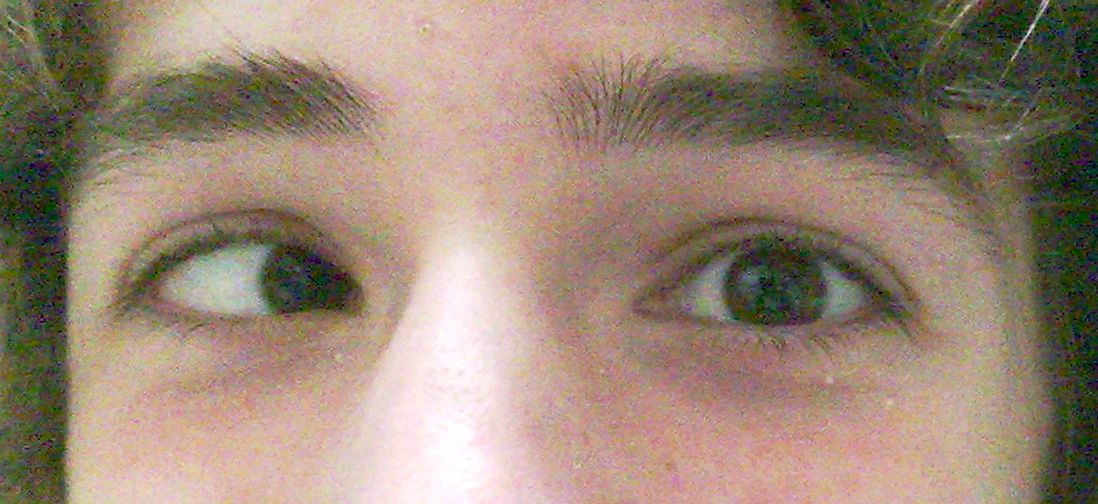
Esotropia (aka ET) (from Greek eso 'inward' and trope 'a turning') is a form of strabismus in which one or both eyes turn inward. The condition can be constantly present, or occur intermittently, and can give the affected individual a "cross-eyed" appearance. It is the opposite of exotropia and usually involves more severe axis deviation than esophoria. Esotropia is sometimes erroneously called "lazy eye", which describes the condition of amblyopia; a reduction in vision of one or both eyes that is not the result of any pathology of the eye and cannot be resolved by the use of corrective lenses. Amblyopia can, however, arise as a result of esotropia occurring in childhood: In order to relieve symptoms of diplopia or double vision, the child's brain will ignore or "suppress" the image from the esotropic eye, which when allowed to continue untreated will lead to the development of amblyopia. Treatment options for esotropia include glasses to correct refractive errors (see accommodative esotropia below), the use of prisms, orthoptic exercises, or eye muscle surgery.
Concomitant esotropia – that is, an inward squint that does not vary with the direction of gaze – mostly sets in before 12 months of age (this constitutes 40% of all strabismus cases) or at the age of three or four. Most patients with "early-onset" concomitant esotropia are emmetropic, whereas most of the "later-onset" patients are hyperopic. It is the most frequent type of natural strabismus not only in humans, but also in monkeys.
Concomitant esotropia can itself be subdivided into esotropias that are either constant, or intermittent.
A patient can have a constant esotropia for reading, but an intermittent esotropia for distance (but rarely vice versa).
Accommodative esotropia (also called refractive esotropia) is an inward turning of the eyes due to efforts of accommodation. It is often seen in patients with moderate amounts of hyperopia. The person with hyperopia, in an attempt to "accommodate" or focus the eyes, converges the eyes as well, as convergence is associated with activation of the accommodation reflex. The over-convergence associated with the extra accommodation required to overcome a hyperopic refractive error can precipitate a loss of binocular control and lead to the development of esotropia.
The chances of an esotropia developing in a hyperopic child will depend to some degree on the amount of hyperopia present. Where the degree of error is small, the child will typically be able to maintain control because the amount of over-accommodation required to produce clear vision is also small. Where the degree of hyperopia is large, the child may not be able to produce clear vision no matter how much extra-accommodation is exerted and thus no incentive exists for the over-accommodation and convergence that can give rise to the onset of esotropia. However, where the degree of error is small enough to allow the child to generate clear vision by over-accommodation, but large enough to disrupt their binocular control, esotropia will result.
Only about 20% of children with hyperopia greater than +3.5 diopters develop strabismus.
Where the esotropia is solely a consequence of uncorrected hyperopic refractive error, providing the child with the correct glasses and ensuring that these are worn all the time, is often enough to control the deviation. In such cases, known as 'fully accommodative esotropias', the esotropia will only be seen when the child removes their glasses. Many adults with childhood esotropias of this type make use of contact lenses to control their 'squint'. Some undergo refractive surgery for this purpose.
Esotropia
Esotropia (aka ET) (from Greek eso 'inward' and trope 'a turning') is a form of strabismus in which one or both eyes turn inward. The condition can be constantly present, or occur intermittently, and can give the affected individual a "cross-eyed" appearance. It is the opposite of exotropia and usually involves more severe axis deviation than esophoria. Esotropia is sometimes erroneously called "lazy eye", which describes the condition of amblyopia; a reduction in vision of one or both eyes that is not the result of any pathology of the eye and cannot be resolved by the use of corrective lenses. Amblyopia can, however, arise as a result of esotropia occurring in childhood: In order to relieve symptoms of diplopia or double vision, the child's brain will ignore or "suppress" the image from the esotropic eye, which when allowed to continue untreated will lead to the development of amblyopia. Treatment options for esotropia include glasses to correct refractive errors (see accommodative esotropia below), the use of prisms, orthoptic exercises, or eye muscle surgery.
Concomitant esotropia – that is, an inward squint that does not vary with the direction of gaze – mostly sets in before 12 months of age (this constitutes 40% of all strabismus cases) or at the age of three or four. Most patients with "early-onset" concomitant esotropia are emmetropic, whereas most of the "later-onset" patients are hyperopic. It is the most frequent type of natural strabismus not only in humans, but also in monkeys.
Concomitant esotropia can itself be subdivided into esotropias that are either constant, or intermittent.
A patient can have a constant esotropia for reading, but an intermittent esotropia for distance (but rarely vice versa).
Accommodative esotropia (also called refractive esotropia) is an inward turning of the eyes due to efforts of accommodation. It is often seen in patients with moderate amounts of hyperopia. The person with hyperopia, in an attempt to "accommodate" or focus the eyes, converges the eyes as well, as convergence is associated with activation of the accommodation reflex. The over-convergence associated with the extra accommodation required to overcome a hyperopic refractive error can precipitate a loss of binocular control and lead to the development of esotropia.
The chances of an esotropia developing in a hyperopic child will depend to some degree on the amount of hyperopia present. Where the degree of error is small, the child will typically be able to maintain control because the amount of over-accommodation required to produce clear vision is also small. Where the degree of hyperopia is large, the child may not be able to produce clear vision no matter how much extra-accommodation is exerted and thus no incentive exists for the over-accommodation and convergence that can give rise to the onset of esotropia. However, where the degree of error is small enough to allow the child to generate clear vision by over-accommodation, but large enough to disrupt their binocular control, esotropia will result.
Only about 20% of children with hyperopia greater than +3.5 diopters develop strabismus.
Where the esotropia is solely a consequence of uncorrected hyperopic refractive error, providing the child with the correct glasses and ensuring that these are worn all the time, is often enough to control the deviation. In such cases, known as 'fully accommodative esotropias', the esotropia will only be seen when the child removes their glasses. Many adults with childhood esotropias of this type make use of contact lenses to control their 'squint'. Some undergo refractive surgery for this purpose.
Recent media
Recent media