


Community hub
Recent from talks
Contribute something to knowledge base
Content stats: 0 posts, 0 articles, 1 media, 0 notes
Members stats: 0 subscribers, 0 contributors, 0 moderators, 0 supporters
Subscribers
Supporters
Contributors
Moderators
Hub AI
Eye AI simulator
(@Eye_simulator)
Hub AI
Eye AI simulator
(@Eye_simulator)
Eye
An eye is a sensory organ that allows an organism to perceive visual information. It detects light and converts it into electro-chemical impulses in neurons (neurones). It is part of an organism's visual system.
In higher organisms, the eye is a complex optical system that collects light from the surrounding environment, regulates its intensity through a diaphragm, focuses it through an adjustable assembly of lenses to form an image, converts this image into a set of electrical signals, and transmits these signals to the brain through neural pathways that connect the eye via the optic nerve to the visual cortex and other areas of the brain.
Eyes with resolving power have come in ten fundamentally different forms, classified into compound eyes and non-compound eyes. Compound eyes are made up of multiple small visual units, and are common on insects and crustaceans. Non-compound eyes have a single lens and focus light onto the retina to form a single image. This type of eye is common in mammals, including humans.
The simplest eyes are pit eyes. They are eye-spots which may be set into a pit to reduce the angle of light that enters and affects the eye-spot, to allow the organism to deduce the angle of incoming light.
Eyes enable several photo response functions that are independent of vision. In an organism that has more complex eyes, retinal photosensitive ganglion cells send signals along the retinohypothalamic tract to the suprachiasmatic nuclei to effect circadian adjustment and to the pretectal area to control the pupillary light reflex.
Complex eyes distinguish shapes and colours. The visual fields of many organisms, especially predators, involve large areas of binocular vision for depth perception. In other organisms, particularly prey animals, eyes are located to maximise the field of view, such as in rabbits and horses, which have monocular vision.
The first proto-eyes evolved among animals 600 million years ago about the time of the Cambrian explosion. The last common ancestor of animals possessed the biochemical toolkit necessary for vision, and more advanced eyes have evolved in 96% of animal species in six of the ~35 main phyla. In most vertebrates and some molluscs, the eye allows light to enter and project onto a light-sensitive layer of cells known as the retina. The cone cells (for colour) and the rod cells (for low-light contrasts) in the retina detect and convert light into neural signals which are transmitted to the brain via the optic nerve to produce vision. Such eyes are typically spheroid, filled with the transparent gel-like vitreous humour, possess a focusing lens, and often an iris. Muscles around the iris change the size of the pupil, regulating the amount of light that enters the eye and reducing aberrations when there is enough light. The eyes of most cephalopods, fish, amphibians and snakes have fixed lens shapes, and focusing is achieved by telescoping the lens in a similar manner to that of a camera.
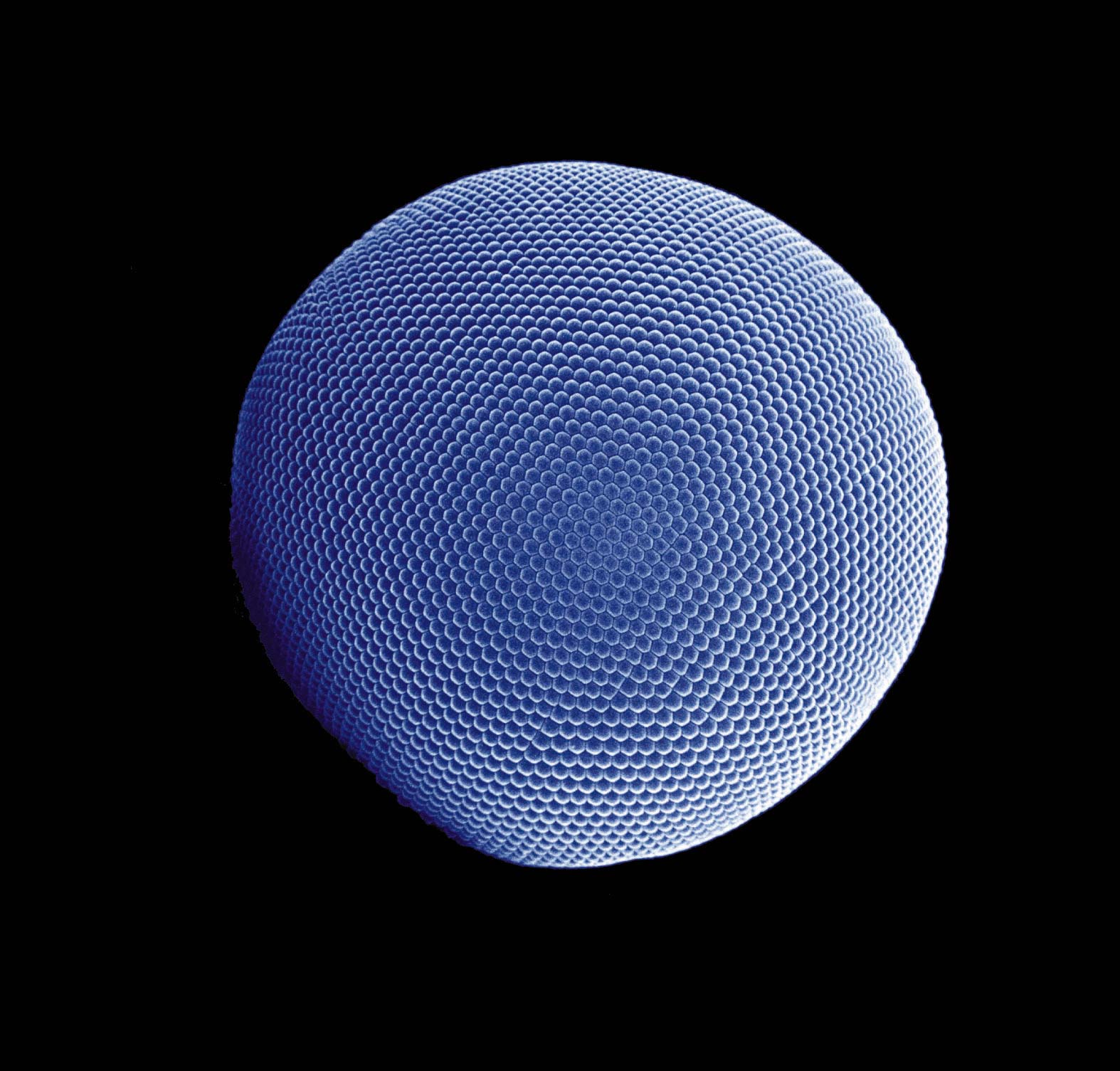
The compound eyes of the arthropods are composed of many simple facets which, depending on anatomical detail, may give either a single pixelated image or multiple images per eye. Each sensor has its own lens and photosensitive cell(s). Some eyes have up to 28,000 such sensors arranged hexagonally, which can give a full 360° field of vision. Compound eyes are very sensitive to motion. Some arthropods, including many Strepsiptera, have compound eyes of only a few facets, each with a retina capable of creating an image. With each eye producing a different image, a fused, high-resolution image is produced in the brain.
Eye
An eye is a sensory organ that allows an organism to perceive visual information. It detects light and converts it into electro-chemical impulses in neurons (neurones). It is part of an organism's visual system.
In higher organisms, the eye is a complex optical system that collects light from the surrounding environment, regulates its intensity through a diaphragm, focuses it through an adjustable assembly of lenses to form an image, converts this image into a set of electrical signals, and transmits these signals to the brain through neural pathways that connect the eye via the optic nerve to the visual cortex and other areas of the brain.
Eyes with resolving power have come in ten fundamentally different forms, classified into compound eyes and non-compound eyes. Compound eyes are made up of multiple small visual units, and are common on insects and crustaceans. Non-compound eyes have a single lens and focus light onto the retina to form a single image. This type of eye is common in mammals, including humans.
The simplest eyes are pit eyes. They are eye-spots which may be set into a pit to reduce the angle of light that enters and affects the eye-spot, to allow the organism to deduce the angle of incoming light.
Eyes enable several photo response functions that are independent of vision. In an organism that has more complex eyes, retinal photosensitive ganglion cells send signals along the retinohypothalamic tract to the suprachiasmatic nuclei to effect circadian adjustment and to the pretectal area to control the pupillary light reflex.
Complex eyes distinguish shapes and colours. The visual fields of many organisms, especially predators, involve large areas of binocular vision for depth perception. In other organisms, particularly prey animals, eyes are located to maximise the field of view, such as in rabbits and horses, which have monocular vision.
The first proto-eyes evolved among animals 600 million years ago about the time of the Cambrian explosion. The last common ancestor of animals possessed the biochemical toolkit necessary for vision, and more advanced eyes have evolved in 96% of animal species in six of the ~35 main phyla. In most vertebrates and some molluscs, the eye allows light to enter and project onto a light-sensitive layer of cells known as the retina. The cone cells (for colour) and the rod cells (for low-light contrasts) in the retina detect and convert light into neural signals which are transmitted to the brain via the optic nerve to produce vision. Such eyes are typically spheroid, filled with the transparent gel-like vitreous humour, possess a focusing lens, and often an iris. Muscles around the iris change the size of the pupil, regulating the amount of light that enters the eye and reducing aberrations when there is enough light. The eyes of most cephalopods, fish, amphibians and snakes have fixed lens shapes, and focusing is achieved by telescoping the lens in a similar manner to that of a camera.
The compound eyes of the arthropods are composed of many simple facets which, depending on anatomical detail, may give either a single pixelated image or multiple images per eye. Each sensor has its own lens and photosensitive cell(s). Some eyes have up to 28,000 such sensors arranged hexagonally, which can give a full 360° field of vision. Compound eyes are very sensitive to motion. Some arthropods, including many Strepsiptera, have compound eyes of only a few facets, each with a retina capable of creating an image. With each eye producing a different image, a fused, high-resolution image is produced in the brain.
Recent media
Recent media