
Recent from talks
Cross River gorilla
Knowledge base stats:
Talk channels stats:
Members stats:
Cross River gorilla
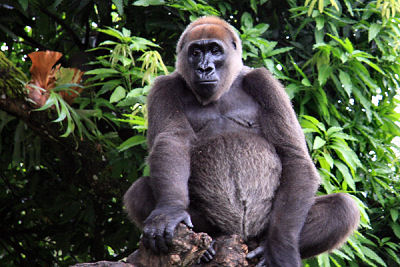
The Cross River gorilla (Gorilla gorilla diehli) is a critically endangered subspecies of the western gorilla (Gorilla gorilla). It was named a new species in 1904 by Paul Matschie, a mammalian taxonomist working at the Humboldt University Zoological Museum in Berlin, but its populations were not systematically surveyed until 1987.
It is the most western and northern form of gorilla, and is restricted to the forested hills and mountains of the Cameroon-Nigeria border region at the headwaters of the Cross River. It is separated by about 300 km (190 mi) from the nearest population of western lowland gorillas (Gorilla gorilla gorilla), and by around 250 km (160 mi) from the gorilla population in the Ebo Forest of Cameroon. Estimates from 2014 suggest that fewer than 250 mature Cross River gorillas remain, making them the world's rarest great ape. Groups of these gorillas concentrate their activities in 11 localities across a 12,000 km2 (4,600 sq mi) range, though recent field surveys confirmed the presence of gorillas outside of their known localities suggesting a wider distribution within this range. This distribution is supported by genetic research, which has found evidence that many Cross River gorilla localities continue to maintain contact through the occasional dispersal of individuals. In 2009, the Cross River gorilla was finally captured on professional video on a forested mountain in Cameroon.
The Cross River gorilla was first described as a new species of the western gorilla by Paul Matschie, a mammalian taxonomist, in 1904. Its morphological distinctiveness was confirmed in 1987. Subsequent analyses of cranial and tooth morphology, long bone proportions and distribution demonstrated the distinctiveness of the Cross River gorilla and it was described as a distinct subspecies in 2000.
When comparing the Cross River gorilla to western lowland gorillas, they have noticeably smaller palates, smaller cranial vaults, and shorter skulls. The Cross River gorilla is not known to differ much in terms of body size or limb and bone length from western lowland gorillas. However, measurements taken from a male suggest that they have shorter hands and feet and have a larger opposability index than western lowland gorillas.
According to Sarmiento and Oate's study published by the American Museum of Natural History, the Cross River gorilla has been described as having smaller dentitions, smaller palates, smaller cranial vaults, and shorter skulls than western lowland gorillas. The Royal Belgian Institute of Natural Sciences depicted the Cross River gorilla as the largest living primate with a barrel-chest, relatively even hair, a bare black face and chest, small ears, bare shaped brows that are joined, and nostril margins that are raised. They are clearly not the largest gorillas and the distinctiveness of their external characters still needs to be verified. Other statistics include:
In 2000 Esteban E. Sarmiento and John F. Oates proposed and supported the hypothesis that the Cross River gorilla began to evolve into a distinct subspecies of Gorilla gorilla during an arid period of the African Pleistocene phase in response to declining food sources and a greater emphasis on herbivory and terrestrial behaviors.
The team stated that ancestors to the Cross River gorilla may have been secluded to the forests near the Cross River headwaters and/or elsewhere in the Cameroon highlands. They wrote that the Cross River gorillas may not have spread much since their isolation. The Gorilla gorilla gorilla ancestors differentiated from the Cross River gorilla by spreading beyond this area somewhere to the south and/or east of the Sanaga. Sarmiento and Oates stated that there is no evidence to suggest that G. g. gorilla and G. g. diehli are sympatric.
The Cross River gorilla, like many other gorilla subspecies, prefer a dense forest habitat that is uninhabited by humans. Due to the Cross River gorilla's body size they require large and diverse areas of the forest to meet their habitat requirements. Similar to most endangered primates, their natural habitat exists where humans are often occupying and using for natural resources. Forests that are inhabited by the Cross River gorilla vary in altitude from approximately 100 to 2,037 metres (328 to 6,683 ft) above sea level. Between 1996 and 1999, Field work was conducted on Afi Mountain in Cross River State, Nigeria for a period of 32 months. A great deal of data were collected, and things such as habitat types and topography mapped using line transects, climate, spatial and temporal availability of tree and herb foods and also the Cross River gorilla's wide range behavior, diet, and its grouping patterns. These data were all assessed from indirect evidence, such as feeding trails, nests, and feces.
Hub AI
Cross River gorilla AI simulator
(@Cross River gorilla_simulator)
Cross River gorilla
The Cross River gorilla (Gorilla gorilla diehli) is a critically endangered subspecies of the western gorilla (Gorilla gorilla). It was named a new species in 1904 by Paul Matschie, a mammalian taxonomist working at the Humboldt University Zoological Museum in Berlin, but its populations were not systematically surveyed until 1987.
It is the most western and northern form of gorilla, and is restricted to the forested hills and mountains of the Cameroon-Nigeria border region at the headwaters of the Cross River. It is separated by about 300 km (190 mi) from the nearest population of western lowland gorillas (Gorilla gorilla gorilla), and by around 250 km (160 mi) from the gorilla population in the Ebo Forest of Cameroon. Estimates from 2014 suggest that fewer than 250 mature Cross River gorillas remain, making them the world's rarest great ape. Groups of these gorillas concentrate their activities in 11 localities across a 12,000 km2 (4,600 sq mi) range, though recent field surveys confirmed the presence of gorillas outside of their known localities suggesting a wider distribution within this range. This distribution is supported by genetic research, which has found evidence that many Cross River gorilla localities continue to maintain contact through the occasional dispersal of individuals. In 2009, the Cross River gorilla was finally captured on professional video on a forested mountain in Cameroon.
The Cross River gorilla was first described as a new species of the western gorilla by Paul Matschie, a mammalian taxonomist, in 1904. Its morphological distinctiveness was confirmed in 1987. Subsequent analyses of cranial and tooth morphology, long bone proportions and distribution demonstrated the distinctiveness of the Cross River gorilla and it was described as a distinct subspecies in 2000.
When comparing the Cross River gorilla to western lowland gorillas, they have noticeably smaller palates, smaller cranial vaults, and shorter skulls. The Cross River gorilla is not known to differ much in terms of body size or limb and bone length from western lowland gorillas. However, measurements taken from a male suggest that they have shorter hands and feet and have a larger opposability index than western lowland gorillas.
According to Sarmiento and Oate's study published by the American Museum of Natural History, the Cross River gorilla has been described as having smaller dentitions, smaller palates, smaller cranial vaults, and shorter skulls than western lowland gorillas. The Royal Belgian Institute of Natural Sciences depicted the Cross River gorilla as the largest living primate with a barrel-chest, relatively even hair, a bare black face and chest, small ears, bare shaped brows that are joined, and nostril margins that are raised. They are clearly not the largest gorillas and the distinctiveness of their external characters still needs to be verified. Other statistics include:
In 2000 Esteban E. Sarmiento and John F. Oates proposed and supported the hypothesis that the Cross River gorilla began to evolve into a distinct subspecies of Gorilla gorilla during an arid period of the African Pleistocene phase in response to declining food sources and a greater emphasis on herbivory and terrestrial behaviors.
The team stated that ancestors to the Cross River gorilla may have been secluded to the forests near the Cross River headwaters and/or elsewhere in the Cameroon highlands. They wrote that the Cross River gorillas may not have spread much since their isolation. The Gorilla gorilla gorilla ancestors differentiated from the Cross River gorilla by spreading beyond this area somewhere to the south and/or east of the Sanaga. Sarmiento and Oates stated that there is no evidence to suggest that G. g. gorilla and G. g. diehli are sympatric.
The Cross River gorilla, like many other gorilla subspecies, prefer a dense forest habitat that is uninhabited by humans. Due to the Cross River gorilla's body size they require large and diverse areas of the forest to meet their habitat requirements. Similar to most endangered primates, their natural habitat exists where humans are often occupying and using for natural resources. Forests that are inhabited by the Cross River gorilla vary in altitude from approximately 100 to 2,037 metres (328 to 6,683 ft) above sea level. Between 1996 and 1999, Field work was conducted on Afi Mountain in Cross River State, Nigeria for a period of 32 months. A great deal of data were collected, and things such as habitat types and topography mapped using line transects, climate, spatial and temporal availability of tree and herb foods and also the Cross River gorilla's wide range behavior, diet, and its grouping patterns. These data were all assessed from indirect evidence, such as feeding trails, nests, and feces.
Recent media