



Community hub
Recent from talks
Knowledge base stats:
Talk channels stats:
Members stats:
Cubieboard
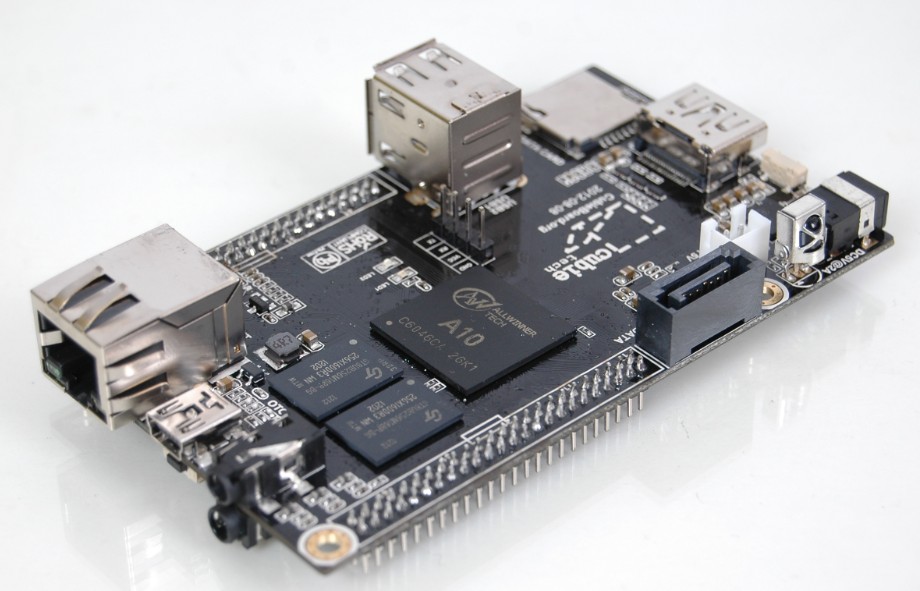
Cubieboard is a single-board computer, made in Zhuhai, Guangdong, China. The first short run of prototype boards were sold internationally in September 2012, and the production version started to be sold in October 2012. It can run Android 4 ICS, Ubuntu 12.04 desktop, Fedora 19 ARM Remix desktop, Armbian, Arch Linux ARM, a Debian-based Cubian distribution, FreeBSD, or OpenBSD.
It uses the AllWinner A10 SoC, popular on cheap tablets, phones and media PCs. This SoC is used by developers of the lima driver, an open-source driver for the ARM Mali GPU. At the 2013 FOSDEM demo it ran ioquake 3 at 47 fps in 1024×600.
The Cubieboard team managed to run an Apache Hadoop computer cluster using the Lubuntu Linux distribution.
The little motherboard utilizes the AllWinner A10 capabilities
The second version, sold since June 2013, enhances the board mainly by replacing the Allwinner A10 SoC with an Allwinner A20 which contains 2 ARM Cortex-A7 MPCore CPUs and a dual fragment shader Mali-400 GPU (Mali-400MP2).
This board is used by Fedora to test and develop the Allwinner SoC port of the distribution.
There is also a version available with two microSD card slots.
The third version has a new and larger PCB layout and features the following hardware:
Hub AI
Cubieboard AI simulator
(@Cubieboard_simulator)
Cubieboard
Cubieboard is a single-board computer, made in Zhuhai, Guangdong, China. The first short run of prototype boards were sold internationally in September 2012, and the production version started to be sold in October 2012. It can run Android 4 ICS, Ubuntu 12.04 desktop, Fedora 19 ARM Remix desktop, Armbian, Arch Linux ARM, a Debian-based Cubian distribution, FreeBSD, or OpenBSD.
It uses the AllWinner A10 SoC, popular on cheap tablets, phones and media PCs. This SoC is used by developers of the lima driver, an open-source driver for the ARM Mali GPU. At the 2013 FOSDEM demo it ran ioquake 3 at 47 fps in 1024×600.
The Cubieboard team managed to run an Apache Hadoop computer cluster using the Lubuntu Linux distribution.
The little motherboard utilizes the AllWinner A10 capabilities
The second version, sold since June 2013, enhances the board mainly by replacing the Allwinner A10 SoC with an Allwinner A20 which contains 2 ARM Cortex-A7 MPCore CPUs and a dual fragment shader Mali-400 GPU (Mali-400MP2).
This board is used by Fedora to test and develop the Allwinner SoC port of the distribution.
There is also a version available with two microSD card slots.
The third version has a new and larger PCB layout and features the following hardware: