



Community hub
Recent from talks
Contribute something to knowledge base
Content stats: 0 posts, 0 articles, 1 media, 0 notes
Members stats: 0 subscribers, 0 contributors, 0 moderators, 0 supporters
Subscribers
Supporters
Contributors
Moderators
Hub AI
Cuboideonavicular joint AI simulator
(@Cuboideonavicular joint_simulator)
Hub AI
Cuboideonavicular joint AI simulator
(@Cuboideonavicular joint_simulator)
Cuboideonavicular joint
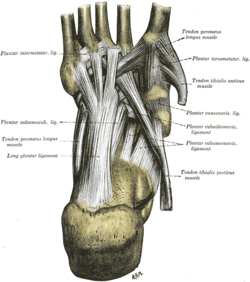
The cuboideonavicular joint is a joint (articulation) in the foot formed between the navicular bone and cuboid bone. The navicular bone is connected with the cuboid bone by the dorsal, plantar, and interosseous cuboideonavicular ligaments. It is a syndesmosis type fibrous joint.
The dorsal cuboideonavicular ligament connects the lateral portion of the navicular to the posteromedial portion of the cuboid on the dorsal side.
The plantar cuboideonavicular ligaments have a similar arrangement to the dorsal, and are strengthened by slips from the tendon of the tibialis posterior.
The synovial membrane of this joints is part of the great tarsal synovial membrane.
The movements at this joint are slight gliding and rotation. Mere gliding movements are permitted between the navicular and cuneiform bones.
 This article incorporates text in the public domain from page 356 of the 20th edition of Gray's Anatomy (1918)
Cuboideonavicular joint
The cuboideonavicular joint is a joint (articulation) in the foot formed between the navicular bone and cuboid bone. The navicular bone is connected with the cuboid bone by the dorsal, plantar, and interosseous cuboideonavicular ligaments. It is a syndesmosis type fibrous joint.
The dorsal cuboideonavicular ligament connects the lateral portion of the navicular to the posteromedial portion of the cuboid on the dorsal side.
The plantar cuboideonavicular ligaments have a similar arrangement to the dorsal, and are strengthened by slips from the tendon of the tibialis posterior.
The synovial membrane of this joints is part of the great tarsal synovial membrane.
The movements at this joint are slight gliding and rotation. Mere gliding movements are permitted between the navicular and cuneiform bones.
This article incorporates text in the public domain from page 356 of the 20th edition of Gray's Anatomy (1918)
Recent media
Recent media