




Community hub
Recent from talks
Contribute something to knowledge base
Content stats: 0 posts, 0 articles, 1 media, 0 notes
Members stats: 0 subscribers, 0 contributors, 0 moderators, 0 supporters
Subscribers
Supporters
Contributors
Moderators
Cue sports
Cue sports are a wide variety of games of skill played with a cue stick, which is used to strike billiard balls and thereby cause them to move around a cloth-covered table bounded by elastic bumpers known as cushions. Cue sports, a category of stick sports, may collectively be referred to as billiards, though this term has more specific connotations in some English dialects.
There are three major subdivisions of games within cue sports:
All cue sports are generally regarded to have evolved into indoor games from outdoor stick-and-ball lawn games, specifically those retroactively termed ground billiards, and as such to be related to the historical games jeu de mail and palle-malle, and modern trucco, croquet, and golf, and more distantly to the stickless bocce and bowls.
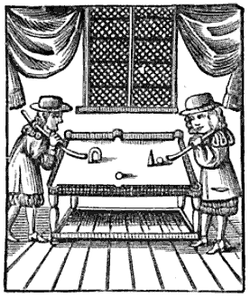
The word billiard may have evolved from the French word billart or billette, meaning 'stick', in reference to the mace, an implement similar to a golf putter, and which was the forerunner to the modern cue; however, the term's origin could have been from French bille, meaning 'ball'. The modern term cue sports can be used to encompass the ancestral mace games, and even the modern cueless variants, such as finger billiards, for historical reasons. Cue itself came from queue, the French word for 'tail'. This refers to the early practice of using the tail or butt of the mace, instead of its club foot, to strike the ball when it lay against a rail cushion.
A recognizable form of billiards was played outdoors in the 1340s, and was reminiscent of croquet. King Louis XI of France (1461–1483) had the first known indoor billiard table. Louis XIV further refined and popularized the game, and it swiftly spread among the French nobility. While the game had long been played on the ground, this version appears to have died out (aside from trucco) in the 17th century, in favor of croquet, golf and bowling games, even as table billiards had grown in popularity as an indoor activity.
In 1535, Mary of Hungary (governor of the Netherlands) played at a billiard table covered with green cloth in a gallery. James VI and I had a "bilzeart burde" covered with green cloth at Holyrood Palace in 1581. The imprisoned Mary, Queen of Scots, had a billiard table at Tutbury Castle. She complained when her table de billiard was taken away (by those who eventually became her executioners, who were to cover her body with the table's cloth). A 1588 inventory of the Duke of Norfolk's estate included a "billyard bord coered with a greene cloth ... three billyard sticks and 11 balls of yvery". Billiards grew to the extent that by 1727, it was being played in almost every Paris café. In England, the game was developing into a very popular activity for members of the gentry.
By 1670, the thin butt end of the mace began to be used not only for shots under the cushion (which itself was originally only there as a preventative method to stop balls from rolling off), but players increasingly preferred it for other shots as well. The footless, straight cue as it is known today was finally developed by about 1800.
Initially, the mace was used to push the balls, rather than strike them. The newly developed striking cue provided a new challenge. Cushions began to be stuffed with substances to allow the balls to rebound, in order to enhance the appeal of the game. After a transitional period where only the better players would use cues, the cue came to be the first choice of equipment.
Cue sports
Cue sports are a wide variety of games of skill played with a cue stick, which is used to strike billiard balls and thereby cause them to move around a cloth-covered table bounded by elastic bumpers known as cushions. Cue sports, a category of stick sports, may collectively be referred to as billiards, though this term has more specific connotations in some English dialects.
There are three major subdivisions of games within cue sports:
All cue sports are generally regarded to have evolved into indoor games from outdoor stick-and-ball lawn games, specifically those retroactively termed ground billiards, and as such to be related to the historical games jeu de mail and palle-malle, and modern trucco, croquet, and golf, and more distantly to the stickless bocce and bowls.
The word billiard may have evolved from the French word billart or billette, meaning 'stick', in reference to the mace, an implement similar to a golf putter, and which was the forerunner to the modern cue; however, the term's origin could have been from French bille, meaning 'ball'. The modern term cue sports can be used to encompass the ancestral mace games, and even the modern cueless variants, such as finger billiards, for historical reasons. Cue itself came from queue, the French word for 'tail'. This refers to the early practice of using the tail or butt of the mace, instead of its club foot, to strike the ball when it lay against a rail cushion.
A recognizable form of billiards was played outdoors in the 1340s, and was reminiscent of croquet. King Louis XI of France (1461–1483) had the first known indoor billiard table. Louis XIV further refined and popularized the game, and it swiftly spread among the French nobility. While the game had long been played on the ground, this version appears to have died out (aside from trucco) in the 17th century, in favor of croquet, golf and bowling games, even as table billiards had grown in popularity as an indoor activity.
In 1535, Mary of Hungary (governor of the Netherlands) played at a billiard table covered with green cloth in a gallery. James VI and I had a "bilzeart burde" covered with green cloth at Holyrood Palace in 1581. The imprisoned Mary, Queen of Scots, had a billiard table at Tutbury Castle. She complained when her table de billiard was taken away (by those who eventually became her executioners, who were to cover her body with the table's cloth). A 1588 inventory of the Duke of Norfolk's estate included a "billyard bord coered with a greene cloth ... three billyard sticks and 11 balls of yvery". Billiards grew to the extent that by 1727, it was being played in almost every Paris café. In England, the game was developing into a very popular activity for members of the gentry.
By 1670, the thin butt end of the mace began to be used not only for shots under the cushion (which itself was originally only there as a preventative method to stop balls from rolling off), but players increasingly preferred it for other shots as well. The footless, straight cue as it is known today was finally developed by about 1800.
Initially, the mace was used to push the balls, rather than strike them. The newly developed striking cue provided a new challenge. Cushions began to be stuffed with substances to allow the balls to rebound, in order to enhance the appeal of the game. After a transitional period where only the better players would use cues, the cue came to be the first choice of equipment.
Recent media
Recent media