



Community hub
Recent from talks
Knowledge base stats:
Talk channels stats:
Members stats:
Ground billiards
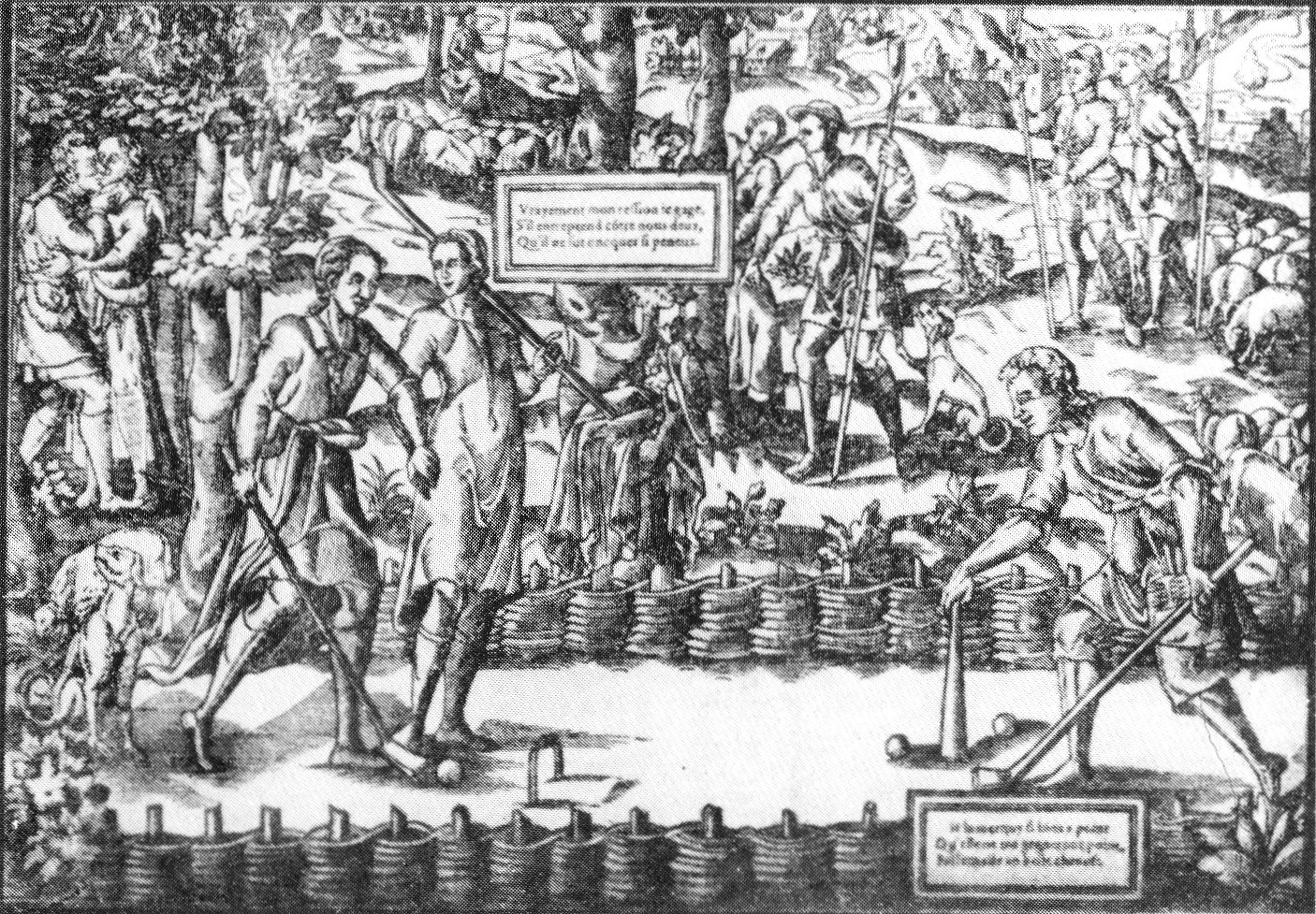
Ground billiards is a modern term for a family of medieval European lawn games, the original names of which are mostly unknown, played with a long-handled mallet (the mace), wooden balls, a hoop (the pass), and an upright skittle or pin (the king). The game, which cue-sports historians have called "the original game of billiards", developed into a variety of modern outdoor and indoor games and sports such as croquet, pool, snooker, and carom billiards. Its relationship to games played on larger fields, such as hockey, golf, and bat-and-ball games, is more speculative. As a broader classification, the term is sometimes applied to games dating back to classical antiquity that are attested via difficult-to-interpret ancient artworks and rare surviving gaming artifacts.
Dating back to at least the 15th century as a tabletop game, and in recognizable form to as early as the 14th, this proto-billiards game appears to have been ancestral to croquet (19th century), trucco (17th century; also known as trucks or lawn billiards), pall-mall (16th century), jeu de mail (15th century), and indoor cue sports (15th century if not earlier – what is usually meant by billiards today). The location of origin is obscure, with various scholars tracing it to medieval France, Italy, Spain, England, Germany, or more than one of these areas. More exotic and earlier origins have also been proposed.
Even in the late 17th to early 18th centuries, indoor billiards was essentially the same game, with smaller equipment and played on a bounded table, with or without pockets. Use of the king pin declined first in most areas, followed by the abandonment of the port arch, though many variants featured both as well as pockets, while the king survived and even multiplied in some cases, leading to such modern cue games as five-pins. Some later stick-and-ball games, including cricket, also evolved multiple pin targets over time. Ground and table billiards were played contemporaneously, and the outdoor version remained known until at least the beginning of the 19th century; derived lawn games like croquet continue to the present day.
The game's relationships to bowling, golf, hockey, and bat-and-ball games are not entirely certain. It is clear that bowling, in its ancestral form of skittles, shares a common origin with ground billiards, as the two game types share both the basic objective, to direct a rolling ball towards one or more targets, and similar equipment, aside from the mace. Some contemporary sources depict the same game being played both with the hand and with a mace, and show a distinctive teardrop-shaped king pin design, with a rounded, wide bottom and a slender top. This pin shape suggests that it may have been the origin of the modern bottom-heavy design of bowling pins and similar skittles of various sizes used in a wide variety of games. A conical king or jack, or sometimes a spherical jack or pallino, as used in modern bowls, boules, bocce, and pétanque, has been employed in lawn-bowling games since at least as early as the 13th century in England; all these games have the same basic objective, to get as close to the jack as possible with one's own ball. Conical king pins are found in depictions and actual surviving game equipment (of carved stone) from Ancient Egypt. Later equipment was typically made of wood, sometimes also with clay, bone, or ivory pieces.
The Dutch game het kolven, a precursor of golf dating to at least the early 13th century, seems to be intermediate between ground billiards on the one hand, and both golf and ice hockey on the other (and its name is etymologically cognate with golf). It was played in a wicker-bounded court during warm weather, and on ice in the winter, like bandy. Players used maces (kolven) very similar to those shown in early ground billiards illustrations. At least one variant of it used holes in the ground, reminiscent of both golf holes and billiards pockets, instead of above-ground targets. The modern version, kolf or kolven, uses a tall, flat-bottomed king pin (paal, 'pole, stake').
Engravings dating back to c. 1300 show a game being played that is an early variant of either ground billiards or one-on-one field hockey (assuming there was any significant difference other than game speed and vigour), sometimes within a bounded area. A similar game has survived to modern times, in the form of box hockey (which uses a flat puck in a confined space, and archways or "mouse holes" cut into wooden barriers, rather than stand-alone arches).
There are hints that ground billiards may be far more ancient than the Late Medieval period. At least as early as 360 BCE, Romans played a somewhat golf-like game called paganica that could have degenerated to simpler, smaller-scale lawn games during the Dark Ages. Third century BCE Greece has also been proposed. Earlier still, a bas relief dating to c. 600 BCE depicts an ancient Greek ball game, a possible ancestor of both ground billiards and field hockey, which may have been called kerētízein or kerhtízein (κερητίζειν) because it was played with an implement shaped like a horn (kéras, κέρας). It appears to be basically the same as the Medieval European activity of c. 1300 CE. An ancient Greek game said (in Leila Dorion's and Julia Shepherd's 1928 History of Bowling and Billiards) to be "analogous to billiards" was reported in Greek writings around 400 BCE, contemporary with the game's play.
Billiards scholars Victor Stein and Paul Rubino conclude in The Billiard Encyclopedia that there is an unbroken chain of game evolution from very widespread prehistoric ball-and-stick games and rituals, through the civilizations of classical antiquity, to modern lawn and cue sports in Europe and Asia. Even polo – a cavalry-training sport with origins among the Iranic peoples of the central Asian steppes and directly attested since at least the Parthian Empire (247 BCE – 224 CE) of Ancient Persia – is essentially the same core game as field hockey or team ground billiards, but played on horseback with a longer cue-mallet. A set of gaming pieces, buried with a child dating to c. 3300 BCE in Egypt, features stone balls, skittles, and an arch (no cue/mace was included in the recovered artifacts). Stein and Rubino, among other researchers, believe that games such as early ball-and-stick activities, chess, and many others were primarily brought into Europe from the Near East and Middle East by returning Crusaders from the 12th century onward, and that the pastimes were kept alive and evolving on that continent principally by the Christian clergy. Ireland has also been proposed as a time and place of origin; the stick-and-ball game hurling (also called camogie, as a women's sport) dates to the 1200s there.
Hub AI
Ground billiards AI simulator
(@Ground billiards_simulator)
Ground billiards
Ground billiards is a modern term for a family of medieval European lawn games, the original names of which are mostly unknown, played with a long-handled mallet (the mace), wooden balls, a hoop (the pass), and an upright skittle or pin (the king). The game, which cue-sports historians have called "the original game of billiards", developed into a variety of modern outdoor and indoor games and sports such as croquet, pool, snooker, and carom billiards. Its relationship to games played on larger fields, such as hockey, golf, and bat-and-ball games, is more speculative. As a broader classification, the term is sometimes applied to games dating back to classical antiquity that are attested via difficult-to-interpret ancient artworks and rare surviving gaming artifacts.
Dating back to at least the 15th century as a tabletop game, and in recognizable form to as early as the 14th, this proto-billiards game appears to have been ancestral to croquet (19th century), trucco (17th century; also known as trucks or lawn billiards), pall-mall (16th century), jeu de mail (15th century), and indoor cue sports (15th century if not earlier – what is usually meant by billiards today). The location of origin is obscure, with various scholars tracing it to medieval France, Italy, Spain, England, Germany, or more than one of these areas. More exotic and earlier origins have also been proposed.
Even in the late 17th to early 18th centuries, indoor billiards was essentially the same game, with smaller equipment and played on a bounded table, with or without pockets. Use of the king pin declined first in most areas, followed by the abandonment of the port arch, though many variants featured both as well as pockets, while the king survived and even multiplied in some cases, leading to such modern cue games as five-pins. Some later stick-and-ball games, including cricket, also evolved multiple pin targets over time. Ground and table billiards were played contemporaneously, and the outdoor version remained known until at least the beginning of the 19th century; derived lawn games like croquet continue to the present day.
The game's relationships to bowling, golf, hockey, and bat-and-ball games are not entirely certain. It is clear that bowling, in its ancestral form of skittles, shares a common origin with ground billiards, as the two game types share both the basic objective, to direct a rolling ball towards one or more targets, and similar equipment, aside from the mace. Some contemporary sources depict the same game being played both with the hand and with a mace, and show a distinctive teardrop-shaped king pin design, with a rounded, wide bottom and a slender top. This pin shape suggests that it may have been the origin of the modern bottom-heavy design of bowling pins and similar skittles of various sizes used in a wide variety of games. A conical king or jack, or sometimes a spherical jack or pallino, as used in modern bowls, boules, bocce, and pétanque, has been employed in lawn-bowling games since at least as early as the 13th century in England; all these games have the same basic objective, to get as close to the jack as possible with one's own ball. Conical king pins are found in depictions and actual surviving game equipment (of carved stone) from Ancient Egypt. Later equipment was typically made of wood, sometimes also with clay, bone, or ivory pieces.
The Dutch game het kolven, a precursor of golf dating to at least the early 13th century, seems to be intermediate between ground billiards on the one hand, and both golf and ice hockey on the other (and its name is etymologically cognate with golf). It was played in a wicker-bounded court during warm weather, and on ice in the winter, like bandy. Players used maces (kolven) very similar to those shown in early ground billiards illustrations. At least one variant of it used holes in the ground, reminiscent of both golf holes and billiards pockets, instead of above-ground targets. The modern version, kolf or kolven, uses a tall, flat-bottomed king pin (paal, 'pole, stake').
Engravings dating back to c. 1300 show a game being played that is an early variant of either ground billiards or one-on-one field hockey (assuming there was any significant difference other than game speed and vigour), sometimes within a bounded area. A similar game has survived to modern times, in the form of box hockey (which uses a flat puck in a confined space, and archways or "mouse holes" cut into wooden barriers, rather than stand-alone arches).
There are hints that ground billiards may be far more ancient than the Late Medieval period. At least as early as 360 BCE, Romans played a somewhat golf-like game called paganica that could have degenerated to simpler, smaller-scale lawn games during the Dark Ages. Third century BCE Greece has also been proposed. Earlier still, a bas relief dating to c. 600 BCE depicts an ancient Greek ball game, a possible ancestor of both ground billiards and field hockey, which may have been called kerētízein or kerhtízein (κερητίζειν) because it was played with an implement shaped like a horn (kéras, κέρας). It appears to be basically the same as the Medieval European activity of c. 1300 CE. An ancient Greek game said (in Leila Dorion's and Julia Shepherd's 1928 History of Bowling and Billiards) to be "analogous to billiards" was reported in Greek writings around 400 BCE, contemporary with the game's play.
Billiards scholars Victor Stein and Paul Rubino conclude in The Billiard Encyclopedia that there is an unbroken chain of game evolution from very widespread prehistoric ball-and-stick games and rituals, through the civilizations of classical antiquity, to modern lawn and cue sports in Europe and Asia. Even polo – a cavalry-training sport with origins among the Iranic peoples of the central Asian steppes and directly attested since at least the Parthian Empire (247 BCE – 224 CE) of Ancient Persia – is essentially the same core game as field hockey or team ground billiards, but played on horseback with a longer cue-mallet. A set of gaming pieces, buried with a child dating to c. 3300 BCE in Egypt, features stone balls, skittles, and an arch (no cue/mace was included in the recovered artifacts). Stein and Rubino, among other researchers, believe that games such as early ball-and-stick activities, chess, and many others were primarily brought into Europe from the Near East and Middle East by returning Crusaders from the 12th century onward, and that the pastimes were kept alive and evolving on that continent principally by the Christian clergy. Ireland has also been proposed as a time and place of origin; the stick-and-ball game hurling (also called camogie, as a women's sport) dates to the 1200s there.