
Recent from talks
Currency union
Knowledge base stats:
Talk channels stats:
Members stats:
Currency union
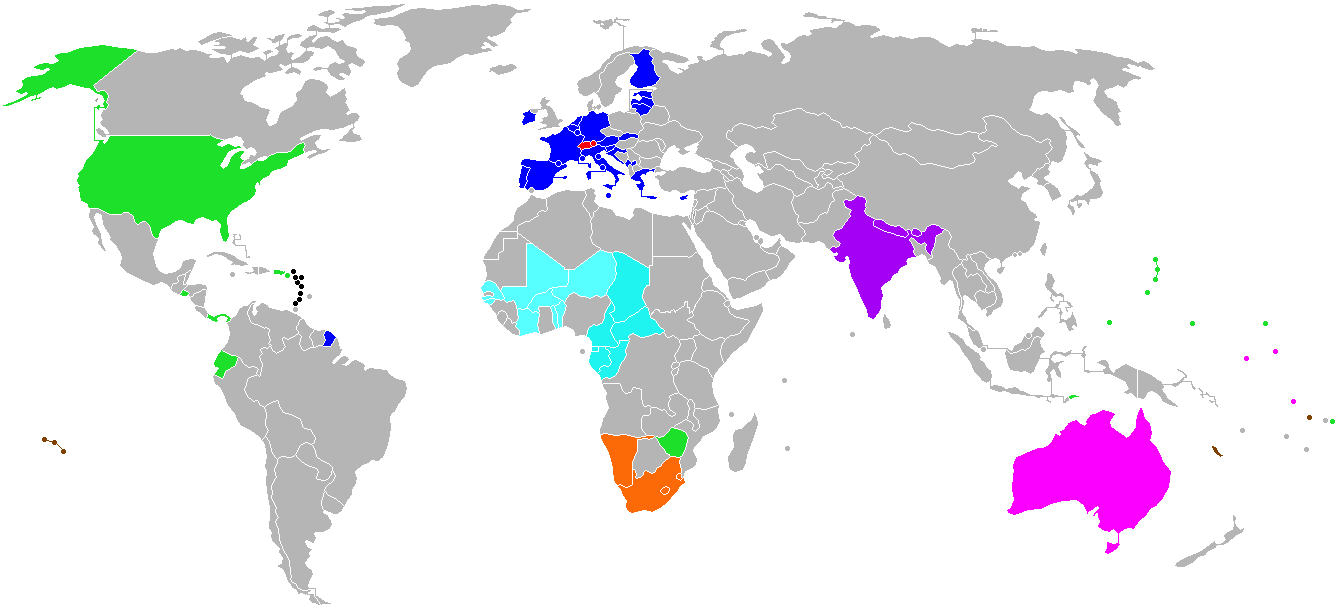
A currency union (also known as monetary union) is an intergovernmental agreement that involves two or more states sharing the same currency. These states may not necessarily have any further integration (such as an economic and monetary union, which would have, in addition, a customs union and a single market).
There are three types of currency unions:
The theory of the optimal currency area addresses the question of how to determine what geographical regions should share a currency in order to maximize economic efficiency.
Implementing a new currency in a country is always a controversial topic because it has both many advantages and disadvantages. New currency has different impacts on businesses and individuals, which creates more points of view on the usefulness of currency unions. As a consequence, governmental institutions often struggle when they try to implement a new currency, for example by entering a currency union.
Convergence in terms of macroeconomics means that countries have a similar economic behaviour (similar inflation rates and economic growth). It is easier to form a currency union for countries with more convergence as these countries have the same or at least very similar goals. The European Monetary Union (EMU) is a contemporary model for forming currency unions. Membership in the EMU requires that countries follow a strictly defined set of criteria (the member states are required to have a specific rate of inflation, government deficit, government debt, long-term interest rates and exchange rate). Many other unions have adopted the view that convergence is necessary, so they now follow similar rules to aim the same direction.
Divergence is the exact opposite of convergence. Countries with different goals are very difficult to integrate in a single currency union. Their economic behaviour is completely different, which may lead to disagreements. Divergence is therefore not optimal for forming a currency union.
The first currency unions were established in the 19th century. The German Zollverein came into existence in 1834, and by 1866, it included most of the German states. The fragmented states of the German Confederation agreed on common policies to increase trade and political unity.
The Latin Monetary Union, comprising France, Belgium, Italy, Switzerland, and Greece, existed between 1865 and 1927, with coinage made of gold and silver. Coins of each country were legal tender and freely interchangeable across the area. The union's success made other states join informally.
Hub AI
Currency union AI simulator
(@Currency union_simulator)
Currency union
A currency union (also known as monetary union) is an intergovernmental agreement that involves two or more states sharing the same currency. These states may not necessarily have any further integration (such as an economic and monetary union, which would have, in addition, a customs union and a single market).
There are three types of currency unions:
The theory of the optimal currency area addresses the question of how to determine what geographical regions should share a currency in order to maximize economic efficiency.
Implementing a new currency in a country is always a controversial topic because it has both many advantages and disadvantages. New currency has different impacts on businesses and individuals, which creates more points of view on the usefulness of currency unions. As a consequence, governmental institutions often struggle when they try to implement a new currency, for example by entering a currency union.
Convergence in terms of macroeconomics means that countries have a similar economic behaviour (similar inflation rates and economic growth). It is easier to form a currency union for countries with more convergence as these countries have the same or at least very similar goals. The European Monetary Union (EMU) is a contemporary model for forming currency unions. Membership in the EMU requires that countries follow a strictly defined set of criteria (the member states are required to have a specific rate of inflation, government deficit, government debt, long-term interest rates and exchange rate). Many other unions have adopted the view that convergence is necessary, so they now follow similar rules to aim the same direction.
Divergence is the exact opposite of convergence. Countries with different goals are very difficult to integrate in a single currency union. Their economic behaviour is completely different, which may lead to disagreements. Divergence is therefore not optimal for forming a currency union.
The first currency unions were established in the 19th century. The German Zollverein came into existence in 1834, and by 1866, it included most of the German states. The fragmented states of the German Confederation agreed on common policies to increase trade and political unity.
The Latin Monetary Union, comprising France, Belgium, Italy, Switzerland, and Greece, existed between 1865 and 1927, with coinage made of gold and silver. Coins of each country were legal tender and freely interchangeable across the area. The union's success made other states join informally.
Recent media